Demystifying Black-Box Artificial Intelligence Through Probing Classifiers and Explainable Embedding Analysis

The rapid proliferation of Large Language Models (LLMs) has fundamentally altered the landscape of natural language processing, shifting the focus from hand-crafted feature engineering to the utilization of dense, high-dimensional vector representations known as embeddings. While these models offer unprecedented performance in text classification, their internal mechanics remain largely opaque, leading to concerns regarding the "black-box" nature of modern AI. To address this, developers are increasingly adopting interpretability frameworks—specifically probing classifiers, UMAP visualization, and SHAP values—to quantify the semantic richness of embedding spaces and track how specific latent features drive predictive outcomes.
The Evolution of Text Classification Paradigms
Historically, text classification relied on statistical methods such as Term Frequency-Inverse Document Frequency (TF-IDF) combined with linear classifiers like Support Vector Machines or Naive Bayes. These methods were inherently interpretable; a developer could identify exactly which words or n-grams contributed to a specific classification. The advent of transformer-based LLMs introduced a paradigm shift. By encoding text into high-dimensional numerical vectors, these models capture complex contextual relationships, including sarcasm, sentiment nuance, and stylistic shifts.
However, the gain in accuracy came at a cost: the loss of transparency. Because embeddings are abstract representations within a latent space, understanding why an LLM categorizes a specific review as "positive" or "negative" has been difficult. The emergence of Scikit-LLM, a library designed to bridge the gap between Scikit-Learn’s accessible API and advanced LLM functionality, provides a standardized pathway to investigate these hidden spaces. By treating embeddings as standard input features, practitioners can now apply traditional diagnostic tools to interrogate the "brain" of the language model.
Methodological Framework for Embedding Diagnostics
The process of probing an LLM’s embedding space involves a structured, multi-stage pipeline. The first phase requires the deployment of a local, cost-effective inference engine, such as Ollama, to generate vector representations without the latency or privacy constraints of cloud-based APIs. Using a standard dataset, such as the IMDB movie review corpus, allows researchers to benchmark model performance against a known ground truth of sentiment.
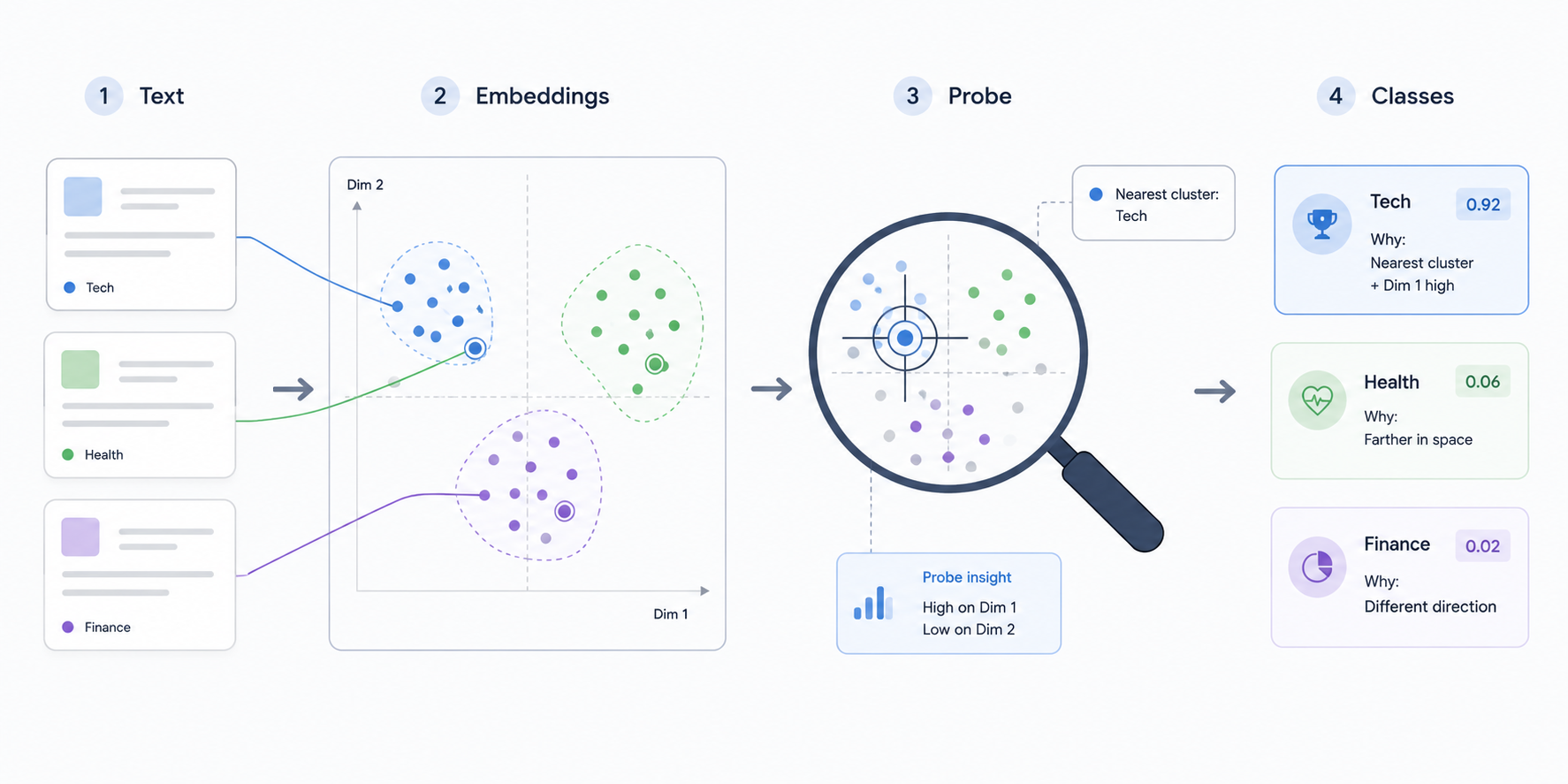
Once the embeddings are generated, the second phase—probing—is implemented. A probing classifier, typically a simple logistic regression model, serves as a "linear probe." The underlying hypothesis is that if a linear model can successfully separate classes using the embeddings as inputs, the embeddings themselves contain high-quality, linearly separable semantic information. If the probing classifier achieves high accuracy, it confirms that the LLM has effectively compressed complex linguistic features into a format that downstream applications can easily parse.
Chronology of the Investigative Workflow
To replicate this analysis, the workflow follows a precise sequence:
- Environment Orchestration: Configuring the development environment to include Scikit-LLM, UMAP (Uniform Manifold Approximation and Projection), and SHAP (SHapley Additive exPlanations). This involves setting up a local server to handle embedding requests.
- Dataset Preparation: Sourcing a balanced dataset, such as the 1,000-sample subset of the IMDB reviews, to ensure that the classifier is not biased by class imbalances.
- Vectorization: Utilizing a transformer-based model like
all-minilmto convert raw text into high-dimensional vectors. This step is the most computationally intensive, as it requires individual inference calls for each text sample. - Probing Implementation: Training a logistic regression model on the training subset and evaluating its performance on the test set using precision, recall, and F1-score metrics.
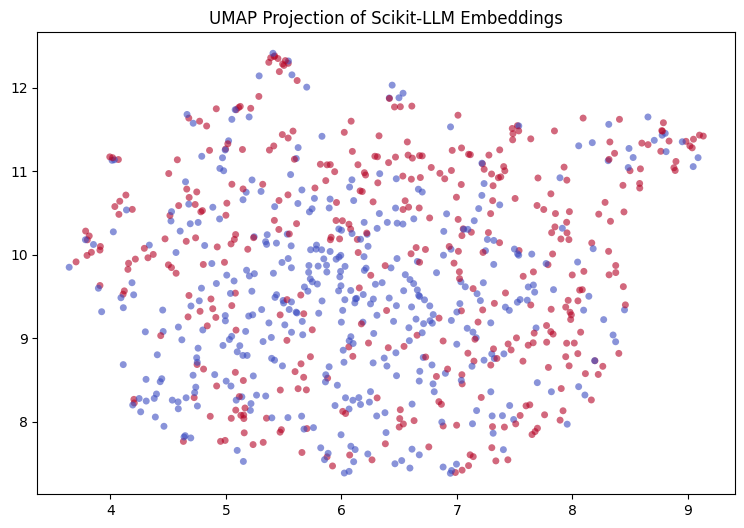
- Spatial Visualization: Applying UMAP to reduce the dimensions of the embedding space from hundreds of dimensions down to two, allowing for a visual inspection of how the data clusters.
- Attribution Analysis: Using SHAP values to calculate the impact of individual latent dimensions on the final model output, thereby identifying which specific components of the vector influence a positive or negative prediction.
Quantitative Insights and Data Analysis
In recent benchmarking, this diagnostic pipeline has yielded compelling results. When analyzing a balanced set of 1,000 movie reviews, a logistic regression probing classifier typically achieves an accuracy rate of approximately 77%. While this may not reach the 95%+ accuracy of a fine-tuned BERT model, the goal of a probe is not maximum performance, but rather an assessment of the "information density" within the embeddings.
The UMAP visualization provides the critical context that accuracy metrics often mask. In these projections, researchers can observe the density and overlap of data points. A successful embedding space will show a discernible, though not necessarily perfect, separation between positive and negative clusters. When the "southern" sector of a plot is dominated by negative sentiment and the "northern" sector by positive sentiment, it serves as a visual confirmation that the LLM has successfully internalized the polarity of the language.
Implications of Explainable AI (XAI)
The application of SHAP values represents the frontier of this interpretability work. By isolating specific dimensions—such as "Dimension 208" or "Dimension 139"—and linking them to the decision-making process, developers can begin to map abstract numerical outputs back to linguistic concepts.
The broader implications for the industry are significant. As enterprises move toward deploying LLMs for mission-critical tasks in finance, healthcare, and legal sectors, the "black-box" nature of these models is increasingly viewed as a liability. Regulators and compliance officers are demanding transparency in automated decision-making. By utilizing probing classifiers and XAI tools, organizations can demonstrate that their models are relying on appropriate semantic signals rather than "spurious correlations"—shortcuts that models sometimes take, such as focusing on high-frequency, low-meaning words rather than the actual sentiment of a statement.
Future Perspectives in Embedding Research
The current methodology using Scikit-LLM and linear probes is merely the beginning of a broader movement toward model auditability. Future developments are likely to include:
- Layer-wise Probing: Investigating not just the final output embeddings, but the intermediate layers of a transformer to see how information is refined across the model’s depth.
- Dynamic Probing: Developing real-time dashboards that monitor embedding drift, alerting developers if a model’s internal representation of a concept begins to skew over time due to data distribution shifts.
- Multimodal Interpretability: Expanding these techniques to include image and audio embeddings, ensuring that the transparency achieved in text classification is replicated across other media types.
The integration of these diagnostic tools into standard machine learning workflows is no longer a luxury but a necessity. By making the internal workings of LLMs observable, developers gain the power to debug, improve, and validate their systems with a level of rigor previously unavailable in the deep learning era. As the community continues to refine these techniques, the divide between the high performance of neural networks and the transparency required by human users will continue to narrow, fostering a new generation of reliable, explainable, and robust artificial intelligence systems.
Related posts: