Penn State Researchers Develop Octopus-Inspired Smart Synthetic Skin Using Advanced 4D Printing Techniques

The field of material science has long been dominated by synthetic substances designed for specific, singular purposes, yet a transformative breakthrough from Penn State University is now challenging this paradigm by introducing a multifunctional "smart synthetic skin" capable of adaptive behavior. Led by Hongtao Sun, assistant professor of industrial and manufacturing engineering (IME), a multidisciplinary research team has pioneered a fabrication technique that allows materials to be programmed for a variety of complex tasks, ranging from information encryption and adaptive camouflage to the enhancement of soft robotic systems. This innovation represents a significant leap forward in 4D printing, a process where 3D-printed objects are designed to change their shape, properties, or functionality over time in response to environmental stimuli.
A Paradigm Shift in Synthetic Materials
Traditionally, synthetic materials used in engineering and industry are "static," meaning their physical properties—such as stiffness, color, and shape—are fixed at the time of manufacture. While these materials are reliable for narrow applications, they lack the versatility required for modern, high-tech environments where adaptability is key. The Penn State team sought to overcome these limitations by developing a material that behaves more like a living organism than a rigid industrial product.
The resulting "smart skin" is composed of a hydrogel, a soft, polymer-based material known for its high water content and biocompatibility. By leveraging a novel 4D-printing approach, the researchers have managed to imbue this hydrogel with "digital instructions." These instructions allow the material to tune its appearance, mechanical behavior, and surface texture on demand. Unlike previous iterations of responsive materials that might only react in one specific way, this new synthetic skin can be programmed to respond to multiple external triggers, including heat, chemical solvents, and physical stress.
The significance of this work was recently recognized by the scientific community, with the team’s findings published in the prestigious journal Nature Communications. Furthermore, the study was selected for the journal’s "Editors’ Highlights," a distinction reserved for research that represents a major advancement in the field of materials science.
The Biological Muse: Biomimicry and the Cephalopod
The core inspiration for this project lies in the natural world, specifically within the remarkable biology of cephalopods like octopuses and cuttlefish. These marine animals are masters of disguise, possessing a sophisticated skin system that allows them to change color, pattern, and texture in milliseconds to blend into coral reefs or communicate with other sea life.
"Cephalopods use a complex system of muscles and nerves to exhibit dynamic control over the appearance and texture of their skin," explained Hongtao Sun, the project’s principal investigator. Sun, who holds additional affiliations in biomedical engineering and material science at the Materials Research Institute, noted that recreating this biological complexity in a laboratory setting required a departure from traditional manufacturing. "Inspired by these soft organisms, we developed a 4D-printing system to capture that idea in a synthetic, soft material."
In nature, an octopus utilizes organs called chromatophores—small sacs of pigment controlled by muscles—to alter its visual appearance. Simultaneously, it uses papillae—projections on the skin—to change its physical texture from smooth to bumpy. The Penn State team’s 4D-printing system acts as a synthetic version of this neuromuscular control, allowing a flat sheet of hydrogel to transform into a textured, three-dimensional object with specific visual data embedded within its structure.
Technical Innovation: Halftone-Encoded 4D Printing
The technical cornerstone of this achievement is a method the researchers call "halftone-encoded printing." This technique draws inspiration from the world of graphic design and traditional printing, where varied dot patterns (halftones) are used to create the illusion of continuous tones in photographs or newspapers.
In the context of 4D printing, the team converted image or texture data into a binary code of ones and zeros. This digital information was then used to guide the printing process, embedding specific patterns directly into the hydrogel’s molecular architecture. Rather than just creating a visual image, these patterns serve as a blueprint for how the material will behave.
By adjusting the density and arrangement of the printed "dots" within the material, the researchers can control the local properties of the hydrogel. For instance, certain areas can be programmed to swell significantly when exposed to water, while others remain rigid. This differential response allows the material to buckle, twist, or fold into specific shapes.
"In simple terms, we’re printing instructions into the material," Sun said. "Those instructions tell the skin how to react when something changes around it."
Demonstrating Multimodality: The Mona Lisa Experiment
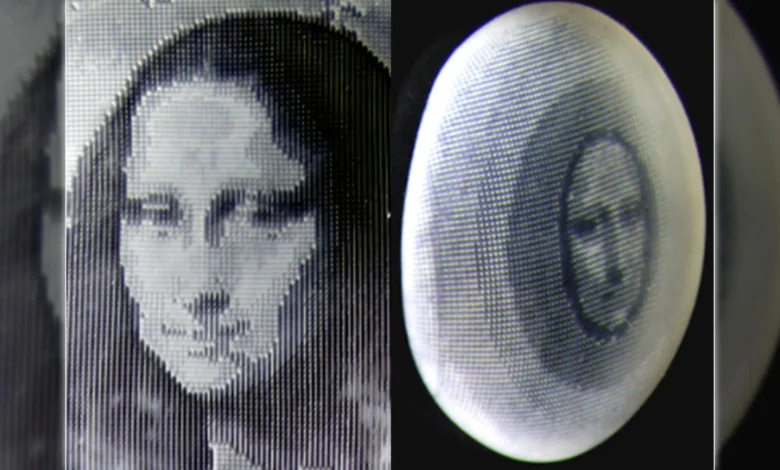
To prove the versatility of their halftone-encoded printing, the research team conducted a series of experiments designed to showcase the skin’s ability to hide and reveal information. The most striking of these demonstrations involved the "Mona Lisa," one of the world’s most recognizable images.
Haoqing Yang, a doctoral candidate in IME and the paper’s first author, explained the process. The team encoded the complex visual data of the Mona Lisa into a hydrogel film. Initially, when the film was treated with ethanol, it appeared entirely transparent and featureless, effectively "hiding" the masterpiece. However, the image was not gone; it was simply encrypted within the material’s structure.
The hidden image could be revealed through specific environmental triggers. When the film was placed in ice water or subjected to gradual heating, the encoded instructions were activated. The different regions of the hydrogel responded to the temperature change by altering their refractive index or opacity, causing the image of the Mona Lisa to emerge clearly.
Yang emphasized that the use of the Mona Lisa was a proof of concept. The technique is capable of encoding virtually any visual or digital data into the material. This has profound implications for information security, where sensitive data could be hidden in plain sight on a surface and only revealed to someone who knows the specific "key"—such as a specific temperature or chemical exposure—required to unlock it.
Mechanical Security and Information Encryption
Beyond visual changes, the research team explored how the smart skin could be used for mechanical encryption. They demonstrated that concealed patterns could be detected through physical interaction. By gently stretching the hydrogel material, the researchers could observe how it deformed.
Using a technique called digital image correlation (DIC) analysis, the team was able to map the minute strains and stresses across the material’s surface as it was pulled. Because the halftone-encoded patterns change the local mechanical stiffness of the hydrogel, the stretching process reveals the hidden data as a map of mechanical deformation.
This dual-layer security—visual and mechanical—adds a significant hurdle for any unauthorized attempt to access encrypted information. It suggests a future where high-security documents or hardware components could have "baked-in" authentication measures that are invisible to the naked eye and traditional scanning methods.
Single-Layer Versatility and Geometric Complexity
One of the most significant engineering hurdles in the development of shape-shifting materials has been the need for multiple layers or "bimorph" structures. Traditionally, to make a material bend, engineers would bond two different materials with different expansion rates together. When exposed to heat or moisture, one layer expands faster than the other, causing the structure to curve.
The Penn State team’s approach eliminates the need for this complexity. Their smart skin achieves complex 3D transformations—shifting from a flat sheet to a dome or a textured surface—within a single, monolithic layer of hydrogel. This is possible because the halftone encoding allows for "gradient" properties within that single layer.
"Similar to how cephalopods coordinate body shape and skin patterning, the synthetic smart skin can simultaneously control what it looks like and how it deforms, all within a single, soft material," Sun noted. This reduction in complexity makes the material easier to manufacture and more durable, as there are no internal interfaces between different materials that could delaminate or fail over time.
The Evolution of the Research: A Chronological Perspective
This latest breakthrough is the result of a multi-year research trajectory at Penn State. The team’s journey began with an earlier study, also published in Nature Communications, which focused on the foundational mechanics of 4D-printed hydrogels. That initial research established how to transition materials from flat 2D sheets to 3D forms using programmable mechanical properties.
Building on that foundation, the current study expanded the scope of the technology. The integration of halftone encoding allowed the team to move beyond simple shape-shifting and into the realm of multi-functional "smart" systems. The timeline of this research shows a clear progression from basic material science to sophisticated, digitally-integrated manufacturing.
The project was a collaborative effort, involving a diverse group of experts. Co-authors included Penn State doctoral candidates Haotian Li and Juchen Zhang, as well as Tengxiao Liu, a lecturer in biomedical engineering. The team also benefited from the expertise of H. Jerry Qi, a professor of mechanical engineering at the Georgia Institute of Technology, whose work in soft mechanics provided crucial insights into the material’s behavior.
Broader Implications for Science and Industry
The potential applications for this octopus-inspired skin are vast and span several critical industries:
- Soft Robotics: Traditional robots are often rigid and cumbersome. Smart skins could provide soft robots with the ability to change their shape to navigate tight spaces or alter their surface texture to improve grip or aerodynamics.
- Adaptive Camouflage: In defense applications, surfaces coated with this material could change their appearance and texture to match their surroundings, much like the cephalopods that inspired them. This goes beyond simple color matching to include "active" camouflage that responds to changing light and environments.
- Biomedical Devices: Because hydrogels are biocompatible, this technology could be used to create "smart" medical implants. For example, a stent could be printed in a compact form for easy insertion and then programmed to expand into a specific 3D shape once it reaches the target body temperature.
- Advanced Manufacturing: The ability to "print instructions" into a material opens the door to a new era of digital manufacturing where the function of a part is determined not just by its shape, but by its internal, digitally-encoded properties.
Future Outlook: Scalability and Integration
As the team looks toward the future, the primary goal is to create a scalable and versatile platform. While the current experiments were conducted on a laboratory scale, the underlying principles of halftone-encoded 4D printing are compatible with industrial-scale manufacturing processes.
The researchers are also exploring ways to integrate more functions into the skin, such as sensing capabilities. Imagine a material that not only changes shape in response to heat but also "feels" pressure and communicates that data back to a central system. Such a development would bring synthetic materials even closer to the functionality of living skin.
"This interdisciplinary research at the intersection of advanced manufacturing, intelligent materials and mechanics opens new opportunities with broad implications for stimulus-responsive systems, biomimetic engineering, advanced encryption technologies, biomedical devices and more," Sun concluded.
By bridging the gap between digital data and physical matter, the Penn State team has provided a glimpse into a future where the objects around us are no longer static, but are instead dynamic, responsive, and "smart" in the truest sense of the word. The octopus, a creature of ancient biological design, has provided the blueprint for the next generation of human-made technology.
Related posts: