Mastering Microsoft Excel for Modern Accounting and Financial Analysis in Jakarta

Jakarta — In the fast-paced landscape of contemporary corporate finance and accounting, Microsoft Excel remains an indispensable cornerstone for professionals worldwide. From small and medium-sized enterprises to multinational corporations operating in Indonesia’s bustling capital, accounting workflows are heavily dependent on spreadsheet architecture to process transactional data, reconcile ledgers, and formulate comprehensive financial reports. Yet, as the volume, velocity, and variety of corporate data expand exponentially, the reliance on rudimentary spreadsheet practices has emerged as a significant bottleneck for organizational efficiency. Industry experts increasingly emphasize that basic data entry and manual calculations are no longer sufficient to meet the rigorous demands of modern financial auditing, forecasting, and strategic decision-making.
The Evolution of Financial Data Processing
The transition from manual ledger keeping to digital spreadsheets revolutionized the accounting profession several decades ago. However, the evolution of Microsoft Excel has transformed it from a simple electronic ledger into a sophisticated computational and analytical engine. Today, accounting professionals are expected to move beyond basic arithmetic functions and simple summation formulas. Modern financial operations demand an intricate understanding of advanced data structuring, automated error-checking, conditional formatting, and multi-variable scenario analysis.
Despite the widespread availability of advanced Excel capabilities, a substantial skill gap persists within the workforce. Many accounting graduates and mid-level professionals enter the job market with a superficial understanding of spreadsheet applications. They are typically proficient in fundamental functions such as basic addition, subtraction, and standard cell referencing, but they frequently falter when tasked with specialized financial modeling, dynamic data aggregation, or automated reporting. This knowledge gap often leads to extended processing times, frustrated finance teams, and—most critically—an elevated risk of human error in high-stakes financial reporting.
The Dangers of Manual Workflows in Accounting
In the realm of finance, accuracy is paramount. A single misplaced decimal point or an incorrectly applied formula within a massive general ledger can cascade through an entire financial statement, resulting in distorted balance sheets, inaccurate tax filings, and flawed strategic planning. Studies by various financial technology institutions consistently highlight that manual data manipulation remains one of the leading causes of spreadsheet discrepancies.
When accountants rely on manual data entry or outdated calculation methods, several operational vulnerabilities emerge:
- Time Inefficiencies: Manual compilation of multi-departmental expenses consumes hours that could otherwise be dedicated to high-value financial analysis and strategic advisory.
- Heightened Risk of Error: Repetitive data copying increases fatigue, paving the way for costly entry mistakes that may bypass initial reviews.
- Lack of Scalability: As business transactions scale, manual systems fail to process growing datasets efficiently, creating bottlenecks at the close of every fiscal month or quarter.
- Limited Analytical Depth: Static spreadsheets do not easily accommodate changing market variables, restricting an accountant’s ability to provide proactive forecasting.
Moving Beyond Basic Arithmetic: The Analytical Power of Excel
Modern accounting extends far beyond historical bookkeeping; it requires forward-looking analysis, risk assessment, and strategic forecasting. Excel is uniquely equipped to bridge the gap between historical recording and future projection through advanced tools such as What-If Analysis, Data Tables, Scenario Manager, and Goal Seek. These features allow financial analysts to simulate multiple economic outcomes based on fluctuating variables such as inflation rates, currency volatility, and shifting consumer demand.
By harnessing these sophisticated functionalities, financial professionals can transform raw transactional numbers into actionable business intelligence. For instance, What-If Analysis empowers management teams to evaluate the financial viability of a new capital expenditure project under best-case, worst-case, and most-likely economic scenarios. Similarly, advanced lookup and reference formulas, combined with dynamic data validation rules, ensure data integrity across complex budgeting models.
However, bridging the gap between theoretical knowledge and practical workplace application remains a primary challenge for corporate training departments. Professionals often understand the concept of a function in isolation, but struggle to integrate it within an end-to-end financial reporting framework that includes raw data cleaning, analysis, Pivot Table summarization, and executive dashboard visualization.
Addressing the Skill Gap Through Targeted Professional Development
To combat the pervasive inefficiencies associated with traditional spreadsheet usage, targeted professional education initiatives have gained significant traction among finance practitioners in Indonesia. Acknowledging the urgent need for upskilling, industry training providers have rolled out specialized technical workshops designed to transition accountants from reactive data processors to proactive financial analysts.
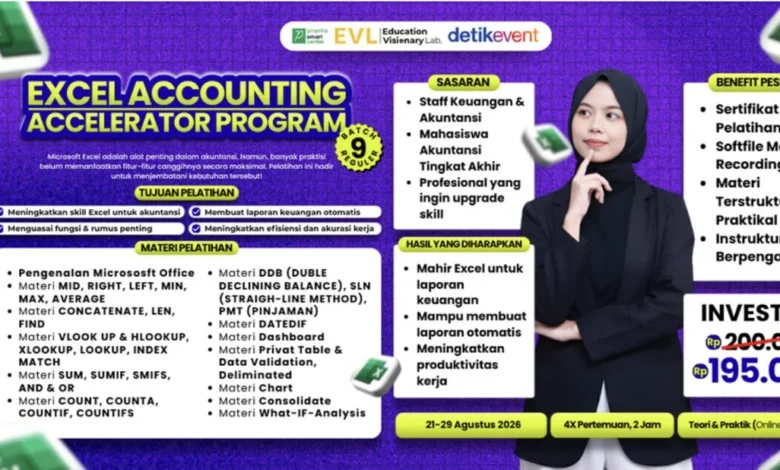
A prominent example of this educational push is the upcoming Excel Accounting Accelerator Program Reguler Batch 10. Curated specifically for accounting and finance practitioners, auditors, financial analysts, and corporate administrators, this intensive professional development program aims to dismantle traditional learning barriers and replace them with practical, workflow-oriented spreadsheet techniques.
Comprehensive Curriculum and Structural Overview
The Excel Accounting Accelerator Program Reguler Batch 10 has been meticulously structured to address the specific pain points experienced by modern finance professionals. Rather than focusing on abstract mathematical theories, the curriculum dives directly into real-world accounting scenarios, utilizing hands-on exercises, industry-standard case studies, and guided database manipulations.
The syllabus covers a comprehensive spectrum of essential and advanced topics, ensuring that participants gain a holistic mastery of the software:
- Advanced Formulas and Functions: Deep-dive exploration of complex logical, lookup, and mathematical formulas designed to automate intricate financial calculations.
- Data Processing and Cleansing: Techniques for standardizing raw, unformatted financial data extracted from various Enterprise Resource Planning (ERP) systems.
- Pivot Tables and Pivot Charts: Mastery of data aggregation, cross-tabulation, and rapid report generation for multi-departmental expense tracking.
- Data Validation and Error Reduction: Implementation of strict input controls to safeguard financial models against user error and maintain data integrity.
- Advanced Financial Analysis: Practical application of analytical tools to evaluate corporate performance, profitability margins, and variance reporting.
- Executive Dashboard Creation: Designing clear, visually compelling, and interactive financial dashboards tailored for C-suite presentation.
Event Timeline, Format, and Accessibility
To accommodate the busy schedules of working professionals across Indonesia and beyond, the organizer has structured the program in a flexible, remote-learning format.
- Program Name: Excel Accounting Accelerator Program Reguler Batch 10
- Delivery Method: Fully online via Zoom Virtual Meeting platform
- Session Schedule: Four intensive meetings scheduled across two consecutive weekends
- Dates: September 21, 22, 28, and 29, 2026
- Time: 18.30 – 20.30 Western Indonesia Time (WIB)
This carefully planned schedule ensures that participants can balance their daily corporate responsibilities while dedicating uninterrupted evening hours to professional enrichment. The interactive virtual format allows for real-time screen sharing, immediate instructor feedback, and collaborative problem-solving among peers from diverse industry backgrounds.
Broader Economic Implications and Industry Outlook
The demand for advanced digital literacy in accounting aligns closely with Indonesia’s broader national initiatives toward digital transformation and economic modernization. As regulatory requirements become stricter and corporate governance standards rise, companies require finance teams that can operate with absolute precision and speed.
Industry analysts point out that upskilling corporate personnel in advanced spreadsheet applications yields a high return on investment. Organizations that embrace automated reporting and sophisticated financial modeling consistently experience reduced closing cycles, enhanced budgeting accuracy, and improved strategic agility. Furthermore, professionals who master these advanced capabilities position themselves as invaluable assets within their organizations, paving the way for career advancement, leadership roles, and increased market competitiveness.
Registration and Participation Guidelines
Professionals who find themselves struggling with manual reconciliations, time-consuming monthly reports, or uncertain formula applications are encouraged to seize this structured learning opportunity. Bridging the technical divide not only optimizes daily workflow efficiency but also instills absolute confidence in the accuracy and reliability of corporate financial disclosures.
Enrollment for the Excel Accounting Accelerator Program Reguler Batch 10 is currently open. Interested participants can secure their slots and review comprehensive registration guidelines by visiting the official detikevent platform. With limited seating designed to maintain an optimal student-to-instructor interaction ratio, early registration is highly recommended for finance practitioners seeking to elevate their professional competencies ahead of the upcoming fiscal quarters.