AWS Weekly Roundup: OpenAI GPT-6 Astra on Amazon Bedrock, Amazon Quick desktop GA, Kiro for students, and more (September 14, 2026) | Amazon Web Services

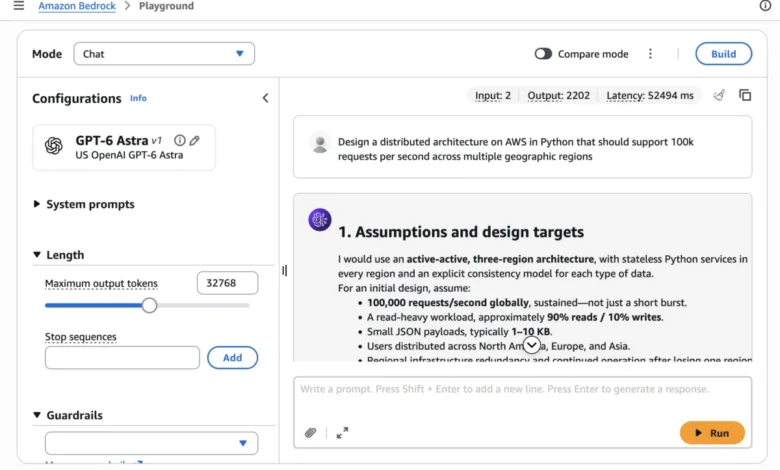
The Evolution of the Generative AI Landscape
The arrival of GPT-6 Astra on Amazon Bedrock follows a period of rapid iteration in the field of Large Language Models (LLMs). Since the initial surge of generative AI in 2022, enterprise adoption has been characterized by a transition from experimental chatbots to deep integration into core business operations. GPT-6 Astra is designed specifically to address the limitations of its predecessors, particularly regarding multi-step reasoning, contextual awareness, and the ability to interface with external computer environments.
For AWS, the integration is a strategic move to maintain its position as the preferred cloud provider for enterprise AI. By hosting GPT-6 Astra, Amazon Bedrock provides developers with a unified API to access state-of-the-art models, allowing businesses to swap or combine models based on specific requirements without migrating their infrastructure. This follows a long-term roadmap that has seen AWS systematically add models from Anthropic, Meta, Mistral, and Stability AI to its portfolio.
Technical Capabilities and Performance Metrics
GPT-6 Astra introduces a context window of up to 1 million tokens, a critical advancement for enterprise users dealing with massive datasets. In practical terms, this allows the model to ingest entire legal libraries, extensive codebase repositories, or multi-year financial statements in a single prompt. This capacity enables the model to perform "reconciliation tasks," such as identifying discrepancies between conflicting contractual clauses or finding bugs across sprawling microservices architectures.
Beyond raw text processing, GPT-6 Astra is engineered for advanced "computer and browser use." This functionality allows the model to navigate software interfaces, interact with web-based business applications, and execute tasks that previously required human intervention. The integration of enterprise plugins for ChatGPT Work further automates these workflows, allowing the model to bridge the gap between static document analysis and dynamic task execution.

Security and Governance Frameworks
One of the primary concerns for organizations deploying LLMs is the protection of proprietary data. The AWS implementation of GPT-6 Astra adheres to the established AWS Shared Responsibility Model. Central to this offering is the assurance that customer inference data is not utilized to train the base model. This is a critical selling point for industries with stringent regulatory requirements, such as finance, healthcare, and legal services.
AWS provides a suite of management tools—including AWS Identity and Access Management (IAM), AWS CloudTrail, and Amazon CloudWatch—to monitor and audit model usage. By routing requests through Bedrock, developers can implement fine-grained access controls, ensuring that only authorized personnel can invoke the model for sensitive business processes. This "security-first" approach is intended to mitigate risks associated with hallucinations, data leakage, and unauthorized model usage.
Strategic Implications for Enterprise Workflow
The deployment of GPT-6 Astra is expected to shift the focus from "generative" AI—which creates content—to "agentic" AI, which performs actions. The ability to handle complex reasoning tasks with higher accuracy than previous iterations allows businesses to move toward autonomous process management. For example, a procurement department could theoretically use the model to monitor supply chain fluctuations, read incoming contract amendments, and draft responses based on internal policies, all within a secure, monitored environment.
Industry analysts suggest that the increased context window will significantly reduce the need for Retrieval-Augmented Generation (RAG) fine-tuning in some specific, high-volume use cases. While RAG remains the standard for maintaining up-to-date knowledge bases, the model’s ability to maintain a massive coherent context allows for more nuanced interpretation of long-form documents without the "chunking" artifacts that often degrade performance in smaller-context models.
Chronology of the OpenAI-AWS Integration
The path to this general availability has been marked by a series of technical milestones:

- Late 2023: AWS announces the expansion of Bedrock to include third-party foundational models, moving away from a single-model approach.
- Early 2024: Introduction of robust data privacy guarantees for Bedrock, solidifying enterprise trust.
- Mid-2024: Beta testing of advanced reasoning models with select AWS enterprise partners.
- September 2026: Official launch of GPT-6 Astra on Amazon Bedrock, accompanied by the release of specialized browser-use plugins for business automation.
Market Response and Future Outlook
While OpenAI continues to innovate at a rapid pace, the availability of its models through AWS provides a layer of stability that many corporate IT departments require. Developers can now utilize the latest GPT-6 capabilities while remaining within the Amazon ecosystem, benefiting from the low latency of AWS regional data centers and the reliability of Amazon’s infrastructure.
Market observers have noted that this development creates a "best-of-breed" environment for builders. By providing a platform that hosts multiple competing models, AWS forces a competitive dynamic where models must prove their utility through measurable ROI rather than just parameter size. The success of this integration will likely be measured by how quickly organizations transition from proof-of-concept testing to wide-scale deployment of autonomous agents.
Operational Recommendations for Developers
For teams looking to integrate GPT-6 Astra, the recommended path involves leveraging the existing AWS Bedrock API documentation to transition from current models. Developers are encouraged to utilize the "What’s New with AWS" portal for specific guidance on model configuration and API versioning. Furthermore, the AWS Builder Center provides resources for optimizing prompt engineering to maximize the utility of the 1-million-token context window.
As organizations begin to experiment with the new browser-use capabilities, security teams are advised to conduct rigorous stress testing on the permissions granted to these AI agents. While the model brings significant efficiency gains, the potential for autonomous agents to interact with live production environments necessitates a robust "human-in-the-loop" oversight mechanism for initial deployment phases.
Conclusion
The availability of GPT-6 Astra on Amazon Bedrock is a milestone in the commercialization of artificial intelligence. It bridges the gap between the high-level capabilities of frontier models and the operational requirements of global enterprises. By combining OpenAI’s research-driven innovation with the robust, secure, and scalable infrastructure of AWS, businesses are now better equipped to tackle tasks that require deep reasoning and high-volume data analysis. As the industry moves forward, the focus will likely shift toward the long-term sustainability of these agentic workflows and their impact on operational efficiency across the global digital economy. The integration serves as a reminder that the most successful AI-driven organizations are those that treat AI not merely as a tool, but as a foundational layer in their digital architecture.