AWS Announces Enhanced Custom Event Bus for Amazon EventBridge to Revolutionize Scalable Event-Driven Architecture

The rapid adoption of serverless computing has fundamentally changed how modern enterprises design their digital infrastructure. Central to this evolution is the event-driven architecture, a paradigm where software components communicate via the production and consumption of events. Amazon EventBridge has long served as the backbone for these systems on AWS, allowing developers to route events from custom applications, integrated SaaS applications, and AWS services. However, as organizations have moved from single-account prototypes to complex, multi-account enterprise environments, the operational overhead associated with managing these event buses has grown significantly. Addressing these challenges, AWS has today announced the launch of an enhanced custom event bus for Amazon EventBridge, designed to provide a centralized, scalable, and ordered event backbone for large-scale distributed systems.
The Evolution of Event-Driven Complexity
In the early stages of cloud adoption, organizations typically operated within a single AWS account. In this environment, a single Amazon EventBridge custom event bus proved sufficient for orchestrating communication between microservices. As digital transformation initiatives expanded, IT leaders adopted the "best practice" multi-account strategy, creating separate AWS accounts for different business units, development teams, or operational domains.
While the multi-account approach successfully isolated workloads and improved security posture, it created a new hurdle: inter-team communication. To route events between these isolated accounts, engineers were forced to implement complex, fragmented architectures. These workarounds often involved cross-account rules, bus-to-bus configurations, and cumbersome IAM permission policies. This complexity eroded the primary value proposition of serverless architecture—operational simplicity. Platform teams frequently struggled with visibility, finding it difficult to track which internal teams were subscribing to specific event streams. Furthermore, the compounding costs of cross-account routing, combined with the lack of native ordering guarantees, forced developers to integrate additional technologies like Amazon SQS or custom middleware, further bloating the system.
A New Architecture for Global Scaling
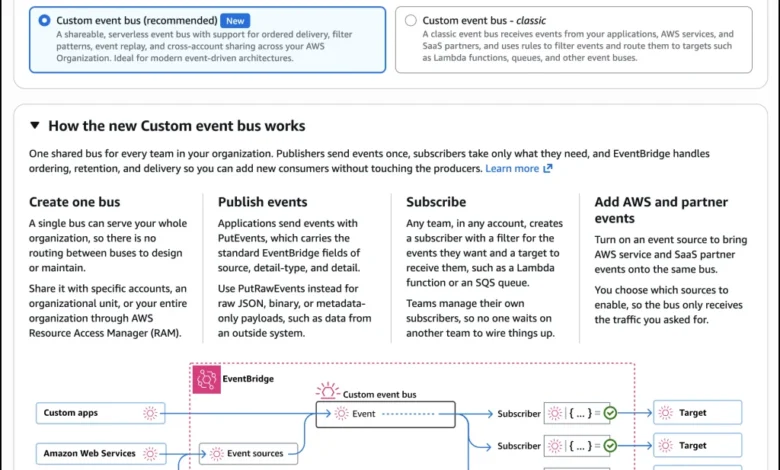
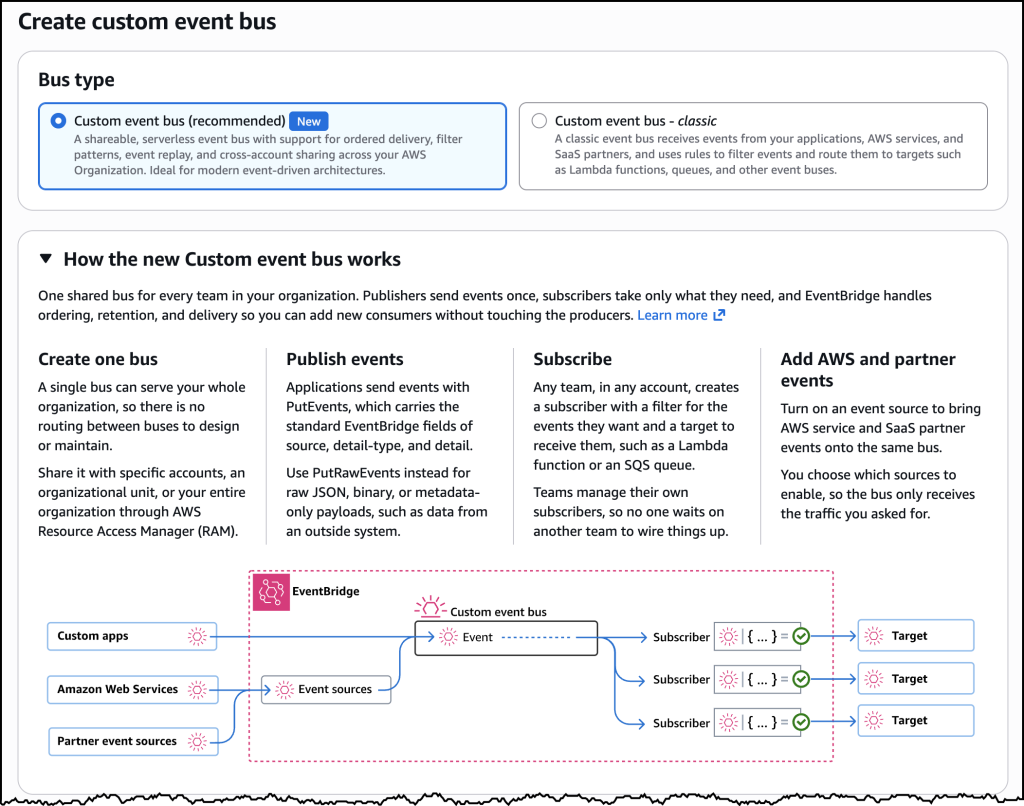
The enhanced custom event bus serves as a structural answer to these industry-wide pain points. By enabling a single, centralized event bus that can be shared across an entire AWS organization, AWS is effectively removing the need for the "spaghetti architecture" that characterized many enterprise event grids.

At the core of this update is the integration with AWS Resource Access Manager (AWS RAM). This allows platform administrators to share a single event bus across multiple AWS accounts, organizational units (OUs), or even specific IAM roles and users. This centralized approach ensures that publishers no longer need to maintain knowledge of individual downstream consumers. Instead, they publish to the central bus, and subscribers define their own ingestion requirements independently. This decoupling fosters a more agile development environment where infrastructure provisioning is no longer a bottleneck for team-wide integration.
Solving the Ordering Conundrum
One of the most persistent challenges in distributed systems is the guarantee of message ordering. Traditional event buses are optimized for high-throughput, asynchronous processing, where the arrival time of a specific event is often secondary to the overall throughput of the system. However, specific use cases—such as logistics tracking, financial transactions, and state-synchronized inventory management—require strict adherence to temporal sequences.
Previously, developers attempting to maintain order across distributed event buses faced significant technical hurdles. The enhanced custom event bus introduces EventGroupId functionality, which allows publishers to tag events. EventBridge then ensures that events sharing the same ID are delivered in the precise order they were ingested to subscribers opting for ordered delivery. This implementation removes the necessity for developers to build custom sequencing logic within their application layer. Furthermore, by introducing synchronous invocation for targets like AWS Lambda, the service provides a reliable pathway for high-stakes workflows that require confirmation of processing before moving to the next event in a sequence.
Rationalizing the Economics of Events
The pricing structure of cloud-native services often dictates the viability of an architecture at scale. The previous per-event pricing model, while predictable at a small scale, became unpredictable when multiplied across numerous cross-account routing paths. The new pricing model for the enhanced custom event bus transitions to an ingress and egress throughput-based approach.
This shift simplifies cost allocation, a vital requirement for large organizations operating under chargeback or showback models. By decoupling the cost from the number of hops or bus-to-bus connections, the new model aligns more closely with actual utility. Publishers incur costs based on data ingestion, while subscribers pay for the delivery of the events they consume. Industry analysts suggest this change will likely lower the total cost of ownership (TCO) for large-scale event grids by eliminating the "routing tax" associated with legacy multi-bus configurations.

Enhancing Subscriber Capabilities
The introduction of the "Subscriber" resource represents a major step forward in operational management. In the previous iteration of EventBridge, maintaining a subscription involved managing a combination of rules, targets, retry policies, and dead-letter queues as distinct resources. This made it difficult to manage the lifecycle of a subscription at scale.
The new Subscriber resource consolidates these elements into a single, cohesive unit. This unification simplifies:
- Target Configuration: Centralizing where events are routed.
- Error Handling: Managing retry policies and dead-letter destinations in one place.
- Data Transformation: Utilizing JSONata expressions to reshape event payloads before delivery, a feature that reduces the need for custom transformation code within the target services.
- Schema Flexibility: Native support for deserializing Avro or Protocol Buffers into JSON, allowing developers to filter and route events without manual serialization overhead.
Reliability Through Deduplication
To further strengthen system reliability, the new event bus includes content-based deduplication. In distributed systems, retries are common, and network timeouts often lead to "at-least-once" delivery, which can result in duplicate processing. EventBridge now performs a hash-based analysis of the event payload. If a duplicate event arrives within a five-minute window, the service automatically suppresses it. This feature provides "exactly-once" delivery semantics, a significant advantage for applications that are not natively idempotent.
Industry Implications and Market Context
The release of the enhanced custom event bus marks a significant maturity milestone for AWS. It signals a shift from providing modular, individual services to providing sophisticated, integrated platforms that address the specific needs of large enterprises. By reducing the reliance on third-party message brokers or complex custom-built middleware, AWS is reinforcing the competitiveness of its serverless ecosystem.
The technical community is expected to welcome the inclusion of features like JSONata integration and improved quota limits—which now default to 10,000 subscribers per bus—as these updates directly address the constraints that often forced developers to look toward alternative cloud providers or self-managed open-source solutions.
Availability and Deployment
The enhanced custom event bus is available immediately in major AWS regions, including US East (N. Virginia, Ohio), US West (Oregon), Europe (Ireland, Frankfurt, Stockholm, Spain), and Asia Pacific (Hong Kong, Malaysia, Mumbai, Singapore, Sydney, Thailand, Tokyo).
For existing customers, the transition path is non-disruptive. Legacy custom event buses will remain available under the designation "Custom event bus – classic," ensuring that existing production workloads continue to function without interruption. Organizations can adopt the new enhanced event bus at their own pace, enabling them to modernize their event-driven backbones through the AWS Management Console, the AWS CLI, or via the EventBridge APIs as their specific development cycles allow. As enterprise architecture continues to trend toward massive, event-driven, multi-account distributions, this update establishes a new standard for how data flows through the cloud.