Architecting the Enterprise Data Layer for Agentic AI: Why Machine Consumers Require a Paradigm Shift in Data Governance

The current technology landscape is captivated by agent frameworks, complex orchestration patterns, and advanced communication protocols, yet these innovations ultimately fail if organizations neglect the foundational data layer. Before any artificial intelligence agent framework can produce reliable business outcomes, enterprise data must be engineered into a shape that a machine can seamlessly consume, implicitly trust, and safely act upon. For over three decades, data systems have been meticulously constructed for human consumers. Enterprise dashboards, analytical reports, and ad hoc queries were all designed around a human operator sitting before a visual display. This paradigm succeeded because human analysts bring an enormous volume of implicit context, institutional memory, and innate skepticism to their work.
A human data analyst intuitively understands what revenue means within a specific organization, which database tables to query, and which legacy repositories to avoid. When a figure appears anomalous—such as a suspiciously rounded total, a date falling on an obscure public holiday, or a price drop that defies market logic—a human analyst pauses to investigate. This cognitive instinct performs a vast amount of invisible context and knowledge work. By contrast, AI agents possess none of this tribal knowledge. They cannot rely on the pattern recognition that human personnel accumulate over years of operational experience. Consequently, agents require explicit context, real-time access, and uncompromising data quality. The most critical behavioral distinction is that while a human analyst hesitates when confronted with dubious data, an autonomous agent acts upon it with absolute confidence.
Recent industry surveys underscore the severe disconnect between enterprise confidence and actual data readiness. According to the 2026 State of Data Integrity and AI Readiness report, published jointly by Precisely and Drexel University’s LeBow College of Business, a survey of 505 data and analytics leaders revealed that while 87% of respondents believed their data was adequately prepared for artificial intelligence, 43% simultaneously cited data readiness as the single greatest barrier to realizing value from their deployments. This organizational delusion mirrors the behavior of a flawed pricing agent: entirely sure of itself, yet fundamentally incorrect. Parallel findings from the KPMG Global AI Pulse survey of 2,145 executives indicate that nearly half of global enterprises now report that the operational costs of their artificial intelligence initiatives exceed the tangible benefits, frequently driven by downstream errors cascading from stale or unverified data fields.
To bridge this operational chasm, organizations must transition from human-centric architectures to rigorous, machine-consumable data paradigms. This transformation relies on four foundational pillars: strict data contracts and quality gates, comprehensive traceability and governance, a robust semantic and contextual layer, and a structured spectrum of actionable data access.
Enforcing Data Integrity Through Code and Contracts
Because language models are inherently gullible—accepting and acting upon whatever information is fed into them—data corruption cascades silently through automated workflows without triggering traditional software exceptions. Consider a commercial scenario where a pricing agent is queried regarding the current cost of a specific product. If yesterday the price was increased from $49.99 to $59.99, but the agent’s underlying data pipeline has failed to refresh, the agent will retrieve the stale figure of $49.99 and quote it to the customer. The transaction completes successfully, and the enterprise absorbs an unrecoverable margin loss on every unit sold. Every computational step executed by the agent was technically correct; the underlying data was the sole point of failure.
To prevent agents from accessing compromised data, modern enterprises are adopting data contracts modeled after specifications like the Open Data Contract Standard, recommended by industry benchmarks such as the Thoughtworks Technology Radar. Data contracts treat schemas as immutable law rather than advisory suggestions. Enforced programmatically across schema compliance, freshness service-level agreements (SLAs), and statistical quality parameters, these contracts intercept invalid records before they ever reach agent-accessible storage tiers.
When data violates established contracts, modern architectures employ a quarantine pattern functioning as a digital circuit breaker. Raw ingestion streams pass through automated validation gateways. If a dataset fails to meet freshness thresholds—such as a product pricing table failing to update within a mandated 24-hour window—the record is diverted to a dead-letter queue for human review, and automated alerts are dispatched. Consequently, when queried about the price, the agent responds transparently by stating that current pricing data is unavailable, rather than executing a transaction based on corrupted figures. Furthermore, analytical data architectures must adapt by restricting AI agents exclusively to validated tiers, such as the Gold and Adaptive Gold tiers within a medallion architecture, completely shielding autonomous systems from raw Bronze or Silver ingestion tables.
Auditing Autonomous Workflows and Ensuring Regulatory Compliance
As artificial intelligence systems transition from passive recommendation engines to autonomous actors capable of executing enterprise transactions, governance requirements expand exponentially. Traditional audit logging infrastructure records what happened—documenting which service account queried a specific database table and at what timestamp. However, autonomous agents require architectures capable of explaining why an action was taken.
This capability gap carries profound regulatory implications. The European Union Artificial Intelligence Act, specifically under Articles 12 and 19, mandates that high-risk AI systems maintain automated operational logs over their lifecycle and retain these records for a minimum of six months. Non-compliance carries severe financial penalties, reaching up to €15 million or 3% of an enterprise’s global annual turnover, whichever is greater. To satisfy these statutory mandates, organizations are implementing agentic lineage models borrowed from distributed systems observability frameworks, utilizing tools such as OpenTelemetry, Langfuse, and Arize Phoenix. These systems generate end-to-end traces where each computational span documents the precise decision-making rationale, contextual inputs, and source references utilized by the agent.
To deploy autonomous capabilities safely without exposing the enterprise to catastrophic operational risks, organizations are implementing staged autonomy frameworks. Modeled after traditional corporate onboarding, autonomy is categorized into distinct phases: Shadow Mode, where agents merely recommend actions for human execution; Supervised Mode, where agents prepare workflows awaiting explicit approval; Autonomous with Guardrails, where agents operate within strict programmatic boundaries defined by reversibility rather than transaction volume; and Full Autonomy. Crucially, security patterns such as delegated per-user access, just-in-time credentials, and strict least-privilege scoping are enforced to dismantle the lethal trifecta of agent vulnerabilities: simultaneous access to private data, exposure to untrusted external content, and tools capable of external communication.
Establishing the Context Layer and Actionable Data Access
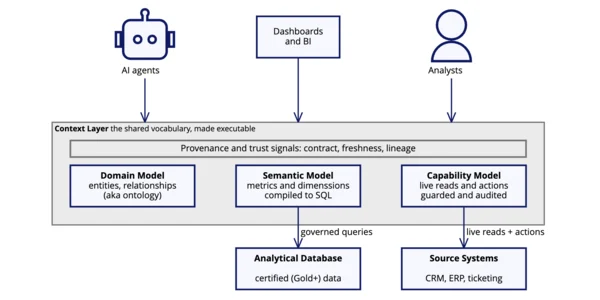
Beyond structural integrity and auditability, artificial intelligence agents require explicit semantic context to interpret enterprise data accurately. A human analyst easily navigates ambiguous terminology, whereas an agent confronted with a query regarding quarterly revenue requires a rigorous, version-controlled context layer comprising three distinct models: a domain model defining enterprise entities and relationships, a semantic model translating business metrics into standardized SQL queries via specifications like dbt MetricFlow, and a capability model governing permissible read and write operations.
This context layer eliminates conversational ambiguity. When an agent processes a request using governed semantic models, it avoids generating erroneous queries against raw schemas, ensuring that business logic—such as net revenue calculations incorporating discounts and returns—remains consistent across all digital consumers.
Finally, agent-ready data access must extend beyond passive retrieval-augmented generation (RAG) to encompass real-time operational reads and controlled write-back capabilities. Utilizing protocols such as the Model Context Protocol (MCP), enterprises expose curated capabilities rather than naive API wrappers. By adhering to disciplined software engineering principles—defining rich descriptions, strict preconditions, and clear reversibility metrics for every tool—organizations ensure that automated write-back actions, such as generating support tickets or processing financial adjustments, remain securely tethered to human oversight.
Ultimately, as autonomous agents solidify their role as primary consumers of enterprise data, the underlying data architecture effectively becomes the core artificial intelligence architecture. Organizations that systematically construct trusted data contracts, robust observability frameworks, semantic context layers, and staged access models will successfully transition their AI initiatives from experimental cost centers into secure, highly scalable enterprise assets.