Enhance your app for the new Pixel lineup: Unveiled at Made by Google

The annual Made by Google hardware and software showcase has once again served as the primary launching pad for the company’s next-generation device ecosystem, headlined by the debut of the Pixel 11 Pro Fold, the Pixel Watch 5, and an array of supporting hardware. Beyond the consumer-facing appeal of these devices, Google utilized the event to address the global community of Android software engineers and product managers, outlining a comprehensive roadmap for developing adaptive, context-aware, and AI-driven applications. With foldable device users statistically demonstrating significantly higher engagement and monetization metrics—spending up to 14 times more than standard smartphone users—the technology giant is heavily incentivizing developers to optimize their platforms for expanded screens, touch-free wrist gestures, and localized machine learning models.

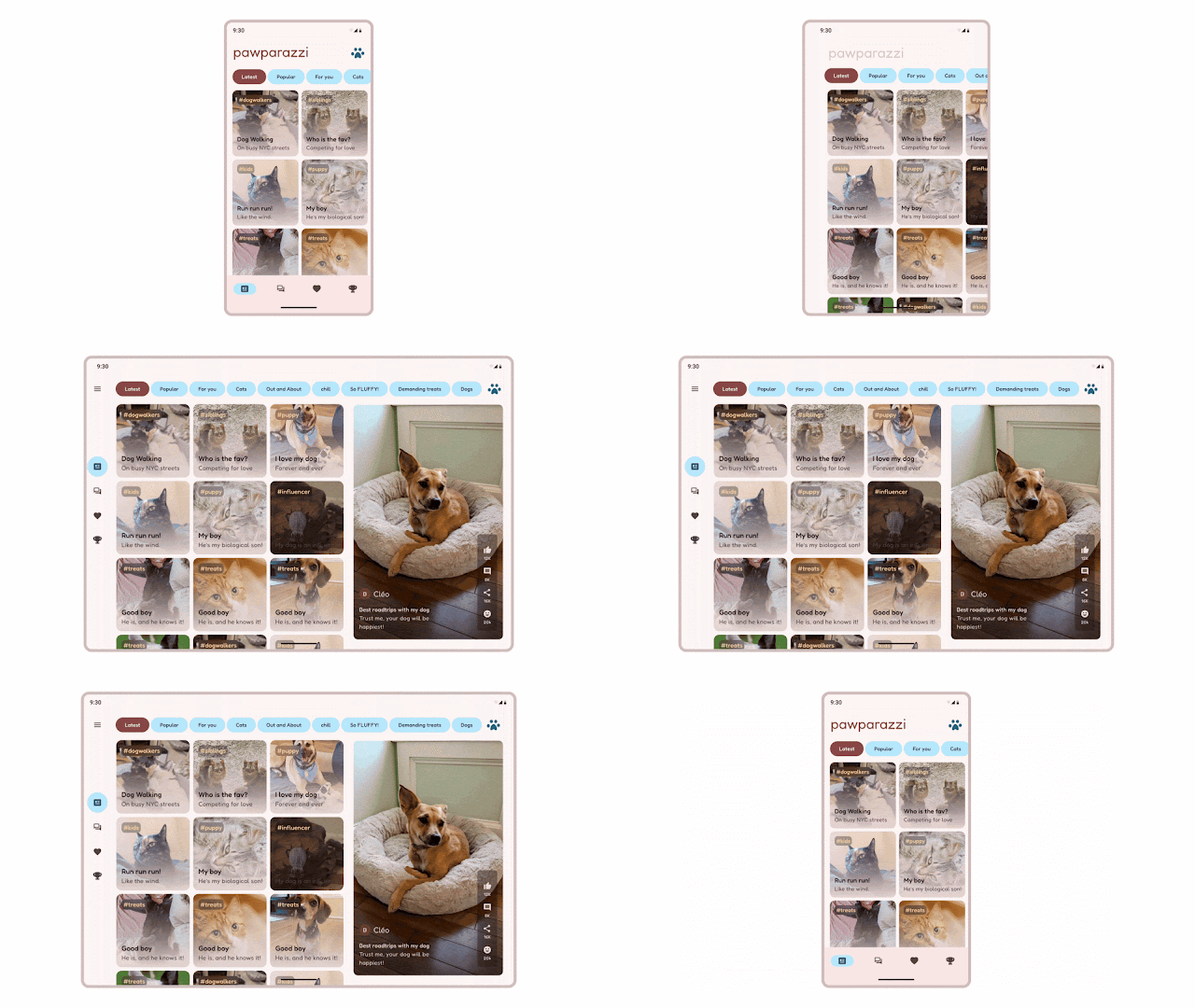
The release of the Pixel 11 Pro Fold establishes a renewed benchmark for hardware-software integration within the Android ecosystem. By combining a conventional outer screen with a sprawling, flexible inner display, the device challenges traditional mobile UI paradigms that rely on rigid, hardcoded layout rules. To streamline the transition for developers, Google has introduced a suite of updated Jetpack Compose tools, including Navigation 3 with Scene management strategies, alongside adaptive layout primitives like Grid and FlexBox. These additions allow containers to dynamically wrap, span, and reflow according to the available window space rather than relying strictly on physical device dimensions. Furthermore, experimental features such as the MediaQuery API enable real-time UI adaptation based on environmental signals like hardware posture and active keyboard states.
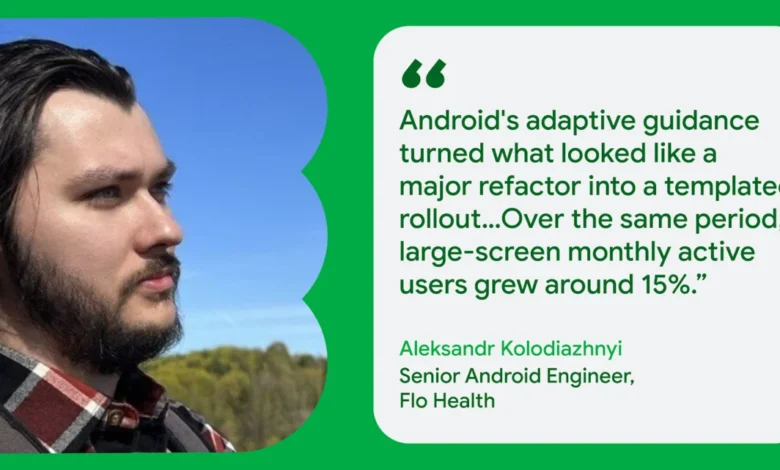
Prominent enterprise applications have already begun implementing these structural guidelines with notable efficiency. Notability, a leading digital note-taking platform, utilized Material 3 Window Size Classes to engineer a responsive, two-pane layout capable of shifting seamlessly between folded and expanded states. According to Ryan Shea, Android Engineering Manager at Notability, tracking the exact window dimensions rather than the device footprint allowed the engineering team to maintain correct page scaling and canvas zoom through every rotation and split-screen resize. Similarly, health tracking platform Flo Health integrated Jetpack Compose state primitives and Window Size Classes to protect high-traffic user journeys from disruption during folding and unfolding transitions. Aleksandr Kolodiazhnyi, Senior Android Engineer at Flo Health, noted that adopting Google’s adaptive guidance streamlined a potentially complex refactor into a systematic rollout, reducing state-preservation code by approximately 30 percent while simultaneously resolving persistent lifecycle and analytics discrepancies.

Hardware Evolution and Camera Flexibility for Foldable Form Factors
Addressing the mechanical realities of dual-screen and foldable devices requires meticulous state preservation across configuration changes. Google’s architectural guidance heavily emphasizes the role of the ViewModel component in retaining user interface state—including scroll positions, form inputs, and active modal dialogs—preventing user interruption during physical transformations. Beyond layout management, the Pixel 11 Pro Fold introduces specific hardware postures, such as the partially folded tabletop mode, which divides the workspace by positioning primary controls on the lower screen and primary content or viewfinders on the upper display.
To support these complex postures without demanding excessive custom development, Google has updated its media acquisition libraries. Developers managing camera previews across foldable state changes are encouraged to migrate to the CameraX library, which natively handles sensor rotation and display scaling across multiple screens. For legacy codebases utilizing Camera2, stability can be maintained via the CameraViewfinder library. These technical integrations aim to simplify dual-screen previewing and high-resolution rear-camera selfie functionalities, minimizing the engineering overhead traditionally associated with unconventional hardware layouts.

Wear OS 7 and Gesture-Driven Interactivity on the Wrist
Parallel to the mobile updates, the introduction of the Pixel Watch 5 marks the broad deployment of Wear OS 7, an operating system optimized for touch-free efficiency and energy conservation. Delivering up to a 10 percent improvement in battery longevity compared to its predecessor, Wear OS 7 introduces system-level performance enhancements designed to facilitate rapid task completion with minimal physical input. Central to this user experience is the newly expanded one-handed gestures framework, which allows users to interact with smartwatch applications using physical movements of the watch-wearing arm, such as a double-pinch or a wrist rotation, eliminating the need for traditional two-handed navigation.
Early adopters of the gesture framework include major media platforms like Spotify, which is mapping Wear OS gesture events directly to its media player state. This integration permits users to pause and resume audio playback via a simple double-pinch gesture, maintaining accessibility when their hands are otherwise occupied. Additionally, Wear OS 7 introduces Live Updates directly to the wrist interface, surfacing real-time data streams such as live sports scores, fitness tracking progress, and delivery service statuses. Logistics platforms like Just Eat have integrated Live Updates to supply users with immediate delivery ETAs and order tracking directly on the watch face, supported by local publishing or smartphone notification bridging.

To ensure consistency across device categories, Wear OS 7 incorporates Wear Widgets powered by Jetpack Glance and RemoteCompose. These widgets replace the legacy Tiles framework, offering small and large layout options that mirror the 2×1 and 2×2 grid formats established on mobile platforms. Developers can utilize the newly released Wear OS 7 emulator environment to test these glanceable, widget-based interactions ahead of public deployment.
On-Device Intelligence Powered by Gemini Nano 4
A cornerstone of the 2026 hardware and software announcements is the deep integration of localized artificial intelligence via Gemini Nano 4, which is engineered directly into the architecture of Pixel 11 devices. By executing AI workflows on the local hardware rather than relying on cloud-based server infrastructure, developers can deliver real-time, low-latency experiences that operate instantaneously and function independently of network connectivity.

Interaction with Gemini Nano 4 is mediated through the ML Kit GenAI Prompt API, enabling applications to issue natural language requests directly to the on-device model. Supporting over 140 languages, the updated model features enhanced multimodal understanding and advanced reasoning modalities, including structured output generation and explicit thinking mode capabilities. By abstracting the complexity of local model management, Google is enabling software creators to embed conversational, predictive, and context-aware features directly into consumer applications without incurring recurring cloud compute costs or privacy vulnerabilities associated with off-device data transmission.
Agentic Development Tools and Future Implications for the Android Ecosystem
To accelerate the adoption of these disparate technologies—spanning foldables, wrist-worn wearables, and localized machine learning—Google has expanded its ecosystem tooling to include AI-optimized development aids known as Android skills. Designed to provide contextual instructions for artificial intelligence coding agents and command-line interfaces, these resources supply automated guidance for complex integration workflows. Developers utilizing Gemini in Android Studio or running the Android CLI can leverage specific skills, such as the CameraX skill for display scaling or the Adaptive skill for dynamic Compose layouts, to construct robust applications with significantly reduced manual intervention.

The systematic evolution showcased at Made by Google reflects a broader industry trajectory toward ambient computing, where software boundaries dissolve across varying form factors and intelligence is distributed to the edge. For the developer community, the simultaneous introduction of flexible screen APIs, gesture-based wearable controls, and on-device generative AI presents both an operational challenge and a significant commercial opportunity. As consumer adoption shifts toward multi-screen and AI-augmented hardware, the ability to deliver unified, adaptive application experiences will increasingly dictate market success. Comprehensive documentation, software development kits, and the complete catalog of Android skills remain accessible via the official Android developer portal and associated open-source repositories.
Related posts: