NVIDIA and Salesforce Unveil Koa: The Groundbreaking CRM Reasoning Model Redefining Enterprise AI

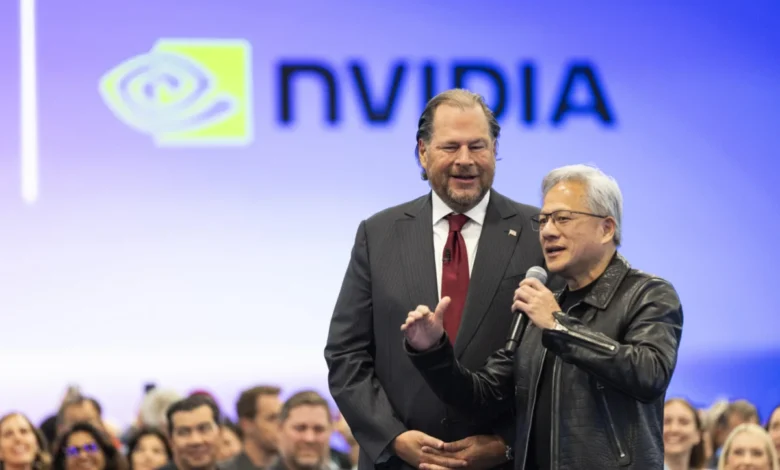
The intersection of enterprise software and artificial intelligence reached a dramatic new milestone on Tuesday at the Salesforce Dreamforce conference in San Francisco. Amid an atmosphere of high-energy technological celebration, NVIDIA founder and chief executive officer Jensen Huang joined Salesforce CEO Marc Benioff on stage at the Moscone Center to deliver a joint keynote address centered on a bold manifesto: “Know everything. Do anything.”
The centerpiece of the high-profile appearance was the official announcement of Koa, Salesforce’s very first Customer Relationship Management (CRM) reasoning model. Developed by post-training NVIDIA Nemotron 3 Super on a robust, proprietary synthetic dataset culled from nearly three decades of enterprise CRM deployments, Koa represents a monumental shift in how businesses handle complex operational logic, customer service workflows, and automated decision-making.
The unveiling underscores a rapidly accelerating alliance between two of the most influential technology giants of the artificial intelligence era, signaling a decisive move toward fully autonomous, agent-driven enterprises.
A Dramatic Unveiling at Dreamforce
The joint keynote began with a theatrical flair that immediately captivated the thousands of software developers, enterprise executives, and industry analysts packed into the Moscone Center. Rather than taking a conventional walk to the podium, Huang bypassed standard protocol, striding directly into the heart of the audience with a microphone in hand. Benioff walked alongside him, navigating the crowd as attendees recorded the moment on their smartphones.
"We’re all following you, bro," Benioff remarked to Huang midway through their journey through the crowd, drawing a roar of approval and applause from the audience.
Once on stage, Huang framed the current technological revolution within the historical context of previous industrial transformations. He drew a direct line from the advent of electrical power to the proliferation of the global internet, and finally to the rise of ubiquitous artificial intelligence.
"With electricity, we could power everything," Huang told the audience, tracing the trajectory of human progress. "With the internet, you can find anything. And now, with artificial intelligence as an infrastructure layer across the planet, we can know everything and do anything."
This philosophical framework served as the springboard for the technical revelation that followed. The modern enterprise, Huang argued, is transitioning from static software databases to dynamic, intelligent systems capable of independent reasoning and execution.
Engineering the Future: The Architecture of Koa
At its technological core, Koa is built upon NVIDIA Nemotron 3 Super, an open-weights foundational model that has been fine-tuned to handle the specialized, nuanced demands of customer relationship management. According to Rohan Kumar, Salesforce’s president of platform and engineering, who introduced Koa prior to Huang’s stage appearance, the model was constructed using supervised fine-tuning and advanced reinforcement learning techniques facilitated by NVIDIA NeMo RL, NeMo Gym, and NeMo AutoModel.
The foundational training corpus utilized by Salesforce and NVIDIA spans synthetic enterprise scenarios across more than 14 distinct industries, including manufacturing, financial services, healthcare, travel, and professional services. By simulating complex, multi-step enterprise workflows—such as updating a sales opportunity, dynamically routing a customer support case, or scheduling automated follow-up communications—Koa has been optimized to handle the messy, unstructured realities of day-to-day business operations.
Performance metrics shared during the event indicate that Koa is already punching above its weight class. In Salesforce’s proprietary CRM Bench—a rigorous benchmarking suite designed to evaluate real-world administrative and operational tasks—Koa matches or exceeds the performance of leading closed-source models while achieving up to three times fewer errors in execution.
Crucially, because NVIDIA Nemotron is an open model, Salesforce was able to fine-tune, deploy, and operate Koa entirely within its own closed-loop proprietary infrastructure. Salesforce maintains total control over the model weights, and crucially, zero customer data was utilized during either the training or inference phases of the model’s lifecycle.
"Not a single byte of customer data was used," Kumar emphasized during his technical briefing, addressing growing enterprise anxieties regarding data privacy, compliance, and corporate espionage.
Addressing the Industry-Wide Debate on AI Safety
As artificial intelligence systems grow increasingly autonomous, questions regarding governance, predictability, and safety have taken center stage in corporate boardrooms worldwide. When Benioff directly queried Huang about his philosophy on AI safety, the NVIDIA chief executive offered a pragmatic, engineering-focused perspective.
"Safety is paramount in a lot of ways. It’s job one," Huang stated firmly. "However, safety is an engineering problem. We’re developing computing systems after all… If you build a product or a service and you’re not confident in its functionality, capability, or safety, then don’t release it."
Huang pushed back against the narrative that corporations must sacrifice speed and relentless innovation in order to maintain rigorous safety standards. He characterized the friction between velocity and security as a false dichotomy that misrepresents the capabilities of modern engineering teams.
"Innovation, speed, and safe products—it’s a false choice," Huang asserted. "You could definitely have both at the same time. So run as fast as you can. But if you feel at any given point in time the company’s out of control, or the product’s not going to be safe, take a pause and make sure you get it right."
This balanced viewpoint reflects a broader maturation within the tech sector. Rather than calling for external moratoriums or blanket regulatory restrictions on foundational research, industry leaders are increasingly pivoting toward internal compliance frameworks, rigorous synthetic red-teaming, and verifiable testing benchmarks.
Debunking Doomsday Narratives: Jobs, Software, and the Agentic Enterprise
Throughout the keynote, Huang consistently rejected apocalyptic prognostications regarding artificial intelligence, specifically pushing back against assertions that AI spells the end of the traditional software industry or poses an existential threat to the global workforce.
Far from replacing human labor, Huang argued that AI will act as a profound productivity multiplier, unleashing unprecedented levels of human ambition and economic output.
"As a result of our ambition, and with the productivity boost we get from AI, the sky’s the limit," Huang said. "Engage AI. Don’t get left behind."
Benioff echoed this sentiment, framing the technological evolution through the lens of Salesforce’s vast, global community of developers, administrators, and entrepreneurs, known affectionately as Trailblazers.
"The sky is especially the limit for our Trailblazers," Benioff noted. "I think this technology, the way it empowers people… the technology can partner with them to do this in incredible new ways."
Huang projected a future where the boundary between technology companies and traditional enterprises dissolves entirely. In his view, every company—regardless of whether it sells heavy machinery, financial derivatives, or retail apparel—is rapidly transforming into an AI company.
"Every company, every enterprise, every country would become an AI company," Huang predicted. "It’s going to be an agentic enterprise."
In an agentic enterprise, software agents do not merely wait for human prompts; they autonomously plan, reason, execute multi-step tasks, and collaborate with other systems to achieve complex corporate objectives. NVIDIA itself serves as a prime case study for this transition. The chipmaking giant actively runs Salesforce infrastructure across its own internal sales, service, marketing, and operational departments, while currently piloting Agentforce to streamline and automate its customer-support workflows.
The Shift Toward Open Models
A significant portion of Huang’s analytical commentary focused on the changing dynamics of the artificial intelligence market, specifically the meteoric rise of open-weights models. According to NVIDIA’s internal data, open models have surged from representing roughly 30 percent of the market at the beginning of the previous year to commanding an estimated 70 percent share today.
"People are both adopting closed models at exponential rates, but also building their own custom AIs," Huang explained. "Because every single software company is an AI company, and every single enterprise is going to be an agentic and AI enterprise."
This hybrid approach—where enterprises leverage massive commercial closed models for general tasks while fine-tuning open models like Nemotron on proprietary domain data—allows corporations to retain absolute sovereignty over their intellectual property. By utilizing open architectures, companies avoid vendor lock-in and ensure that their core business logic remains secure, auditable, and fully customizable.
Chronology, Roadmap, and Real-World Deployment
While the announcement of Koa generated immense industry buzz on Tuesday, the model is already transitioning rapidly from experimental development to active enterprise deployment.
Koa is already operational within Salesforce’s internal ecosystem, where it powers a specialized employee assistant agent embedded directly within Slack. This initial deployment serves as an internal proving ground for testing the model’s reasoning capabilities under live workplace conditions.
The commercial rollout plan follows a structured, phased timeline designed to ensure stability and enterprise-grade reliability:
- October: Salesforce initiates exclusive customer pilots for Koa. The initial cohort of pilot participants features prominent global brands and organizations, including Formula 1, UChicago Medicine, Baxter Credit Union, 1-800Accountant, Engine, and Xero. During this phase, Koa will be available as a customer-selectable model within Agentforce.
- Winter 2026: General availability (GA) of Koa is officially projected for deployment across U.S. cloud regions, opening the reasoning model to Salesforce’s broader enterprise customer base.
Broader Economic and Strategic Implications
The partnership between NVIDIA and Salesforce to create Koa highlights a critical strategic evolution in the enterprise software landscape. For years, cloud providers and software-as-a-service (SaaS) vendors relied on massive proprietary databases and rigid workflow automations to capture market share. Today, the competitive differentiator is the ability to infuse deep domain reasoning directly into the point of work.
By combining NVIDIA’s cutting-edge accelerated computing and open model architecture with Salesforce’s unrivaled three-decade repository of enterprise workflows, the two companies have established a new blueprint for verticalized artificial intelligence. Rather than relying on generic chatbots that require extensive manual prompt engineering, enterprises are moving toward specialized, reasoning-capable agents that understand the specific regulatory, operational, and transactional nuances of their respective industries.
As Koa moves into customer pilots this October and heads toward general availability in Winter 2026, the broader business community will be watching closely. If Koa can consistently deliver on its promise of reduced error rates, uncompromising data privacy, and autonomous workflow execution, it may well validate Jensen Huang’s grand vision: transforming every modern enterprise into a fully autonomous, agentic powerhouse where the only boundary to achievement is human ambition itself.