The Comprehensive Roadmap to Mastering Voice Agents and Conversational AI Architecture

Voice interfaces have transcended their origins as experimental novelties to become the primary medium for human-computer interaction, marking a pivotal shift in the deployment of artificial intelligence. From sophisticated customer service automated response systems to specialized healthcare virtual assistants and smart home ecosystem controllers, voice technology is currently undergoing a period of rapid industrial scaling. For developers and engineers already fluent in the mechanics of large language models (LLMs) and text-based agent frameworks, voice systems represent the next evolutionary step, layering real-time acoustic processing onto existing reasoning engines to create fluid, spoken-language experiences.
The Evolution of the Voice Interface
The transition from text to voice is not merely a change in input format; it is a fundamental shift in user experience design. Historical data from the last decade underscores this transition: the adoption of voice-enabled smart speakers grew from early-adopter niche status in 2014 to being present in over 40% of American households by 2023, according to industry research firm Voicebot.ai.
This maturation is supported by the concurrent development of high-performance Transformer-based architectures. While early voice systems relied on rigid, rule-based decision trees, modern agents leverage the same generative AI backbones as chatbots, specifically fine-tuned for conversational pacing and auditory responsiveness. The shift is further underscored by the decline in error rates; the Word Error Rate (WER) for commercial speech recognition systems has plummeted from roughly 20% in the early 2010s to near-human parity at approximately 3% to 5% today, effectively removing the primary barrier to mass-market adoption.
Defining the Voice Agent Pipeline
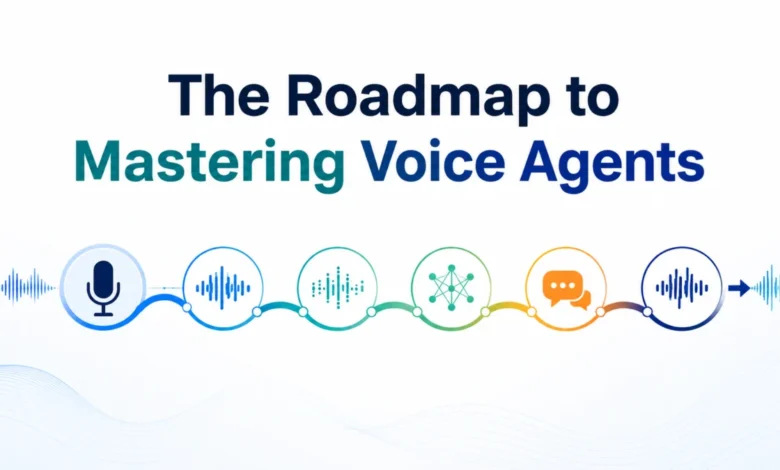
To understand the technical requirements of voice agents, one must view them as tripartite systems. Unlike a standard text agent, a voice agent operates through a three-stage pipeline that must function in near-perfect synchronization:
- Automatic Speech Recognition (ASR) / Speech-to-Text (STT): This is the sensory input layer. It captures raw waveform data and converts it into structured, vectorized text. The challenge here is context—dealing with ambient noise, regional accents, and overlapping speech.
- The Reasoning Core: This is the agent’s "brain." Once the input is converted to text, it enters an LLM-driven environment. Unlike text-based agents, this stage must be optimized for brevity, as long-winded text responses translate into inefficient and tedious audio output.
- Text-to-Speech (TTS) Synthesis: The final layer translates the textual response into synthetic audio. Contemporary neural TTS systems now offer high-fidelity, prosody-rich voices that can modulate tone and pacing to convey empathy or authority, a critical factor in user retention.
Comparative Analysis: Voice Versus Text
The divergence between text and voice architectures is significant. Engineers transitioning from text-based LLM development often encounter four primary constraints that necessitate a change in strategic approach:
Latency as a Critical Failure Point
In a standard web-based chatbot, a three-second delay is acceptable. In a voice conversation, a three-second pause is perceived by the user as a systemic failure. Studies in human-computer interaction suggest that conversational fluidity is lost if the latency between a user’s prompt and the system’s response exceeds 800 milliseconds. Consequently, developers must utilize streaming architectures, where the system begins generating and transmitting audio output before the final sentence has even been fully formulated by the LLM.
The Absence of Visual Cues
Text interfaces benefit from Markdown, bullet points, and hyperlinks, which allow users to scan information. Voice agents lack this luxury. Information density must be managed through verbal prosody and concise syntax. An agent that reads a long, unstructured paragraph will inevitably frustrate the user, as audio memory is significantly more ephemeral than visual processing.
The Complexity of Turn-Taking
Conversational dynamics are bidirectional. Humans frequently interrupt, use filler words, or provide corrective feedback mid-sentence. Implementing a "barge-in" mechanism—where the agent can detect a user’s interruption and cease its output immediately—is a complex engineering task that requires robust signal processing to distinguish between ambient noise and intentional speech.
Strategic Roadmap for Development
Building a production-grade voice agent requires a structured approach to prevent common architectural bottlenecks. The following seven-stage roadmap serves as the industry standard for development:
Stage 1: Establishing the Pipeline Foundation
Before attempting to integrate advanced models, developers must master the basic signal processing chain. This involves understanding audio encoding (e.g., PCM, Opus, or AAC), sample rates, and the impact of jitter in real-time transmission.
Stage 2: Optimizing the Reasoning Layer
At this stage, the focus shifts to prompt engineering for auditory output. The goal is to train or prompt the LLM to write for the ear, not the eye. This means shorter sentences, explicit use of signposting, and a clear, distinct personality that remains consistent across sessions.
Stage 3: Implementing Streaming Architecture
Engineers must move away from request-response cycles toward asynchronous streaming. This involves managing buffers and ensuring that the TTS output is synchronized with the LLM’s text generation tokens.
Stage 4: Mastering Conversation Design
This stage involves the application of linguistics and UX research. Designing a "flow" involves mapping out conversation paths, managing error recovery—what happens when the agent doesn’t understand the user—and creating "filler" states that maintain the illusion of active listening during processing lags.
Stage 5: Integrating Persistent Memory and Tools
True utility is found in an agent’s ability to interact with the external world. This includes Function Calling (or Tool Use), where the agent executes API requests, queries databases, or updates records in real-time based on the spoken intent of the user.
Stage 6: Production Deployment and Evaluation
Evaluating a voice system requires a different toolkit than text. Metrics include Task Completion Rate (TCR), latency distributions, and "turn-count efficiency"—the number of turns required to complete a task. Telephony infrastructure, such as Twilio or Amazon Connect, often serves as the delivery vehicle, necessitating knowledge of SIP (Session Initiation Protocol).
Stage 7: Advanced Multimodal Features
The final frontier includes emotional sentiment analysis, where the agent modifies its pitch or response style based on the user’s inferred emotional state, and voice cloning for high-touch, personalized interactions.
The Broader Economic Impact
The implications of this technology are widespread. In the healthcare sector, voice-enabled documentation agents are already reducing the administrative burden on physicians, potentially saving thousands of hours of data entry annually. In retail, omnichannel voice support is being deployed to handle high-volume, repetitive inquiries, freeing human personnel for high-value interactions.
As the industry moves toward 2026, the convergence of faster inference, more accurate transcription, and more natural synthesis is expected to make the "voice-first" paradigm the standard for customer-facing AI. For the developer, mastering this stack is no longer a niche interest; it is a core competency that will define the next wave of professional AI integration. By adhering to a rigorous, stage-gated development path, organizations can ensure their voice systems are not just technically capable, but fundamentally useful in the complex, high-pressure environments of real-world application.