Android Bench 2.0 Launches With Long-Horizon AI Tasks and Advanced Agentic Evaluations to Test Multi-Day Engineering Workloads

The landscape of software development is undergoing a paradigm shift as artificial intelligence transitions from providing localized code snippets and incremental bug fixes to managing complex, multi-day engineering projects. In response to this rapid maturation of AI capabilities, the development community has introduced Android Bench 2.0. This major upgrade marks a departure from early benchmarking frameworks that primarily evaluated simple modifications to existing codebases. Instead, Android Bench 2.0 establishes a rigorous, multidimensional testing environment designed to measure how large language models and autonomous coding agents handle the scale, ambiguity, and multi-step problem-solving inherent in real-world professional Android development.
The release arrives at a critical juncture for enterprise software engineering and independent development alike. While early iterations of AI coding benchmarks served their purpose during the formative stages of generative AI, they increasingly failed to reflect the actual workloads delegated to modern AI systems. Software engineers now routinely ask AI models to refactor vast application architectures, construct complex user interfaces from scratch, and migrate legacy codebases across entirely different frameworks. Android Bench 2.0 directly addresses this evolution by introducing long-horizon tasks, continuous scoring methodologies, agentic evaluations, and an expanded roster of frontier models.
From Incremental Fixes to Multi-Day Challenges: The Evolution of Android Bench
When Android Bench was originally launched, it established a foundational methodology for evaluating how large language models assist developers with standard Android tasks. At that time, the industry standard for AI code evaluation centered on isolated, incremental changes. Benchmarks typically measured a model’s ability to execute routine bug fixes, complete small feature requests, or generate concise utility functions. These metrics accurately reflected both the technological limitations of early AI assistance and the cautious ways in which developers integrated these tools into their daily workflows.
However, the rapid advancement of model architectures and inference capabilities rendered those early benchmarks insufficient. Developers quickly moved past simple autocompletion and single-file edits, beginning to rely on AI to tackle broader architectural challenges. Recognizing that testing methodologies needed to keep pace with these changing demands, the maintainers of Android Bench began updating their framework, aligning it with the Harbor framework to ensure standardized and rigorous evaluations.
The culmination of this methodological shift is Android Bench 2.0, which introduces long-horizon tasks. These are highly complex projects that typically require a human software engineer multiple days—or even up to a full week—to complete. By incorporating these demanding scenarios, the benchmark now mirrors the ambitious challenges that developers routinely hand off to AI. The scope of long-horizon tasks within the new benchmark includes upgrading critical system dependencies, introducing entirely new feature sets, building sophisticated mobile applications from scratch, and converting cross-platform applications into native Android solutions.
Navigating the Complexity of Continuous Scoring
Evaluating multi-day engineering tasks requires a sophisticated approach to scoring that traditional binary metrics cannot provide. In earlier benchmarks, automated grading systems relied on a simple pass-or-fail binary framework. While effective for checking whether a single unit test passed or a basic bug was resolved, binary grading fails to capture the nuanced realities of expansive software engineering projects.
To illustrate the limitations of binary evaluation, consider a scenario where an autonomous coding agent successfully refactors 40 distinct user interface screens to Jetpack Compose, establishes complex database tables, and satisfies 90 percent of the overarching project requirements. Under a binary scoring system, if the agent fails a single edge-case assertion, the entire run receives a zero percent rating. This binary approach obscures the model’s genuine architectural capabilities and provides little actionable insight to either model developers or end-user software engineers.

To resolve this limitation, Android Bench 2.0 introduces continuous scoring. This methodology provides a nuanced, multi-factor completion rate calculated by evaluating functionality, visual fidelity, and the successful avoidance of regression errors. Furthermore, the evaluation framework applies objective scoring penalties for deviations from specific evaluation instructions or structural constraints.
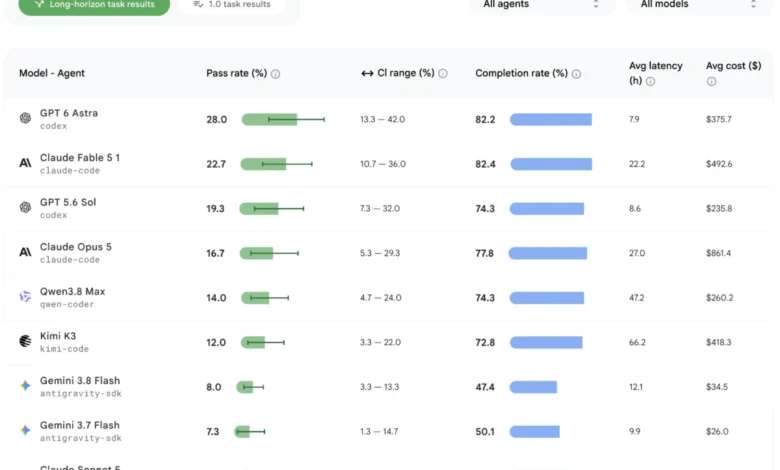
The implementation of this comprehensive scoring system has revealed a stark performance gap between traditional benchmarks and long-horizon evaluations. While models historically achieved pass rates of approximately 91 percent on the original, incremental benchmark tasks, the highest pass rate recorded for long-horizon tasks in Android Bench 2.0 currently sits at approximately 28 percent. This significant drop highlights the immense complexity of multi-day engineering workflows and underscores the substantial distance the industry still has to cover before fully autonomous, long-horizon software engineering becomes universally reliable.
Empirical Insights Into Model Strengths and Weaknesses
The extensive dataset generated by long-horizon evaluations has provided developers and AI researchers with profound insights into the current capabilities and limitations of state-of-the-art language models. A granular analysis of model performance across various tiers reveals distinct patterns regarding how AI processes different types of software engineering labor.
Empirical data indicates that modern AI models consistently perform better when writing new code from scratch compared to refactoring existing codebases. Refactors and framework migrations present unique hurdles because success relies heavily on navigating intricate architectural dependencies rather than simply generating high volumes of code. When tasked with well-established, deterministic transformations, models demonstrate impressive competence. For instance, frontier models excel at converting legacy Java codebases to Kotlin, swapping out Retrofit for Ktor network clients, or introducing a robust ViewModel architectural layer. These patterns are applied consistently across large-scale codebases, sometimes spanning over 125 files and exceeding 8,000 lines of code.
Conversely, models encounter severe difficulties when tasks demand runtime validation—such as resolving missing dependency injection graphs—or when they involve breaking framework changes and unreleased library updates where training data is sparse. Furthermore, porting cross-platform applications to native Android remains an exceptionally difficult challenge. Current testing reveals that no single model achieves a 100 percent pass rate for migration tasks, with even the most advanced frontier models capping out at an 80 percent completion rate.
Integrating Agentic Evaluations and Workflow Harnesses
As software development increasingly incorporates autonomous coding agents rather than raw, unguided chat interfaces, Android Bench 2.0 has expanded its scope to include agentic evaluations. To provide a realistic reflection of how models perform when embedded within integrated developer environments and specialized agent harnesses, the benchmark team began running new models against long-horizon tasks using agents provided directly by the respective model creators.
For example, evaluations paired OpenAI’s model infrastructure with Codex, and Google’s Gemini systems with Google Antigravity. These pairings offer valuable visibility into how thoughtful harness design directly enhances developer outcomes. The integration of advanced technical features—such as prompt caching and compact tool windowing—has been shown to yield significant reductions in token usage while improving task execution efficiency.
By incorporating agentic evaluations, the benchmark creators aim to demystify the interaction between foundational models and the application harnesses that wrap them. Future iterations of the benchmark will expand upon these initial pairings by publishing cross-model and cross-agent comparative results. This ongoing expansion is designed to help development teams discover the precise combinations of models and agent harnesses that best suit their specific organizational workflows and technical stacks.
.png)
Comprehensive Leaderboard Updates and Frontier Model Rankings
To ensure that engineering teams have access to the most current and authoritative data when making architectural and tooling decisions, Android Bench 2.0 introduces a newly expanded leaderboard featuring several newly tested frontier models.
The updated leaderboard incorporates recent releases from across the global artificial intelligence sector, including Google’s Gemini 3.8 Flash and Gemini 3.7 Flash, OpenAI’s GPT-6, Anthropic’s Fable 5.1, Kimi K3, and Qwen 3.8 Max. Among these evaluated systems, OpenAI’s GPT-6 Astra currently occupies the top position on the leaderboard, achieving a leading pass rate of 28 percent on the rigorous long-horizon task suite.
Detailed model cards accompanying the leaderboard allow software architects and researchers to look beyond aggregate scores. Users can click into individual model profiles to examine granular metrics, including specific pass rates, completion percentages, and average operational costs calculated both per model and per individual task. This level of transparency enables development organizations to weigh the performance benefits of frontier models against their computational and financial overhead.
Broader Industry Implications and the Path Forward
The launch of Android Bench 2.0 represents a maturing of the discourse surrounding artificial intelligence in software engineering. By moving beyond simplistic, automated unit tests and embracing the messy reality of multi-day, multi-file software development, the benchmarking initiative provides a much-needed reality check for the technology sector.
The findings underscore that while generative AI has evolved into an exceptionally powerful productivity amplifier—capable of accelerating boilerplate generation, language migration, and deterministic refactoring—fully autonomous software engineering remains an aspirational frontier. Architectural intuition, runtime validation, and the management of deeply nested, ambiguous dependencies continue to require human oversight and strategic guidance.
At the same time, the transparent measurement framework established by Android Bench 2.0 empowers AI research laboratories and infrastructure providers to identify precise architectural bottlenecks. By highlighting where models succeed and where they falter, the benchmark encourages the development of more capable, dependable, and cost-effective AI coding partners.
The maintainers of Android Bench have emphasized that the benchmark will continue to evolve in direct response to community engagement. Developers, researchers, and industry stakeholders are encouraged to review the updated leaderboard and explore the revised methodology documentation at the official Android Bench portal. Furthermore, the project team welcomes ongoing community contributions, bug reports, and methodological discussions via its public GitHub repository and official communication channels on platforms such as X and LinkedIn, ensuring that the benchmark remains a dynamic, community-driven standard for the future of AI-assisted software development.
Related posts: