WordPress Core Flaw Dubbed Click2Shell Enables Automated Theme Installation and Critical Remote Code Execution

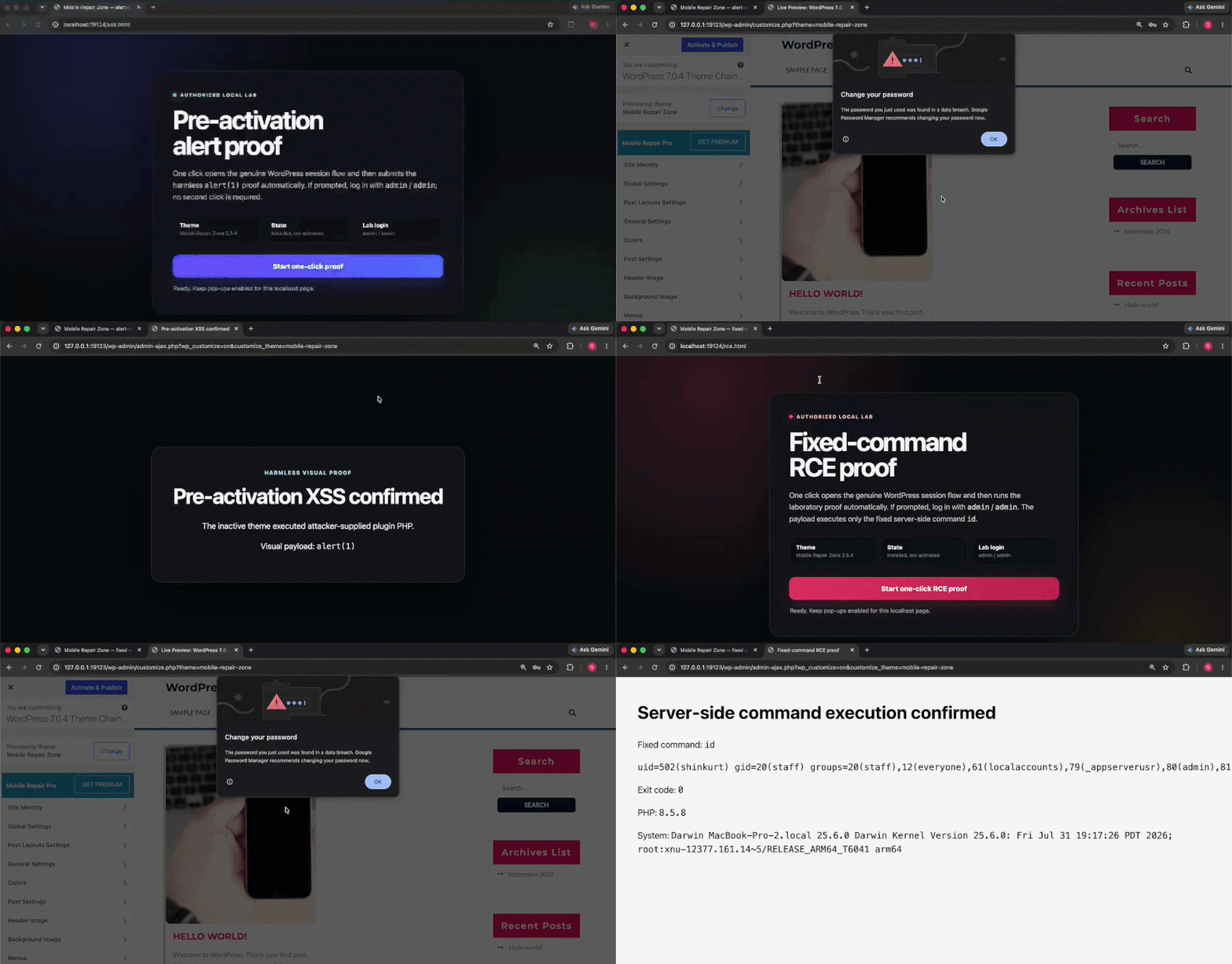
WordPress has officially released emergency patches to address a newly uncovered, high-severity vulnerability within its core software. Disclosed by security research firm pwn.ai and tracked under the attack chain moniker "Click2Shell," the flaw leverages a maliciously crafted web link to automatically install themes from the official WordPress.org directory without requiring any user interaction beyond visiting the URL. While the vulnerability alone is restricted to installing a pre-selected theme, researchers have successfully demonstrated how it can be combined with secondary vulnerabilities present in specific third-party themes to achieve full remote code execution (RCE) on affected servers.
The security update was rolled out globally on September 17, 2026, accompanying the release of WordPress 7.1.1. Given the potential severity of the flaw—which impacts core versions spanning from version 6.0 up to the latest builds—maintainers and site administrators have been urged to apply the updates immediately. Although there is currently no evidence indicating that Click2Shell has been actively exploited in the wild, the complexity and elegance of the attack vector have prompted cybersecurity professionals to classify it as a serious threat to enterprise and personal web infrastructure alike.
Mechanics of the Click2Shell Attack Chain
The underlying vulnerability stems from an inconsistency in how different components of the WordPress ecosystem interpret identical Uniform Resource Locators (URLs). When a specially crafted web link is opened by a site administrator who is currently authenticated, a divergence occurs. The WordPress.org directory perceives the data passed within the link as a standard, legitimate theme name, subsequently returning a valid theme package.
Concurrently, the administrator’s web browser reuses the original text—including specific punctuation and parameters—within internal administrative code designed to target and select elements on the page. By injecting meticulously tailored characters into the URL, attackers can trick the administrative script into isolating the "Install" button and executing a virtual click. Because the victim is already logged into the WordPress dashboard, their active session inadvertently supplies all necessary permissions and security tokens. Consequently, the malicious actor needs neither valid credentials nor explicit authorization to initiate the software installation.

Crucially, the newly installed theme remains deactivated by default. It stays dormant within the system, meaning the public-facing appearance of the website remains unaltered, and standard diagnostic indicators within the administrative dashboard do not immediately reveal that an unauthorized package has been added. To escalate this unauthorized installation into a full server compromise, the attackers must rely on a secondary vulnerability residing within the specific theme that was forced onto the platform.
From Forced Installation to Remote Code Execution
Achieving code execution requires a multi-staged approach because WordPress core checks prevent the direct uploading of arbitrary ZIP files through this specific attack vector. Instead, the exploit relies heavily on the behavior of the WordPress Customizer tool and specific flaws in poorly coded third-party assets.
When WordPress generates a preview via its Customizer interface, it possesses the capability to load a theme’s underlying PHP code even if that theme has not been actively deployed to the live site. Security researchers at pwn.ai demonstrated this concept by utilizing a vulnerable third-party theme named Mobile Repair Zone. This particular theme harbored a critical secondary flaw: an unsecured background handler that accepted arbitrary web addresses from incoming HTTP requests. The handler would automatically download an external package and execute its contained code without validating the permissions or verifying the security tokens of the visitor.
By chaining the core Click2Shell flaw with the vulnerable background handler in the Mobile Repair Zone theme, researchers successfully bypassed authentication barriers to execute arbitrary operating system commands directly on the host server. This escalation path elevated the overall risk profile of the exploit from a high-severity installation bug to a critical-severity remote code execution vulnerability.
Severity Ratings and CVSS Metrics
The vulnerability has prompted varied assessments regarding its overall risk, depending on whether it is evaluated in isolation or as part of a complete attack chain. The security team at pwn.ai assigned the standalone forced-install flaw a High severity rating, yielding a Common Vulnerability Scoring System (CVSS) score of 7.1. However, when combined with a vulnerable theme to achieve full server compromise, the complete exploit chain is rated as Critical, carrying a CVSS score of 9.6.

In its official security advisory, WordPress described the issue with technical restraint, noting that "specially crafted URLs can automatically install and preview an inactive theme from WordPress.org." While formal Common Vulnerabilities and Exposures (CVE) identifiers were not immediately published alongside the initial patch deployment, pwn.ai confirmed that tracking identifiers are being coordinated for future reference.
The patch has been backported extensively to protect legacy installations. WordPress 7.1.1 is part of a comprehensive security release that applies fixes to supported product branches dating all the way back to version 4.7. Documentation released by the WordPress security team confirms that the Click2Shell vulnerability affects all versions ranging from 6.0 up to the releases immediately preceding the patch. Sites configured to handle software updates automatically will receive the patch without manual intervention, whereas administrators managing manual deployments must update their core files immediately.
Broader Context and Recent Core Vulnerabilities
The disclosure of Click2Shell highlights an ongoing trend of sophisticated attack vectors targeting the core infrastructure of the world’s most popular content management system. This discovery follows a series of high-profile security disclosures involving WordPress core software over the preceding months.
In August 2026, WordPress patched a pre-authentication cross-site scripting (XSS) vulnerability also discovered by pwn.ai, which similarly could be chained to achieve remote code execution. In both instances, security researchers noted a discrepancy between the narrow risk descriptions provided by WordPress maintainers and the broader systemic implications demonstrated during technical testing.
Furthermore, July 2026 saw the disclosure of an entirely unrelated core flaw designated as "wp2shell." Unlike Click2Shell, the wp2shell vulnerability required neither administrative authentication nor user interaction via a clicked link. Due to its autonomous nature, wp2shell has been actively tracked by the Cybersecurity and Infrastructure Security Agency (CISA) as being exploited in real-world cyberattacks—a status that Click2Shell has mercifully avoided thus far.

Implications for Web Administrators and Security Professionals
The emergence of Click2Shell underscores the critical importance of robust input sanitization, strict parameter handling, and the principle of least privilege within web application architecture. Even minor discrepancies in how URLs are parsed across different application layers can create pathways for privilege escalation.
For website administrators and digital agencies, the incident serves as a vital reminder regarding administrative hygiene. Because the attack relies on an authenticated administrator opening a malicious link, security awareness training remains a fundamental line of defense. Administrators are strongly advised never to open unsolicited links within administrative contexts while logged into their production environments.
Additionally, the reliance on third-party themes to complete the attack chain highlights the inherent risks of maintaining bloated or poorly audited plugin and theme inventories. Security best practices dictate that site operators regularly audit their installed assets, remove inactive or abandoned themes and plugins, and ensure that all components originate from trusted, actively maintained repositories.
As the cybersecurity community continues to analyze the implications of WordPress 7.1.1 and the Click2Shell attack chain, prompt patch management remains the single most effective mitigation strategy. With no standalone workaround available aside from core updates, webmasters must prioritize system updates to safeguard their infrastructure against emerging multi-staged attack methodologies.