When Mathematics Meets Optics: How the Revolutionary Smith Hat Monotile is Unlocking New Frontiers in Light Physics

A mathematical breakthrough that captivated the global scientific community just a few years ago is once again making headlines, this time by bridging the gap between abstract geometry and advanced optical physics. Researchers from the Institute of Industrial Science at The University of Tokyo, in close collaboration with several premier research institutions, have successfully demonstrated that physical structures based on the famous "Smith hat" shape can force laser light into unusual, highly distinctive chiral patterns. This discovery notedly expands our fundamental understanding of how complex, aperiodic geometry can directly influence light-matter interactions, pointing the way toward innovative methods for manipulating optical behavior at the nanoscale.
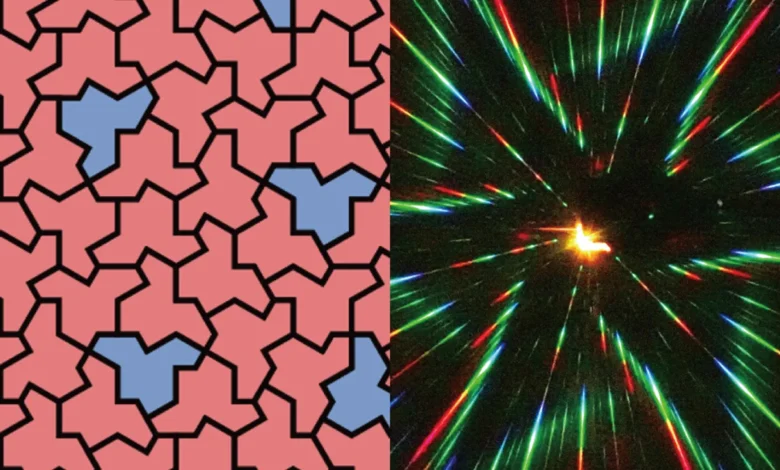
Published in the peer-reviewed journal Nature Communications, the study details how the research team fabricated specialized optical structures inspired by the anisohedral monotile—commonly referred to as the "hat" tile. When these microscopic silicon nitride structures were illuminated with laser light, they generated diffraction patterns characterized by striking pinwheel configurations. These unique visual signatures differ fundamentally from the diffraction effects typically observed in conventional quasicrystals, offering physicists a novel platform to study the intricate interplay between symmetry, structural aperiodicity, and optical chirality.
The Genesis of a Mathematical Marvel: Solving the Einstein Problem
To fully appreciate the significance of this optical discovery, one must examine the foundational mathematical problem the Smith hat was originally created to solve. In geometry and tiling theory, the "Einstein problem"—named as a playful linguistic nod to the German phrase ein Stein, meaning "one stone"—asks a deceptively simple question: Is it possible to find a single, specific geometric shape that can tile an infinite two-dimensional plane completely, without gaps or overlaps, but only in a way that never creates a repeating pattern?
For decades, mathematicians understood that periodic tilings—such as simple squares, rectangles, or regular hexagons—were common and easy to generate. These patterns repeat themselves identically at regular intervals, much like a traditional bathroom floor tile or a honeycomb grid. Even aperiodic systems, which were famously popularized by mathematician Roger Penrose in the 1970s with his famous Penrose tiles, traditionally required a set of at least two distinct tile shapes working in tandem to prevent repetition across a surface.
The quest for a true "monotile"—a single shape capable of aperiodic tiling—baffled researchers for nearly half a century. That decades-long drought came to an end in 2023, when an amateur mathematician named David Smith, alongside professional researchers Joseph Myers, Craig Kaplan, and Chaim Goodman-Strauss, announced the discovery of the "hat" tile. This polygonal shape, constructed from an arrangement of eight kites, achieved what no single shape had done before: it tiled a plane aperiodically without ever falling into a repetitive grid.
The mathematical world reacted with immediate enthusiasm. The Smith hat was hailed as a monumental triumph of discrete geometry. However, its journey from a computer-generated mathematical curiosity to a physical medium for manipulating light has taken researchers into entirely uncharted territory. Lead author Yuto Moritake reflects on the conceptual leap: "What is especially fascinating about the hat tile is that, although the resulting pattern appears irregular at first glance, it is actually constructed from the underlying honeycomb lattice. We wanted to see whether this unique shape could also produce any unexpected physical phenomena when translated into the physical realm."
Translating Abstract Geometry into Nanoscale Optics
Moving from the conceptual safety of computer screens and mathematical proofs to the rigorous demands of experimental physics required precise engineering. To test whether the aperiodic monotile pattern could affect light, the research team turned to advanced nanofabrication techniques. They utilized electron beam lithography to carve nanoscale versions of the Smith hat pattern directly onto thin films of silicon nitride, a material widely prized in integrated photonics for its high refractive index and low optical loss.
Once the physical structures were fabricated, the researchers subjected them to optical testing. By directing a coherent laser beam through the silicon nitride nanostructures, they projected the resulting diffraction patterns onto a viewing screen. The outcomes were immediate and striking. Rather than scattering light in the radially symmetric or discrete spots typical of standard quasicrystals, the light formed distinct pinwheel-like geometries.
These pinwheel shapes served as a direct visual confirmation of chirality—a geometric property often described as "handedness." An object is considered chiral if it cannot be superposed onto its own mirror image, much like a human left hand and right hand. While biological molecules like DNA and certain chemical compounds are famously chiral, introducing macroscopic or microscopic structural chirality into optical components has historically required complex, multi-layered fabrication techniques. Here, however, the chirality emerged naturally from the singular, aperiodic arrangement of the monotile pattern, which inherently lacks mirror symmetry.
"We found that the diffraction patterns themselves become chiral because the structure lacks mirror symmetry," explains senior author Masaya Notomi, highlighting the novelty of the observation. "This kind of optical response is fundamentally different from that observed in conventional quasicrystalline materials, opening a new window into how spatial arrangement dictates wave propagation."
Symmetry, Directionality, and Polarization Control
The implications of the study extend well beyond the initial observation of pinwheel diffraction patterns. As the researchers delved deeper into the optical behavior of the Smith hat structures, they discovered that the resulting light output was acutely sensitive to both the angle of incidence and the polarization state of the incoming laser light.
By systematically altering the direction from which the laser beam approached the silicon nitride film, or by changing its polarization vectors, the research team observed precise, predictable modulations in the diffraction patterns. Furthermore, when the physical silicon nitride structures were computationally or physically mirrored, the corresponding optical behavior reversed in tandem. This direct correlation confirmed that the observed phenomena were not random artifacts of fabrication, but rather a direct, deterministic consequence of the underlying mathematical symmetry—or lack thereof—embedded within the monotile design.
This discovery introduces a novel framework that the authors term symmetry-controlled optical behavior. By leveraging the aperiodic yet highly ordered nature of the Smith hat, scientists can manipulate light waves in ways that were previously difficult to achieve using standard periodic or random scattering media.
"These results open a new direction of research on the fusion of quasiperiodic order and chirality," remarks Moritake, emphasizing the interdisciplinary nature of the findings. "Monotile patterns provide a versatile, highly structured platform for exploring optical phenomena that emerge from the delicate interplay of symmetry, chirality, and aperiodicity."
Broader Implications for Future Optical Technologies
While the research remains firmly rooted in fundamental physics, the long-term technological implications of merging advanced geometry with optics are substantial. Modern photonics industries are in a perpetual search for novel materials and structural designs capable of routing light with extreme precision, controlling polarization states, and minimizing signal loss in optical circuits.
Traditional optical devices rely heavily on periodic lattices—such as photonic crystals—to manipulate light. While powerful, these periodic systems are fundamentally constrained by translational symmetry. The introduction of aperiodic monotile structures, such as those derived from the Smith hat, offers an entirely new design paradigm. Because aperiodic structures lack repeating unit cells, they can scatter light across a wider range of spatial frequencies while maintaining long-range order. When combined with the newly discovered chiral properties, these geometries could eventually contribute to the development of advanced optical filters, ultra-compact polarization controllers, and specialized sensors capable of detecting minute changes in chiral chemical environments.
Furthermore, this study serves as a compelling reminder of the unpredictable, deeply interconnected nature of scientific inquiry. A mathematical puzzle that began as an abstract exercise in tiling surfaces—pondering how an infinite floor might be covered without ever establishing a repeating rhythm—has unexpectedly provided physicists with a powerful new knob to turn in the control of light.
As researchers continue to explore the boundaries where geometry and wave mechanics intersect, the Smith hat stands as a prime example of how pure mathematics can plant the seeds for future technological revolutions. By transforming a mathematical solution into a physical reality, the University of Tokyo team has not only solved another layer of the Einstein problem’s legacy but has also illuminated a bright, chiral path forward for the future of optical science.