Massive North Korean Cyber Campaign Exploits Job Seekers, Compromising 30,000 Devices and Stealing Millions in Crypto

A coordinated international cybersecurity advisory has revealed that state-sponsored North Korean threat actors have successfully compromised at least 30,000 devices across more than 100 countries. Operating under a long-running initiative known widely as the "Contagious Interview" campaign, these cybercriminals have siphoned sensitive credentials and millions in cryptocurrency from victims worldwide.
The joint alert, published by intelligence and cybersecurity authorities from the United States, Japan, Australia, and Germany, underscores the escalating sophistication of North Korea’s cyber operations. Primarily targeting individual web designers, software engineers, and blockchain specialists, the threat actors have plundered an estimated $10.71 million in digital assets from over 7,000 compromised cryptocurrency wallets.
The campaign highlights a dangerous evolution in how state-backed threat actors leverage social engineering, weaponized recruitment processes, and global proxy networks to finance the regime while evading international economic sanctions.
Anatomy of the Contagious Interview Campaign
First identified and tracked by cybersecurity researchers at Palo Alto Unit 42, the Contagious Interview campaign has been active since at least 2022. The operation relies heavily on sophisticated social engineering tactics executed across professional networking platforms like LinkedIn.
Operating under deceptive pretenses, the threat actors pose as legitimate recruiters, venture capitalists, or hiring managers offering lucrative employment opportunities. They actively target software developers and IT professionals working within the Web3, cryptocurrency, and financial technology sectors.

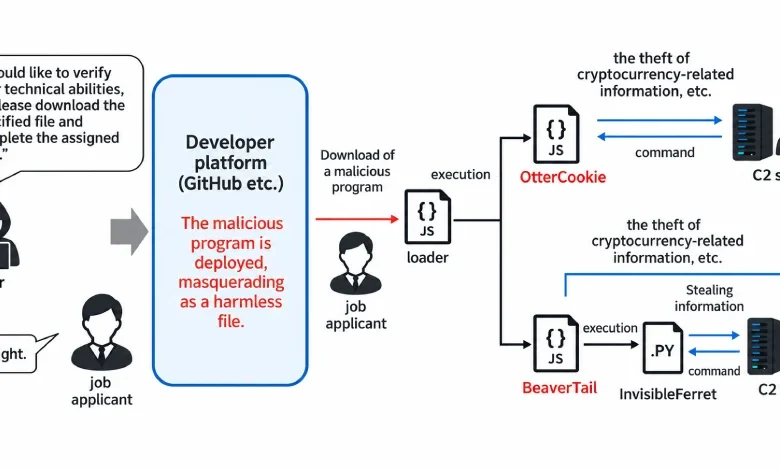
Once initial rapport and trust are established, the scammers invite targets to participate in a routine technical assessment, coding test, or take-home project. This seemingly innocuous request triggers a multi-stage infection chain. Victims are instructed to download and execute seemingly benign project files or development environments that covertly deploy a diverse arsenal of sophisticated malware families.
Among the payload tools deployed in these attacks are BeaverTail, InvisibleFerret, FlexibleFerret, GolangGhost, PylangGhost, OtterCookie, RATatouille, OtterCandy, and StoatWaffle. Once installed, these tools establish robust backdoors, facilitating remote access, persistent control, data exfiltration, and the harvesting of stored browser credentials, session cookies, and private cryptographic keys.
Proliferation of Aliases and Attribution
The cybersecurity community tracks this malicious infrastructure and its operators under a staggering array of monikers, reflecting the decentralized yet tightly coordinated nature of North Korean cyber units. These identifiers include CL-STA-0240, DeceptiveDevelopment, DEV#POPPER, Famous Chollima, Gwisin Gang, PurpleBravo, Tenacious Pungsan, UNC5342, Void Dokkaebi, and WaterPlum.
According to intelligence assessments, clusters such as WaterPlum and various North Korean IT worker factions operate under the broader umbrella of the 313 General Bureau, which is subordinate to North Korea’s Munitions Industry Department. Analysts note that these groups frequently share operational infrastructure, including Internet Protocol (IP) addresses used to access remote laptop farms and submit fraudulent job applications to high-profile cryptocurrency exchanges in regions like Japan and the U.S.
Security analysts emphasize that the threat extends far beyond immediate financial theft. Successfully compromised developer workstations grant threat actors deep access to corporate networks. This exposure introduces severe risks of corporate espionage, intellectual property theft, and lateral movement within critical organizational environments. Furthermore, stolen identity documents gathered during the recruitment process are frequently repurposed by illicit IT workers to impersonate Western citizens, generate foreign currency, and maintain long-term employment scams.
The Evolution of the North Korean IT Worker Scheme
Alongside direct malware distribution, Pyongyang has perfected a parallel operation involving thousands of overseas IT workers deployed globally to secure remote employment at Western and Asian corporations. This initiative represents a modern, digital adaptation of a decades-old state practice.

Historical records analyzed by threat intelligence firm Sekoia indicate that the dispatch of state-sponsored labor to generate foreign currency dates back to the 1960s and 1970s. Initial efforts centered on forestry and logging in the Soviet Far East before expanding into construction, textiles, and restaurant services across Russia, China, the Middle East, and Africa. In the digital age, this model has shifted toward remote software engineering and technical outsourcing.
To bypass strict compliance, identity verification (Know Your Customer, or KYC), and geographic restrictions, these operatives increasingly rely on artificial intelligence to generate convincing synthetic identities, resumes, and video interview personas. Furthermore, recent investigations by threat intelligence firms Kudelski Security and Silent Push have uncovered emerging tactics where North Korean operators leverage virtual private networks (VPNs)—such as Astrill VPN and Mullvad—to obtain stable exit nodes in targeted nations like the United States and Japan.
Recruitment of Western and LATAM Proxies via Discord
In an effort to circumvent rigorous remote-hiring filters, North Korean operators have begun expanding their recruitment pipelines onto mainstream community platforms like Discord. Security researchers recently uncovered a targeted campaign operating within a Discord server named "Mouse Review."
In this scheme, threat actors actively recruit individuals residing in the United States, the European Union, and Latin America to serve as proxy intermediaries. AI-generated recruitment advertisements explicitly outline the division of labor: the proxy acts as the legal face and communications lead, handling video interviews and client meetings, while the North Korean operative executes all technical tasks behind the scenes.
The recruitment advertisements promise steady financial compensation, often structured as a revenue-split model where the foreign national proxy receives approximately 35% of the earnings, while the remaining 65% is funneled back to the regime. Additionally, facilitators who successfully land remote positions are offered lump-sum bonuses ranging between $3,000 and $5,000.
For live coding challenges, threat actors have been observed utilizing remote-management software to directly control the proxy’s screen, completing technical evaluations in real-time while the proxy maintains casual conversation with prospective employers.

Global Response and Defense Recommendations
The publication of the joint cybersecurity advisory by Japan, the United States, Australia, and Germany marks a concerted effort to disrupt North Korea’s financial lifelines. International law enforcement agencies have already begun dismantling physical infrastructure, including localized laptop farms managed by domestic facilitators in countries like Japan.
Cybersecurity agencies have issued comprehensive mitigation strategies for organizations and individual developers alike. Employers are urged to implement rigorous identity verification standards during the recruitment process, including mandatory video interviews with camera checks, live technical evaluations conducted within secure, monitored environments, and strict monitoring of endpoint devices for anomalous behavior or unauthorized remote-access tools.
For software developers and freelancers, security experts advise exercising extreme caution when engaging with unsolicited recruiters on professional networking sites, avoiding the execution of untrusted code or build scripts received during interview assessments, and utilizing hardware-based security keys to protect cryptocurrency wallets and critical accounts from automated credential harvesting. As North Korean threat actors continue to refine their methodologies, heightened vigilance across the global technology sector remains paramount.