MIT Researchers Unlock Insect-Like Agility in Micro-Flying Robots Using Advanced Artificial Intelligence

The landscape of search-and-rescue technology and micro-robotics is undergoing a quiet revolution, driven by a breakthrough at the Massachusetts Institute of Technology (MIT). For decades, engineers have marveled at the agility of natural insects, which can navigate turbulent winds, dodge falling debris, and weave through impossibly narrow spaces with effortless precision. Conversely, artificial aerial microrobots—designed to emulate these biological marvels—have historically lagged far behind. They were plagued by sluggish movements, simplistic flight trajectories, and fragile control systems that struggled to handle the unpredictable physics of the micro-scale world.
That limitation has officially been broken. A cross-disciplinary team of researchers at MIT has successfully developed a novel, AI-driven control system that unlocks unprecedented speed, acceleration, and acrobatic agility in insect-scale flying robots. By bridging the gap between hardware durability and software intelligence, the MIT team has propelled robotic flight performance to a realm that directly rivals nature. Published in the journal Science Advances, this development not only marks a monumental leap in soft and micro-robotics engineering but also clears a vital path toward deploying autonomous robotic bugs into disaster zones where traditional drones simply cannot go.
Main Facts: The Breakthrough in Microrobotics
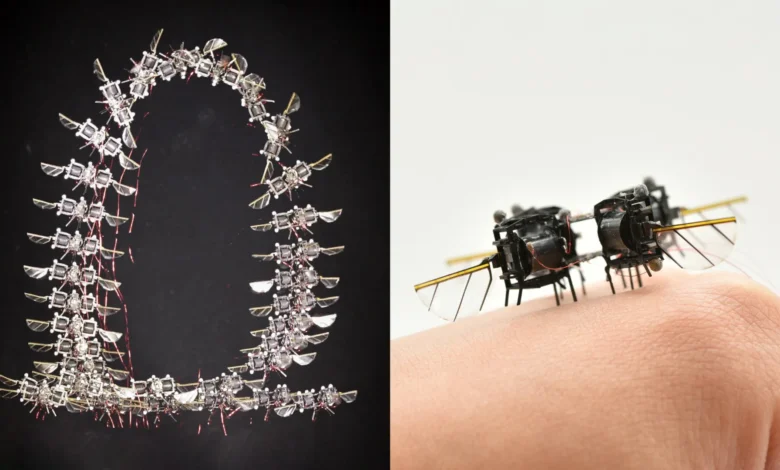
The newly unveiled robotic insect, roughly the size of a standard microcassette and weighing less than a single paperclip, is no longer constrained by the sluggishness of its predecessors. Utilizing a sophisticated two-part AI control framework, the research team increased the robot’s operational speed by approximately 450 percent and its overall acceleration by roughly 250 percent compared to previous benchmarks established by the laboratory.
The physical machinery driving this performance is equally impressive. The robot features enlarged flapping wings powered by advanced soft artificial muscles. These artificial muscles contract at rapid speeds, generating the high-frequency wingbeats necessary to sustain aggressive flight maneuvers. Yet, the true genius of the recent breakthrough lies not just in the hardware, but in the software "brain" orchestrating these movements.
By employing a hybrid control architecture—combining a computationally intensive model-predictive controller with a streamlined, deep-learning-based imitation policy—the robot can now execute complex aerial stunts in real time. Among its most dazzling demonstrations is the ability to complete 10 consecutive, flawless somersaults in just 11 seconds, even while buffeted by external wind disturbances deliberately introduced to knock it off course.
Chronology and Background Context: A Five-Year Journey
The path to this milestone spans over five years of dedicated research within MIT’s Soft and Micro Robotics Laboratory, headed by Kevin Chen, an associate professor in the Department of Electrical Engineering and Computer Science (EECS) and head of the Research Laboratory of Electronics (RLE), alongside co-senior author Jonathan P. How, the Ford Professor of Engineering in the Department of Aeronautics and Astronautics.
For years, the micro-robotics community faced a frustrating bottleneck. While Chen’s laboratory consistently advanced the physical durability and mechanical design of their tiny flying machines, the onboard and offboard controllers remained a major chokepoint. In earlier iterations, human operators had to manually tune the flight controllers. This manual calibration was entirely unsuited for the hyper-fast, highly unpredictable aerodynamic realities of insect-scale flight.
Real-scale quadcopters rely on relatively straightforward physics and abundant payload capacity for heavy onboard computers. In stark contrast, microrobots operate at a physical scale where fluid dynamics behave strangely, and every milligram of weight matters. Developing a control system smart enough to manage these uncertainties typically demands massive computational power—power that a paperclip-sized robot cannot physically carry.
To overcome this seemingly intractable paradox, Chen’s lab joined forces with How’s team, experts in control systems and autonomy. The resulting collaboration yielded a two-step framework that decoupled heavy off-line planning from real-time execution, effectively marrying heavy-duty computational foresight with lightning-fast operational reflexes.
Supporting Data and the Mechanics of the Control System
The two-step control system functions as a masterclass in algorithmic efficiency. The first component is a model-predictive controller (MPC). Operating via a complex dynamic mathematical model, the MPC predicts how the robot will respond to various forces and plots the optimal sequence of actions required to safely execute demanding trajectories—such as sharp turns, aggressive body-angle pitches, and aerial flips.
Crucially, the MPC acts as an expert planner. It factors in strict physical boundaries, such as the maximum force and torque the robot’s artificial muscles can produce, preventing the machine from attempting maneuvers that would inevitably cause a structural crash. However, executing MPC calculations in real time during flight is far too demanding for a microrobot’s operational limits.
To solve this, the researchers utilized imitation learning. They fed the data from the expert MPC planner into a deep-learning model to train a streamlined "policy." This policy acts as the robot’s real-time decision-making engine, translating incoming positional data into instantaneous commands for thrust and torque.
"The robust training method is the secret sauce of this technique," explains Jonathan How. This method successfully captured the brilliant tactical foresight of the heavy MPC model and distilled it into a lightweight AI format capable of reacting within milliseconds.
The resulting performance metrics speak volumes:
- A 447 percent increase in flight speed.
- A 255 percent increase in acceleration.
- The successful execution of 10 consecutive somersaults in 11 seconds, maintaining a tight corridor within 4 to 5 centimeters of the intended path.
- The replication of a natural insect behavior known as a "saccade"—a sudden pitching of the body to rapidly change position followed by a counter-pitch to halt instantly, mimicking how biological insects stabilize their vision and calculate spatial positioning.
Official Responses and Expert Perspectives
The collaborative nature of the research brought together specialists from diverse engineering disciplines, including co-lead authors Yi-Hsuan Hsiao, an EECS graduate student; Andrea Tagliabue (PhD ’24); Owen Matteson, a graduate student in the Department of Aeronautics and Astronautics (AeroAstro); alongside EECS graduate student Suhan Kim and Tong Zhao (MEng ’23).
"We want to be able to use these robots in scenarios that more traditional quadcopter robots would have trouble flying into, but that insects could navigate," states Kevin Chen. Emphasizing the significance of the bioinspired framework, he notes, "Now, the flight performance of our robot is comparable to insects in terms of speed, acceleration, and the pitching angle. This is quite an exciting step toward that future goal."
Jonathan How highlights the symbiotic relationship between hardware and software advancements throughout the development timeline: "The hardware advances pushed the controller so there was more we could do on the software side, but at the same time, as the controller developed, there was more they could do with the hardware. As Kevin’s team demonstrates new capabilities, we demonstrate that we can utilize them."
Yi-Hsuan Hsiao points out the broader paradigm shift represented by the findings: "This work demonstrates that soft and microrobots, traditionally limited in speed, can now leverage advanced control algorithms to achieve agility approaching that of natural insects and larger robots, opening up new opportunities for multimodal locomotion."
Broader Impact and Future Implications
While performing aerial somersaults showcases the technical prowess of the new AI controller, the ultimate utility of these microrobots extends far beyond acrobatic displays. The primary long-term vision for the technology centers on search-and-rescue operations.
Following natural disasters such as earthquakes, traditional urban search-and-rescue teams face immense dangers when attempting to locate survivors trapped deep beneath unstable, collapsed concrete and rubble. Larger drones are often too bulky to navigate tight fissures, and ground-based robots can be impeded by heavy debris. Tiny flying robots, capable of darting through narrow gaps while dynamically dodging falling objects and navigating turbulent air currents, could transform disaster response timelines.
However, significant hurdles remain before these robotic bugs can be deployed in the field. Currently, the experimental robots rely on an external motion-capture system to track their exact positions in real time. A major objective for future research is to miniaturize and integrate onboard cameras and sensors directly onto the robot’s chassis.
Equipping the microrobots with local sensing capabilities would liberate them from external infrastructure, allowing them to operate fully autonomously in unstructured outdoor environments. Furthermore, researchers plan to explore whether onboard sensors could enable swarms of these robotic insects to communicate, coordinate movements, and avoid mid-air collisions while mapping complex subterranean spaces together.
As funding from institutions such as the National Science Foundation, the Office of Naval Research, the Air Force Office of Scientific Research, MathWorks, and the Zakhartchenko Fellowship continues to propel the research forward, the implications of this work extend well beyond rescue missions. By proving that high-performing, computationally efficient control architectures can be successfully miniaturized, the MIT team has opened a new frontier in robotics—one where the boundary between machine engineering and biological design grows thinner by the day.
Related posts: