MIT Engineers Unleash AI-Driven Micro-Insects Capable of Unprecedented Aerial Agility and Speed

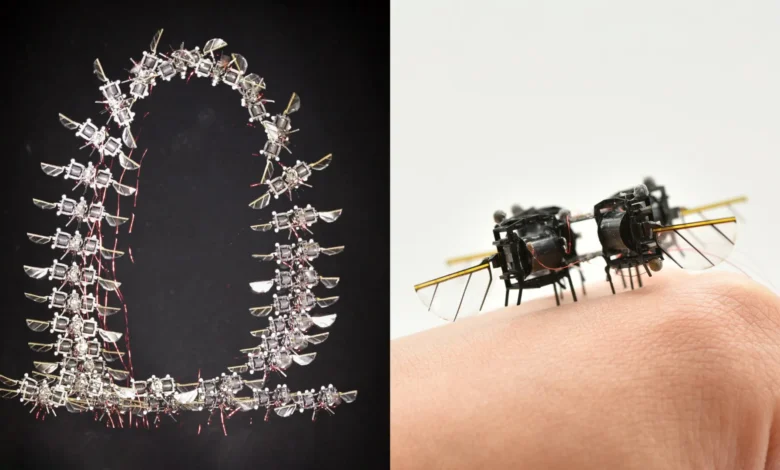
Researchers at the Massachusetts Institute of Technology (MIT) have achieved a significant breakthrough in the field of soft robotics, successfully developing an artificial intelligence-based flight controller that endows insect-scale flying robots with unprecedented speed, agility, and precision. Published in the peer-reviewed journal Science Advances, this development marks a crucial transition for micro-robotics, bridging the longstanding performance gap between synthetic micro-flyers and their biological counterparts in nature.
Weighing less than a standard paperclip and measuring roughly the size of a vintage microcassette, the newly upgraded aerial microrobot is designed for extreme maneuverability. In rigorous laboratory testing, the AI-powered machine achieved a 450 percent increase in speed and a 250 percent boost in acceleration compared to previous iterations. Most notably, the micro-insect successfully executed 10 consecutive aerial somersaults in just 11 seconds, maintaining its trajectory within a narrow four-to-five-centimeter margin despite deliberate wind disturbances meant to knock it off course.
This leap in performance is expected to reshape the future of search-and-rescue operations, environmental monitoring, and hazardous industrial inspections. By combining advanced mechanical engineering with cutting-edge machine learning, the MIT research team has cleared a major technical hurdle that has frustrated roboticists for decades: achieving real-time, complex flight control within severely restricted physical dimensions.
The Long Quest for Insect-Level Agility
For years, the overarching ambition within the micro-robotics community has been to construct autonomous machines capable of navigating confined, treacherous environments that remain inaccessible to larger drones. Following catastrophic earthquakes, structural collapses, or industrial accidents, first responders frequently encounter tight spaces choked with jagged debris, hanging wires, and unstable walls. Traditional quadcopters, while effective in open spaces, are generally too bulky, fragile, and aerodynamically constrained to operate safely inside these narrow pockets.
Biological insects, however, maneuver through cluttered environments effortlessly. Dragonflies, bees, and flies rely on rapid wingbeats, decentralized neural processing, and an innate ability to process complex aerodynamic disturbances in real time. Replicating this capability in a synthetic platform required reimagining both the hardware and the software governing the robot.
Over a five-year development cycle, researchers at MIT’s Soft and Micro Robotics Laboratory—headed by Associate Professor Kevin Chen—focused initially on physical enhancements. The team engineered a more durable micro-robot chassis driven by advanced soft artificial muscles. These synthetic actuators contract rapidly enough to facilitate high-frequency wingbeats. Furthermore, the team equipped the robot with larger, more flexible flapping wings designed to generate greater thrust and sharper directional changes.
Despite these physical improvements, a major bottleneck persisted: the robot’s onboard intelligence, or "controller." In earlier iterations of the technology, human operators had to manually tune the flight controllers. Because the aerodynamics governing a sub-gram flying machine are extraordinarily complex and sensitive to environmental shifts, designing a controller that could execute aggressive maneuvers without crashing demanded immense computational power—power that simply could not be physically housed within a microcassette-sized payload.
A Two-Tiered AI Architecture
To resolve the paradox between high-performance calculation demands and low-payload hardware constraints, Chen’s laboratory joined forces with a team led by Jonathan P. How, the Ford Professor of Engineering in MIT’s Department of Aeronautics and Astronautics and a principal investigator in the Laboratory for Information and Decision Systems (LIDS).
The resulting collaboration yielded a novel, two-part control framework designed to balance mathematical rigor with computational efficiency.
The first component of the system relies on a model-predictive controller (MPC). Operating as an "expert planner," this system utilizes a sophisticated dynamic mathematical model to forecast how the micro-robot will behave under various physical conditions. By continuously calculating the optimal sequence of actions, the MPC allows the robot to plan aggressive trajectories, such as sharp turns, rapid body-angle shifts, and continuous aerial flips.
Crucially, the MPC factors in strict physical limitations regarding the force and torque the robot’s actuators can produce, preventing commands that would trigger a structural stall or crash. However, model-predictive control is notoriously compute-heavy. Executing these calculations in real time on a lightweight platform is exceedingly difficult, particularly when executing complex maneuvers like back-to-back somersaults where micro-errors compound rapidly.
To bridge this gap, the researchers turned to imitation learning. Using data generated by the expert MPC planner, the team trained a deep-learning "policy" network. This policy acts as the robot’s real-time decision-making engine, compressing the heavy computational requirements of the MPC into a streamlined, fast-executing AI model.
"The robust training method is the secret sauce of this technique," explains Professor How, highlighting how the team successfully synthesized complex predictive planning into a lightweight format capable of managing real-time flight dynamics.
During active flight, the AI policy processes real-time data concerning the robot’s exact position, instantly translating telemetry into precise thrust and torque commands. This dual-layer architecture ensures that the robot retains the sophisticated planning capabilities of heavy computational systems while operating with the speed necessary for micro-scale aerial maneuvers.
Replicating Natural Flight Mechanics
During experimental evaluations, the impact of the two-step control framework was immediately clear. The micro-robot achieved a 447 percent increase in operational speed and a 255 percent surge in acceleration metrics.
Beyond linear velocity, the robot demonstrated advanced biomechanical maneuvers, including the execution of a "saccade." In the biological world, insects use saccades to pitch their bodies sharply, transition rapidly to a new spatial coordinate, and pitch in the opposite direction to instantly brake. This rapid deceleration and stabilization mechanism allows insects to recalibrate their position and process visual information clearly.
"This bio-mimicking flight behavior could help us in the future when we start putting cameras and sensors on board the robot," notes Professor Chen. Mastering saccadic movement is considered a foundational milestone for future iterations of the technology, which will require steady optical feeds to navigate autonomously.
Yi-Hsuan Hsiao, an EECS graduate student and co-lead author of the study, emphasizes the broader significance of the achievement. "This work demonstrates that soft and microrobots, traditionally limited in speed, can now leverage advanced control algorithms to achieve agility approaching that of natural insects and larger robots, opening up new opportunities for multimodal locomotion."
Implications for Search, Rescue, and Beyond
The successful demonstration of high-speed, highly agile micro-flight carries profound implications across multiple technological and industrial sectors.
In post-disaster reconnaissance, the deployment of insect-scale autonomous swarms could dramatically reduce the risks faced by human rescue workers. When structural integrity is compromised after an earthquake, sending human personnel into tight voids, collapsed HVAC systems, or unstable rubble piles risks triggering secondary collapses. Autonomous micro-robots capable of weaving through debris fields, mapping internal layouts, and locating trapped survivors could provide emergency response teams with life-saving intelligence within minutes of an incident.
Beyond disaster response, these micro-flyers hold immense potential for industrial maintenance and environmental monitoring. They could be utilized to inspect the internal machinery of complex jet engines, monitor hazardous chemical storage facilities, or pollinate agricultural crops in controlled greenhouse environments where traditional automation is impractical.
Despite these promising applications, several engineering challenges remain before these robots transition from laboratory benches to real-world deployments. Currently, the micro-robot relies on an external motion-capture system to track its precise position during flight tests. A primary objective for future research is the integration of lightweight onboard cameras and localized sensors, enabling the robots to operate entirely untethered and outdoors without relying on external infrastructure.
Additionally, the MIT team aims to investigate cooperative swarm behaviors. By implementing onboard sensing and inter-robot communication protocols, researchers hope to coordinate groups of micro-insects so they can navigate cluttered spaces collaboratively without colliding with one another or external obstacles.
"For the micro-robotics community, I hope this paper signals a paradigm shift by showing that we can develop a new control architecture that is high-performing and efficient at the same time," Chen concludes.
The research was supported by funding from the National Science Foundation, the Office of Naval Research, the Air Force Office of Scientific Research, MathWorks, and the Zakhartchenko Fellowship. With institutional backing and continuous advancements in both hardware and AI software, the prospect of insect-scale robotic helpers navigating the physical world alongside biological insects is steadily moving from theoretical design into practical reality.