The landscape of generative artificial intelligence is undergoing a significant architectural shift as researchers move beyond the traditional autoregressive paradigm that has defined the large language model (LLM) era. While models like GPT-4 and Claude rely on a sequential, token-by-token generation process, a new class of "diffusion" language models is emerging. These models, which draw inspiration from the image generation breakthroughs of the early 2020s, propose a fundamentally different approach: refining a sequence iteratively rather than predicting it one word at a time. This transition from serial generation to parallel refinement represents a potential breakthrough in inference speed and structural coherence.
The Origins of Diffusion in Artificial Intelligence
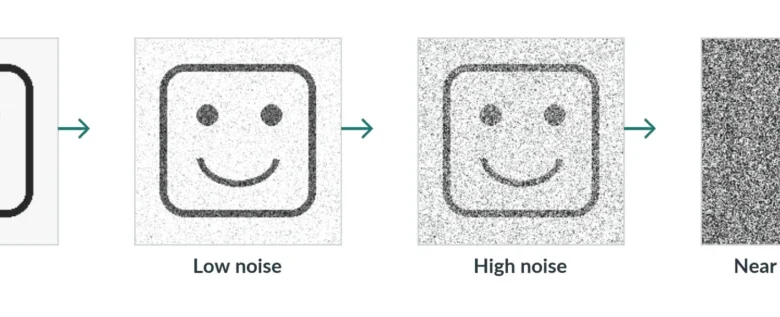
The concept of diffusion models originates from the seminal 2020 paper, "Denoising Diffusion Probabilistic Models." Initially applied to computer vision, these models demonstrated a remarkable ability to transform random Gaussian noise into highly detailed, coherent images. The mathematical elegance of the process involves a "forward" stage, where clean data is systematically corrupted with noise until it becomes unrecognizable, and a "reverse" stage, where a neural network learns to recover the original data by gradually removing the noise.
For years, this methodology remained largely confined to image and audio synthesis. The barrier to entry for text was the discrete nature of language. Unlike pixels, which exist on a continuous spectrum, words and tokens are discrete IDs. Adding Gaussian noise to an integer index does not result in a "nearby" word; it simply results in a nonsensical value. However, the recent introduction of masked diffusion techniques—where noise is introduced by replacing tokens with a [MASK] symbol—has provided a viable bridge, allowing researchers to apply diffusion principles to textual data.
The Autoregressive Bottleneck
To understand why this shift is significant, one must first look at the mechanics of standard LLMs. Current industry-standard models are "autoregressive." They operate under the assumption that the probability of a sequence is the product of conditional probabilities. If a model is generating a sentence, it predicts the first word, appends it to the input, and then uses that updated input to predict the second.
This creates a rigid serial dependency. Because each token relies on the existence of the one before it, the model cannot generate tokens in parallel. This bottleneck forces high-latency inference, as the hardware must perform a full forward pass through the entire transformer stack for every single token produced. While techniques like speculative decoding and KV-caching have attempted to mitigate this, the fundamental constraint remains: the model must wait for the past to build the future.
Chronology of Diffusion Language Models
The push toward diffusion-based text generation accelerated significantly between 2025 and 2026. The progression can be categorized into several key milestones:
- Early 2025: The release of LLaDA marked a pivotal moment, demonstrating that masked diffusion could indeed be scaled to produce coherent text. This was quickly followed by the introduction of Mercury, which refined the sampling strategies necessary for high-quality generation.
- Mid-2025: Google’s DeepMind integrated these concepts into the Gemini Diffusion framework. This signaled a major industry shift, as one of the world’s leading AI research labs began prioritizing diffusion as a production-grade alternative to standard autoregressive architectures.
- 2026: The release of DiffusionGemma underscored the commitment to this new architecture. By applying diffusion techniques to the open-weights Gemma model, Google provided the research community with the tools to benchmark diffusion against traditional LLMs in a controlled, comparable environment.
Mechanics of Masked Diffusion
In a masked diffusion framework, the generation process begins with a "blank canvas"—a sequence of masked tokens. Instead of generating a linear progression, the model assesses the entire sequence simultaneously. The inference procedure generally follows these four steps:
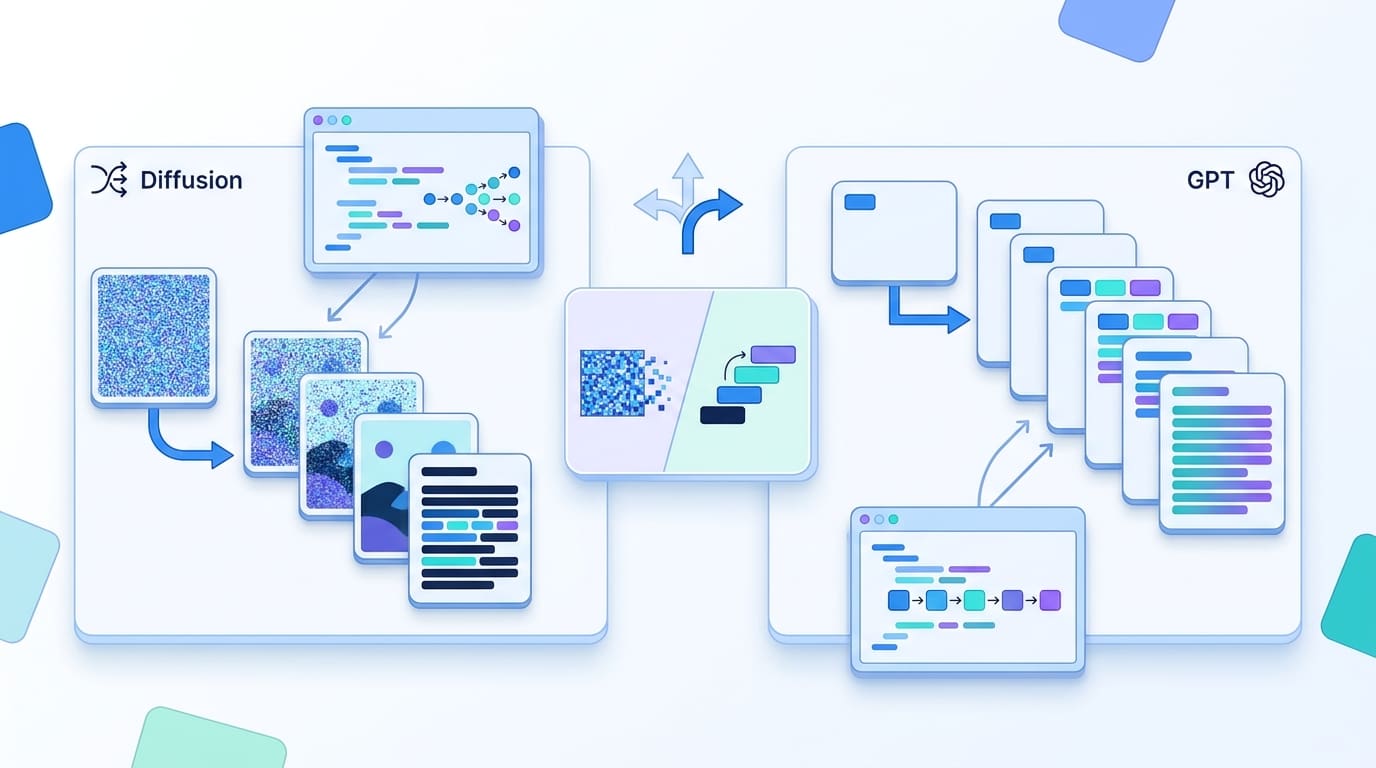
- Initialization: The model is presented with a sequence where all positions are masked.
- Probability Estimation: The transformer backbone predicts the probability distribution for every masked position at once.
- Commitment and Refinement: The sampler selects tokens for positions where the model has high confidence. Positions with low confidence remain masked or are revisited in subsequent rounds.
- Iterative Convergence: This process repeats, with the model continuously refining the sequence until all positions are filled with high-confidence, contextually relevant tokens.
This iterative refinement is the antithesis of the "one-shot" autoregressive approach. It allows for "revision," where the model can potentially change its mind about a previously generated token if the surrounding context becomes clearer in subsequent steps.
Comparative Analysis: Autoregressive vs. Diffusion
| Feature | Autoregressive (GPT-style) | Masked Diffusion |
|---|---|---|
| Generation Order | Sequential (Left-to-Right) | Parallel / Iterative |
| Dependency | Strict Serial | Global (Contextual) |
| Inference Speed | Limited by sequence length | Potentially faster (fewer passes) |
| Revision Capability | None (Static once generated) | High (Iterative refinement) |
| Primary Use Case | Real-time chat, streaming | Batch generation, complex reasoning |
Supporting Data and Implications
Data from recent research benchmarks suggests that diffusion models offer a distinct advantage in specific domains. While autoregressive models remain the gold standard for conversational fluency and interactive chat, diffusion models show promise in tasks that require high levels of planning or global structural awareness. Because diffusion models view the text as a whole rather than a chain, they are theoretically better at "looking ahead" to ensure the conclusion of a paragraph aligns perfectly with its introduction.
However, the industry is not currently shifting toward an "all-diffusion" future. Instead, the consensus among researchers is that the future likely lies in hybrid architectures. For instance, a model might use a diffusion process to outline the high-level structure and intent of a long-form document, while an autoregressive decoder handles the specific phrasing of sentences in real-time.
Challenges and Future Research
Despite the enthusiasm, significant hurdles remain. Diffusion models are computationally expensive to train, and the "sampling schedule"—the strategy by which the model decides how many iterations are necessary to reach convergence—is still a subject of intense optimization.
Furthermore, the "serial dependency" of autoregressive models is currently well-optimized on modern GPU architectures. Moving to a diffusion-based architecture requires a shift in how inference kernels are written, which could temporarily offset the gains in generation speed. Critics also point out that for simple queries, the extra computational overhead of multiple refinement steps may be unnecessary, suggesting that diffusion models are better suited for specialized, high-complexity tasks rather than as a drop-in replacement for everyday assistants.
Broader Impact on the AI Industry
The integration of diffusion into text generation represents a maturation of the field. By decoupling the generation process from strict left-to-right ordering, developers are opening doors to more sophisticated document generation techniques, including non-linear editing, improved long-context consistency, and more robust error correction.
As we move through 2026 and beyond, the focus will likely shift from merely proving that diffusion works to finding the "sweet spot" of efficiency. If research continues at the current pace, the distinction between "image generation" and "text generation" will continue to blur, leading to unified models that can manipulate data—be it pixels, tokens, or audio waves—using the same underlying probabilistic diffusion principles. For now, these models stand as a powerful addition to the AI toolkit, offering a glimpse into a future where computation is allocated not just by time, but by the complexity of the task at hand.