Strumming the Quantum Chord: ETH Zurich Researchers Harness Microscopic Vibrations to Revolutionize Computer Memory

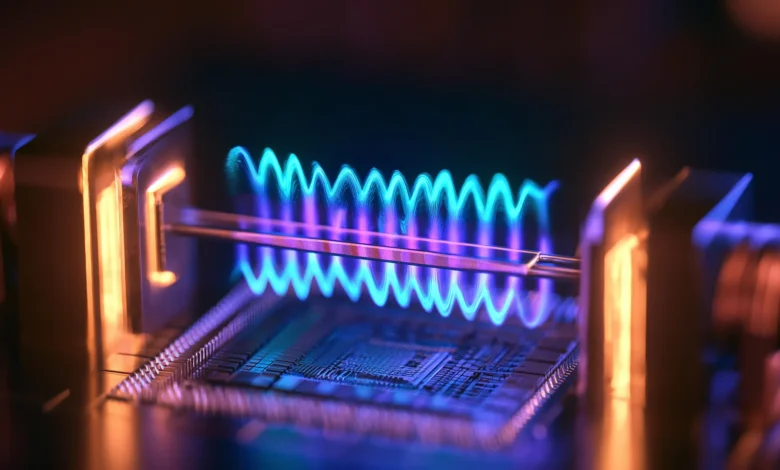
The race to build a functional, large-scale quantum computer has taken a remarkably harmonious turn, drawing inspiration from an unlikely source: the acoustic physics of a guitar. Researchers at the prestigious Swiss Federal Institute of Technology (ETH Zurich) have successfully engineered a novel quantum computing system that utilizes microscopic mechanical vibrations to store and manipulate fragile quantum data. Led by physicist Yiwen Chu, the research team has demonstrated that tiny mechanical resonators can mimic the vibrating strings of a musical instrument—albeit at frequencies far beyond the threshold of human hearing—to serve as an efficient, highly stable form of quantum working memory.
Published in the peer-reviewed journal Science, this breakthrough marks a significant philosophical and architectural shift in quantum hardware design. By decoupling the processor from the memory and reimagining how information is retained at the subatomic level, the ETH Zurich team has charted a viable path toward overcoming some of the most persistent bottlenecks in modern quantum engineering.
Main Facts and the Architectural Breakthrough
At the core of conventional digital computing lies a well-established blueprint: the Central Processing Unit (CPU) executes mathematical calculations, while a separate Random Access Memory (RAM) temporarily holds the data required for those operations. This division of labor allows traditional computers to run efficiently, allocating distinct tasks to specialized hardware components.
Until recently, however, many experimental quantum computers blurred these lines. Traditional quantum architectures often integrated information processing and storage within the same electromagnetic infrastructure, leading to severe spatial constraints and control complications. Chu and her team recognized that scaling quantum machines would require a modular approach inspired by classical computing principles.
In the newly developed ETH Zurich system, a superconducting qubit functions as the quantum equivalent of a CPU, executing primary calculations and controlling operations. Operating alongside this processor is a distinct quantum working memory. The defining innovation, however, lies in the medium of storage. Rather than relying on traditional electromagnetic fields—the industry standard for decades—the team utilizes mechanical vibrations confined within a microscopic chip.
When the superconducting qubit requires data, it accesses the stored vibrational state within a mechanical resonator, performs the necessary calculation, and subsequently returns the modified information to the memory bank. This separation of duties not only streamlines operations but also minimizes thermal and electromagnetic interference, which has historically plagued quantum processors.
A Brief Chronology of Quantum Memory Evolution
To understand the weight of the ETH Zurich breakthrough, it is helpful to examine the historical trajectory of quantum memory development over the past two decades:
- Early 2000s: Early quantum experiments focused primarily on trapped ions and photons, proving that quantum superposition and entanglement were mathematically viable for computing. However, keeping these states stable—a condition known as coherence—proved exceptionally difficult, often lasting only fractions of a second.
- 2010s: The rise of superconducting circuits shifted the paradigm. Tech giants and academic institutions alike gravitated toward electromagnetic resonators to store quantum states. While these systems offered precise electronic control, researchers quickly realized they were bulky and notoriously difficult to scale beyond a few dozen qubits.
- Late 2010s to 2020: Material scientists began exploring electromechanical interfaces, hypothesizing that coupling superconducting qubits with macroscopic or microscopic mechanical oscillators could bridge the gap between electrical processing and mechanical stability.
- 2021–2023: Laboratories worldwide intensified efforts to isolate mechanical vibrations in microchips, looking for ways to prevent thermal noise from destroying quantum data.
- Present Day: The ETH Zurich team achieves a milestone by demonstrating that mechanical resonators can actively participate in complex quantum algorithms, such as the quantum Fourier transform, proving that mechanical memory is functionally viable for general-purpose quantum computing.
Supporting Data and Technical Advantages
The transition from electromagnetic storage to mechanical vibration addresses two of the most critical challenges in quantum information science: spatial footprint and decoherence time.
In terms of physical architecture, electromagnetic memory units are notoriously space-consuming. As quantum computers grow from dozens of qubits to the thousands or millions required for industry-grade applications, the physical wiring and electromagnetic cavities required for traditional storage quickly become unmanageable. Microscopic mechanical resonators, by contrast, occupy a fraction of the space. Because a single mechanical structure can support numerous distinct patterns of vibration simultaneously—much like a guitar string producing various harmonics—it can theoretically store significantly more data density than its electromagnetic counterparts.
Furthermore, the longevity of the stored data represents a monumental victory. Quantum states are notoriously fragile; even minute environmental fluctuations can cause decoherence, resulting in the catastrophic loss of data. The mechanical resonators developed by Chu’s team demonstrated an impressive ability to preserve quantum states for extended periods before degradation occurred. Longer storage times are essential for executing complex, multi-step algorithms that require data to remain stable throughout prolonged computational sequences.
Rigorous Testing and Algorithmic Execution
To validate the reliability of their vibration-based memory architecture, the ETH Zurich researchers subjected the system to rigorous benchmarking. The team did not merely test the device’s ability to retain static data; they required it to actively execute demanding computational procedures that necessitate the precise coordination of multiple quantum states.
Specifically, the system was tested using the quantum Fourier transform—a mathematical operation foundational to numerous quantum algorithms, including Shor’s algorithm for integer factorization—alongside a period-finding algorithm designed to demonstrate how the transform is applied in practice.
Igor Kladaric, a doctoral student on Chu’s team and co-author of the study, emphasized the significance of these tests. "The Quantum Fourier Transform is a fundamental computational procedure required for many quantum algorithms. The period-finding algorithm we implemented served as a demonstration of how this procedure can be used," Kladaric explained.
Successfully completing these complex tasks proved that the mechanical memory architecture can seamlessly interact with the superconducting processor without sacrificing data integrity. It provided definitive empirical evidence that vibration-based memory can support active, genuine quantum computation rather than merely acting as a passive storage locker.
Official Responses and Scientific Reactions
The publication of these findings in Science has generated considerable interest and discussion within the global physics community. Independent researchers have praised the elegance of combining macro-scale acoustic principles with nano-scale quantum mechanics.
Reflecting on the foundational nature of the breakthrough, Yiwen Chu noted the broader implications for the field: "The interaction between the quantum processor and the quantum memory provides a crucial foundation with a view to establishing quantum computers as a powerful and reliable way to perform computations that are not feasible with conventional computers."
While industry analysts and academic peers acknowledge that the system successfully satisfies the criteria for a programmable, general-purpose quantum architecture, they also maintain a balanced perspective regarding the timeline for commercialization. Prominent physicists not involved in the study have pointed out that transitioning from a controlled laboratory demonstration to an industrial-grade quantum processor remains a formidable engineering hurdle. Nevertheless, the consensus among experts is that acoustic and mechanical approaches have officially graduated from theoretical novelty to a front-runner status in quantum hardware design.
Broader Impact and Future Implications
The implications of ETH Zurich’s acoustic-inspired quantum memory extend far across scientific and industrial landscapes. If quantum computers are ever to fulfill their theoretical promise—solving complex logistical problems, accelerating pharmaceutical discovery, and modeling molecular structures with absolute precision—they must overcome the scaling crisis.
Conventional electromagnetic architectures risk hitting a physical wall due to thermal output, wiring congestion, and spatial limitations. By shrinking memory storage into micro-mechanical vibrations, engineers can bypass many of these roadblocks. The compactness of mechanical resonators opens a realistic pathway toward packing thousands of functional memory units onto a single chip without triggering catastrophic crosstalk or overheating.
However, significant challenges remain on the horizon. The primary objective for Chu’s laboratory and the broader scientific community is scalability. Researchers must now determine whether mechanical quantum memory can maintain its exceptional precision and extended coherence times as thousands of additional components and increasingly intricate circuitry are integrated into the system.
Practical, fault-tolerant quantum computers capable of outperforming classical supercomputers across a wide spectrum of commercial applications are still years away from widespread deployment. Yet, by proving that the fundamental physics of a vibrating string can be harnessed to orchestrate subatomic data, the ETH Zurich team has illuminated a brilliant new path forward. In the quest to build the ultimate computing machine, humanity may ultimately owe a debt of gratitude not just to silicon and electricity, but to the timeless physics of acoustic harmony.