React Native 0.85 Debuts with New Shared Animation Backend and Enhanced Developer Tooling

Meta has announced the general availability of React Native 0.85, a pivotal update that introduces a redesigned animation architecture and streamlines the developer experience through modularized testing utilities and improved debugging tools. This release represents a significant step in the framework’s long-term "New Architecture" rollout, focusing on performance parity between different animation libraries and tightening the integration between the core framework and its surrounding ecosystem. By incorporating 604 commits from 58 contributors, version 0.85 addresses long-standing limitations in layout animations and modernizes the underlying infrastructure to support contemporary development standards, including secure local networking and updated Node.js requirements.
The Evolution of React Native Animation Architecture
For years, the React Native community has navigated a fragmented landscape regarding animations. Developers primarily chose between the built-in Animated API and the community-driven Reanimated library by Software Mansion. While Animated provided a familiar interface for simple transitions, it often struggled with complex layout changes that required the "native driver" to avoid frame drops caused by JavaScript thread congestion. Conversely, Reanimated offered high-performance worklets but operated as a separate engine, sometimes leading to reconciliation challenges during major framework updates.
React Native 0.85 resolves this friction by introducing the Shared Animation Backend. Developed in direct collaboration with Software Mansion, this new internal engine serves as the unified foundation for both the core Animated API and the Reanimated library. By moving the primary animation update logic directly into the React Native core, the development team has ensured that animation reconciliation is more stable and better tested against future framework iterations.
This architectural shift allows Reanimated to achieve performance optimizations that were previously inaccessible due to its external nature. Furthermore, it bridges the feature gap for the core Animated API. Historically, developers using Animated were limited to animating non-layout properties—such as opacity and transforms—when using the native driver. Attempting to animate properties like width, height, or flexbox positions would force the animation to run on the JavaScript thread, often resulting in "jank" during heavy computations. With the 0.85 release, these layout props can now be handled by the native driver, significantly expanding the utility of the built-in animation library for performance-critical applications.
Technical Analysis of Native Driver Expansion
The ability to animate layout properties on the native thread is a breakthrough for developers seeking to build fluid, responsive interfaces without the overhead of external dependencies. In previous versions, the documentation explicitly warned against using useNativeDriver: true for properties that affected the layout of the UI, as the native animation engine did not have a mechanism to communicate these changes to the layout engine (Yoga) without crossing back to the JavaScript side.
In the 0.85 environment, the Shared Animation Backend allows the native side to manage these updates directly. For example, a component whose width expands from 100 to 300 pixels can now maintain a smooth 60 or 120 frames per second (FPS) even if the JavaScript thread is occupied with data fetching or complex business logic. This is particularly beneficial for enterprise-grade applications where smooth transitions are a hallmark of quality, but where the complexity of the app often puts a strain on the main thread.
To utilize this feature, developers must opt into the experimental channel of React Native. The team has indicated that while the backend is present in 0.85.0, the full suite of experimental features will be most accessible starting with version 0.85.1. This staged rollout allows the community to provide feedback on the new engine before it becomes the default behavior in future major releases.
Modernizing Development with Metro TLS and Advanced DevTools
Security and debugging have received substantial attention in this release cycle. One of the most requested features for local development has been native support for Transport Layer Security (TLS) within the Metro bundler. As modern web and mobile APIs increasingly require secure contexts (HTTPS/WSS), developers often find themselves jumping through hoops to proxy their local development traffic through secure tunnels.
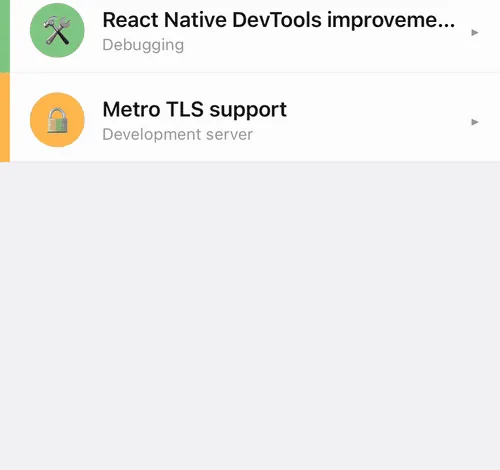
React Native 0.85 introduces Metro TLS support, allowing the development server to accept a configuration object containing CA certificates, public certificates, and private keys. This enables HTTPS for the dev server and WebSockets over SSL (WSS) for Fast Refresh. By utilizing tools like mkcert, developers can now create locally-trusted certificates that allow their mobile applications to communicate with local development servers under a secure protocol, mirroring the production environment more accurately and satisfying the requirements of modern security-sensitive APIs.
Simultaneously, the React Native DevTools suite has undergone a series of refinements. The latest version includes improved integration with macOS, featuring native tab support that aligns with the desktop operating system’s aesthetic and functional standards. These UI improvements are paired with underlying stability fixes that ensure the inspector and debugger remain responsive during high-load scenarios, such as when profiling the newly introduced layout animations.

Decoupling the Testing Infrastructure
In a strategic move to reduce the footprint of the core react-native package and provide more granular control over project dependencies, the Jest preset has been moved to a dedicated package. Previously, the testing configuration for React Native was bundled within the main library. In version 0.85, this has been extracted into @react-native/jest-preset.
This change is more than just a cosmetic reorganization. By separating the testing preset, the React Native team can iterate on testing utilities and mock implementations without requiring a full release of the core framework. For developers, this means a one-line change in their jest.config.js file, but it yields benefits in terms of project flexibility. Projects that may want to use specific versions of testing tools or those that are sensitive to package size will find this modular approach more efficient. This migration follows the broader industry trend of "un-coring" frameworks, a philosophy Meta has applied to React Native over several years to ensure the core remains lean and performant.
Breaking Changes and Maintenance of the Dependency Lifecycle
As with any significant release, React Native 0.85 prunes deprecated APIs and updates its environment requirements to ensure the framework stays current with the broader JavaScript ecosystem. A major update in this release is the formal dropping of support for Node.js versions that have reached their End-of-Life (EOL) status. Specifically, React Native now requires Node.js v20.19.4 or higher.
The decision to move to Node.js 20 (the current Long Term Support or LTS version) ensures that the build tools and scripts used by React Native can leverage modern V8 features and security patches. Developers still operating on Node.js 16 or 18 will need to upgrade their environments before migrating to 0.85.
On the API front, the release officially removes StyleSheet.absoluteFillObject. This API had been deprecated for several versions in favor of StyleSheet.absoluteFill. While the change is minor, it is a necessary cleanup of the styling API. Developers are encouraged to use a global search-and-replace to update their codebases, as the replacement is functionally identical but follows the standardized naming convention that the framework is moving toward.
Ecosystem Impact and the Path to SDK 56
The release of React Native 0.85 has immediate implications for the broader ecosystem, most notably for users of the Expo platform. The Expo team has confirmed that the upcoming Expo SDK 56 will be built upon React Native 0.85. This alignment ensures that developers who prefer the managed workflow of Expo will soon have access to the Shared Animation Backend and Metro TLS features.
The community response to the 0.85 release has been largely positive, particularly regarding the collaboration with Software Mansion. Industry analysts suggest that this move strengthens React Native’s position against competitors like Flutter and Kotlin Multiplatform by addressing one of the most cited criticisms of the framework: the complexity of achieving high-performance animations across both iOS and Android.
With 0.85 now serving as the latest stable version, React Native 0.82 has officially moved to the "unsupported" status. This follows the framework’s support policy of maintaining the three most recent minor versions. Organizations currently running on 0.82 are urged to begin their upgrade paths to avoid security vulnerabilities and to take advantage of the performance gains inherent in the new architecture.
Conclusion and Future Implications
React Native 0.85 is a foundational release that prioritizes internal stability and developer productivity over superficial feature additions. By unifying the animation backend and modernizing the toolchain with TLS support and modular testing, Meta and the community contributors have prepared the framework for the next generation of mobile applications.
The move toward a shared backend for animations is particularly telling of the framework’s future direction. It suggests a more integrated relationship between core development and the community’s most essential libraries. As the "New Architecture" (including Fabric and TurboModules) becomes the standard, the improvements seen in 0.85 lay the groundwork for a React Native that is faster, more secure, and easier to debug than its predecessors. For developers, the message is clear: the framework is maturing into a highly stable platform capable of handling the most demanding UI requirements with native-level performance.
Related posts: