Google Integrates Gemini 4 Argon Into Android Studio and Antigravity to Usher in New Era of Agentic Development

The landscape of mobile software engineering is undergoing a fundamental architectural shift, transitioning from passive code-completion assistants to fully autonomous, goal-directed AI agents. Google has announced the official rollout of Gemini 4 Argon across its primary Android development surfaces. Designed to handle complex, multi-step software tasks with minimal human intervention, the new model aims to redefine how applications are conceptualized, built, tested, and deployed.
The release marks a significant milestone in the evolution of artificial intelligence within developer tooling. By moving beyond traditional assistive programming—such as syntax highlighting and single-line autocompletion—Gemini 4 Argon enables developers to delegate end-to-end workflows, from architectural planning to error self-correction, directly to autonomous systems.
The Evolution of Agentic Workflows in Android Engineering
For years, artificial intelligence in integrated development environments (IDEs) has functioned primarily as a reactive utility. Developers relied on tools to predict the next few lines of code, suggest variable names, or generate isolated unit tests. While these capabilities improved developer velocity incrementally, they still required continuous human oversight for every functional block of code.
Agentic development, by contrast, relies on closed-loop execution. An agent is given a high-level directive—such as implementing a complex UI flow or refactoring a legacy networking stack—and is equipped with the autonomy to plan, execute, evaluate results, and self-correct when builds fail. Gemini 4 Argon has been specifically optimized for this kind of long-horizon execution. Internal benchmarks indicate that the model excels at deep, contextual work across a variety of demanding domains, including cybersecurity, finance, legal analysis, and advanced software engineering.
By integrating Argon into the Android ecosystem, Google is providing developers with total flexibility regarding the models and orchestration agents they employ. Rather than locking engineers into a single proprietary workflow, the platform supports varied configurations across desktop apps, cloud playgrounds, and command-line interfaces.
Core Capabilities: Autonomous Self-Correction and UI Sophistication
Gemini 4 Argon introduces several architectural enhancements designed specifically for the rigorous demands of modern mobile development. Among the most notable is its closed-loop build self-correction capability. When an agent attempts to compile an Android project and encounters a build error, missing dependency, or Gradle configuration issue, Argon can analyze the stack trace, formulate a correction, apply the fix, and re-run the build independently. This drastically reduces the friction of iterative debugging.
In addition to back-end logic and build management, Argon demonstrates high proficiency in front-end design craft. The model is capable of generating production-ready Jetpack Compose code out of the box, incorporating fluid motion, complex state management, and shader-backed UI elements that adhere to modern Material Design guidelines. This enables developers to translate design specifications into functional, reactive user interfaces with unprecedented speed.
Ecosystem Integration via Google Antigravity and the Android CLI
To ensure that developers can incorporate Gemini 4 Argon into their existing workflows without friction, Google has deployed the model across multiple development surfaces and environments.
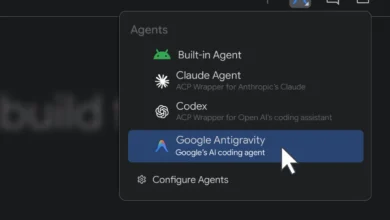
At the center of this ecosystem is Google Antigravity, a specialized workspace available as a standalone desktop application for macOS, Windows, and Linux, as well as an integrated extension within Android Studio Canary. Google AI Ultra subscribers gain immediate access to these environments, allowing them to leverage Argon’s autonomous capabilities locally.
Simultaneously, Google is releasing the official Android CLI plugin, acting as the bridge between autonomous agents and local development tools. The command-line interface allows any terminal-based agent to execute programmatic commands, manage project directories, and invoke custom developer skills.
Developers can configure their local agentic workspaces through multiple pathways:
- Visually, via the Antigravity desktop application or Android Studio Canary.
- Via the Terminal CLI by installing the Android plugin using the command
agy plugin install android-cli-plugin. - For general terminal agents utilizing the Android CLI, by initializing the workspace with the command
android init.
Availability Across Development Surfaces
The rollout of Gemini 4 Argon is global, encompassing several primary access points for developers on supported tiers:
- Google Antigravity: Available to Google AI Ultra subscribers through the standalone desktop app or via terminal CLI integration.
- Android Studio: Integrated directly into the latest preview and production releases for seamless in-IDE agentic workflows.
- Google AI Studio: Accessible via the Playground and build environments for Google AI Ultra subscribers and developers operating on the paid tier of the Gemini API.
- Firebase AI Logic: Enabled client-side for developers on the paid Gemini API tier, facilitating the integration of intelligent, agent-driven features directly into mobile and web applications.
Industry Implications and Future Outlook
The introduction of Gemini 4 Argon into the Android development ecosystem reflects a broader industry trend toward agentic software engineering. As AI models gain the capacity for sustained, multi-step reasoning, the role of the software engineer is shifting from manual code authorship to architectural oversight, systems integration, and quality assurance.
Industry analysts note that while autonomous agents significantly accelerate velocity, they also place a premium on robust automated testing and code review practices. Because agents can generate substantial volumes of code and modify project structures rapidly, maintaining rigorous CI/CD pipelines becomes essential to ensure application stability, security, and performance.
Google has encouraged the developer community to share their experiences, experimental projects, and feedback regarding Gemini 4 Argon across official channels, including GitHub, X (@AndroidDev), and LinkedIn. As developers begin to explore the boundaries of agentic development, the insights gathered from these early adopters will likely shape the next generation of intelligent tooling for the Android platform.
Related posts: