The Rise of Agentic AI and the Shift to Continuous Post-Training Maximizing Intelligence per Dollar with NVIDIAs Next-Generation Platforms

The landscape of artificial intelligence is undergoing a fundamental transition from static generative models to dynamic agentic systems. While the previous era of AI was defined by large language models (LLMs) capable of responding to discrete prompts, the emerging "agentic era" focuses on models that function as autonomous entities. These agents do not merely provide answers; they are assigned high-level goals and must navigate shifting environments, resolve unforeseen edge cases, and utilize a variety of external tools to achieve their objectives. This shift necessitates a complete reimagining of the AI development lifecycle, moving away from a one-time training approach toward a continuous cycle of refinement known as agentic post-training.
To understand this shift, one might look to professional sports. What separates an elite athlete from a casual player is not just the initial talent or the basic training they received years prior; it is the continuous refinement that occurs between games. Elite performers adjust their strategies based on new opponents and sharpen specific skills based on the weaknesses exposed in their last performance. Agentic AI operates on the same principle. Because these models operate in production environments where codebases, corporate policies, and software tools change weekly, a model’s intelligence must be updated constantly to remain effective.
The Mechanics of Agentic Post-Training
Post-training is the phase of AI development that occurs after a model has been initially trained on massive datasets of raw information. In the pretraining phase, a model learns the basic structure of language and how to predict the next token in a sequence. This provides the model with fluency, but not necessarily functional intelligence or reasoning capabilities. Post-training is where the "specialization" happens. It is during this stage that a model learns to write functional code, plan multi-step logic chains, use search engines or databases, and—most importantly—recover when it encounters an error mid-task.
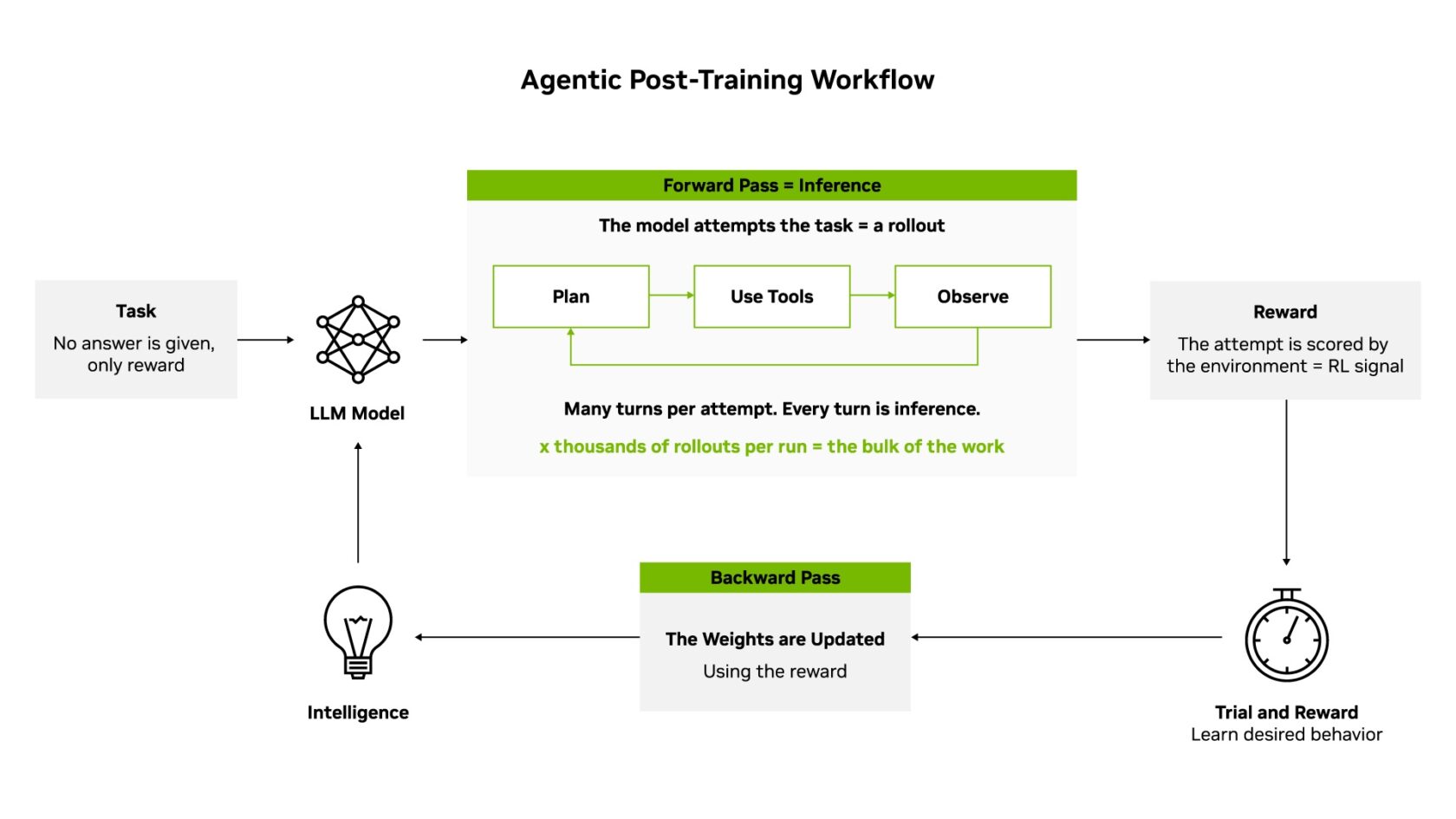
Unlike traditional supervised learning, which relies on a static "answer key," agentic post-training utilizes Reinforcement Learning (RL) techniques. In this framework, the model is given a task and generates an attempt, known as a forward pass or rollout. This attempt is then scored based on its success or failure. The resulting feedback is used to update the model’s internal weights—a process called the backward pass. By repeating this loop millions of times across diverse environments, the model’s intelligence grows.
This process is exceptionally compute-intensive. Running RL loops at a global scale presents a massive orchestration challenge. It requires thousands of simulated environments to generate rollouts in parallel, while simultaneously verifying rewards and flowing updated weights back into the training infrastructure. To address this, NVIDIA has introduced open libraries such as NeMo Gym and NeMo RL. These tools transform what was once bespoke research code into repeatable industrial infrastructure, allowing developers to scale post-training as a continuous workload rather than a one-off event.
Redefining AI Economics: Intelligence per Dollar
As the industry matures, the metrics used to evaluate AI performance are evolving. For the past several years, the primary metric for the "inference factory" has been the "cost per token"—the all-in cost of delivering one million tokens of output. However, in the agentic era, a new metric is taking center stage: "intelligence per dollar."
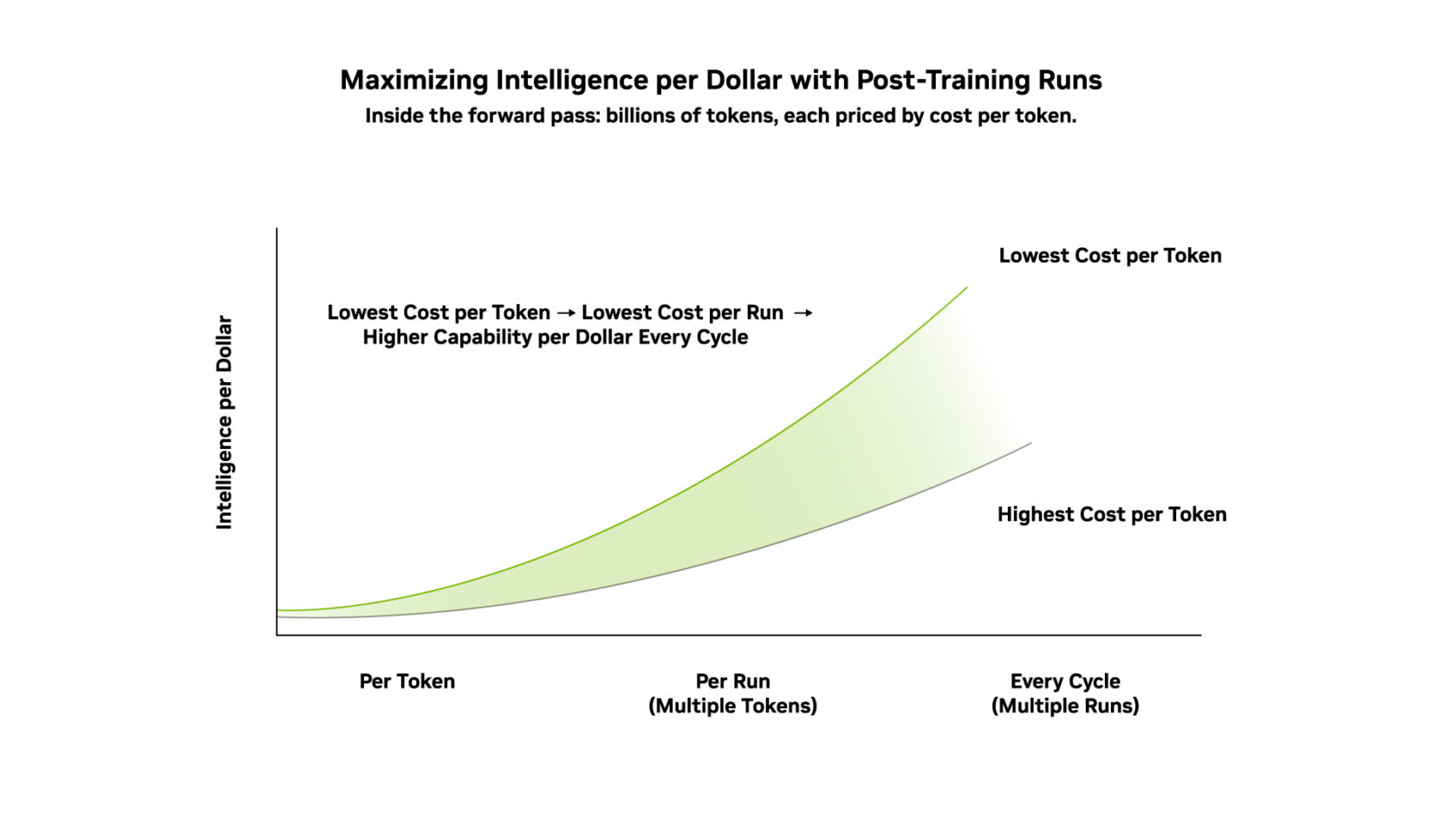
Intelligence per dollar is a macro-metric that sits above cost per token. It asks a more complex question: What does it cost to build a model that is worth serving, and how do we keep it valuable as its environment changes? While cost per token measures operational yield, intelligence per dollar measures the actual return on investment in model capability.
These two metrics are nested. Any technological advancement that lowers the cost per token—such as more efficient GPU architectures—directly lowers the cost of every "point" of intelligence built into the model during post-training. Conversely, every increase in model intelligence raises the value of every token the model eventually serves. In an agentic workflow, a more intelligent model might complete a complex task in 500 tokens that a less capable model would fail to complete in 5,000 tokens. Thus, maximizing intelligence per dollar becomes the primary driver of economic viability for enterprise AI.
Benchmarking the Agentic Era: Nemotron 3 Ultra
The practical application of these theories is visible in the performance of NVIDIA’s Nemotron 3 Ultra. This model is an open-weight, 550-billion-parameter Mixture-of-Experts (MoE) architecture. Unlike dense models, MoE models only activate a fraction of their parameters for any given task, allowing for high intelligence with lower computational overhead during inference.
NVIDIA utilized its NeMo RL post-training recipe to refine Nemotron 3 Ultra, specifically targeting real-world utility. In the SWE-bench (Software Engineering Benchmark) verified test, the model scored 71.7%. This benchmark is particularly rigorous because it requires the AI to resolve real software bugs from open-source projects. For each bug, the model must write a fix that is then checked against the project’s own internal test suite. Scoring nearly 72% indicates that the model can successfully repair seven out of ten real-world software vulnerabilities, a feat that requires high-level reasoning, tool use, and the ability to understand complex, pre-existing codebases.
Hardware Evolution: From Blackwell to Vera Rubin
The transition to continuous post-training requires hardware that can handle the relentless loop of rollouts and weight updates. The NVIDIA Blackwell platform was designed to lower the cost per run, making the frequent post-training cycles of agentic AI economically feasible. However, the roadmap for AI infrastructure is accelerating.
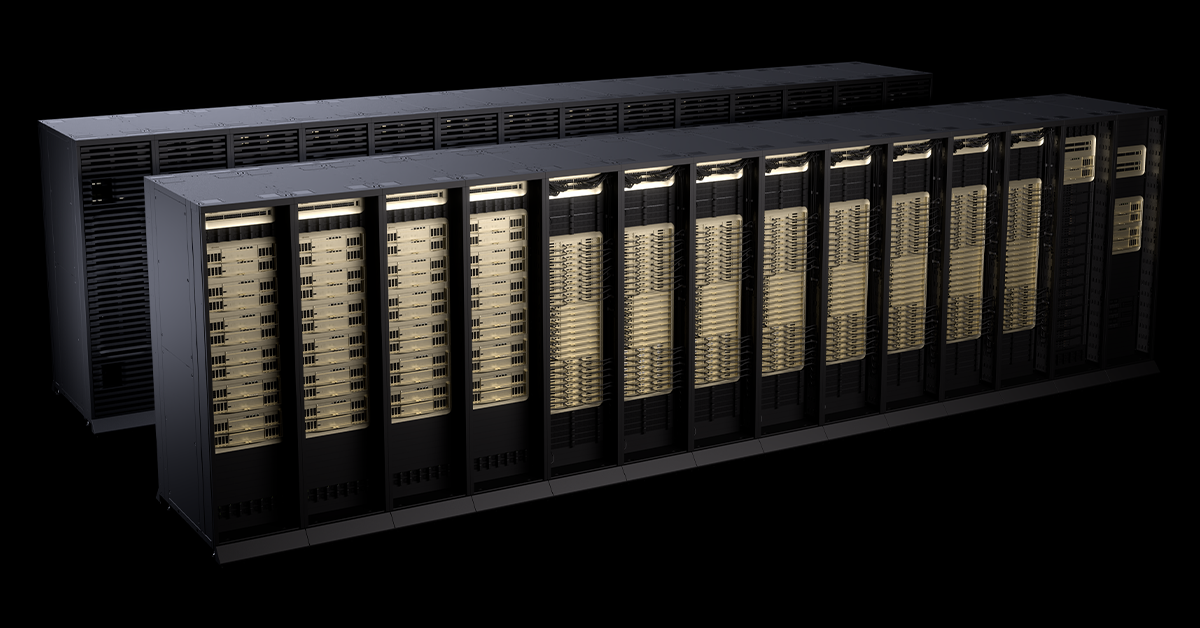
NVIDIA’s upcoming Vera Rubin platform is designed to extend this trajectory even further. The Vera Rubin architecture was co-designed from the ground up to maximize intelligence per dollar for the specific demands of agentic workloads. According to NVIDIA, the platform will be capable of training the largest frontier models using only one-fourth the number of GPUs required by the Blackwell generation. This efficiency gain is critical for "AI factories" that need to run continuous reinforcement learning environments, generate massive numbers of rollouts, and maintain iteration loops that never stop.
Industry Adoption and Case Studies
Several leading AI companies are already integrating these continuous post-training workflows into their operations.
Prime Intellect: This organization’s lab continuously post-trains open-frontier models on NVIDIA Blackwell systems. Using NVIDIA Dynamo for inference orchestration, Prime Intellect plans to scale its RL environments on the Vera Rubin platform. Notably, Prime Intellect has optimized its sandbox infrastructure to integrate with NVIDIA Vera CPUs. In realistic reinforcement learning sandbox workloads, the Vera CPUs delivered an average of 30% greater throughput compared to alternative x86 architectures. This allows for lower-latency, more energy-efficient training-to-inference loops.

Perplexity: The AI-powered search engine utilizes an asynchronous RL post-training stack that runs across hundreds of NVIDIA GPUs. To manage the massive data requirements, Perplexity employs an RDMA-based (Remote Direct Memory Access) weight transfer engine. This system can sync trillion-parameter models between training and inference nodes in under two seconds. Their post-trained Qwen3 235B models are currently served on NVIDIA GB200 NVL72 systems, allowing for rapid updates based on user interaction data.
Together AI: Operating as a "Post-Training as a Service" provider, Together AI offers supervised fine-tuning, RL, and direct preference optimization (DPO) via a specialized API. Their platform, built on NVIDIA’s optimized kernel libraries, is designed to support the full lifecycle of agentic development. They are currently preparing to harness the Vera Rubin platform to further reduce the cost of building high-intelligence models for their enterprise clients.
Broader Implications and the Future of AI Factories
The shift toward agentic AI and continuous post-training represents a maturing of the artificial intelligence industry. It signals a move away from the "magic box" perception of AI toward a more disciplined, industrial approach to software intelligence.
The implications for the global economy are significant. As AI factories transition from simple "token generation" to "intelligence production," the barriers to automating complex, multi-step professional tasks will continue to fall. The ability to maintain an AI model that learns from its own production failures means that software will become increasingly self-correcting and adaptive.
Furthermore, the focus on intelligence per dollar will likely lead to a divergence in the hardware market. While general-purpose cloud computing will remain important, the demand for specialized "AI factories" equipped with architectures like Vera Rubin will grow. These facilities will not just host models; they will serve as the "gymnasiums" where agentic AI is constantly refined, tested, and improved in a never-ending cycle of digital evolution.
In conclusion, the agentic era is defined by movement and adaptation. By treating post-training as a continuous, compute-intensive workload, and by focusing on the efficiency of intelligence production, the industry is setting the stage for AI that does not just talk, but acts, reasons, and learns in real-time.
Related posts: