NVIDIA CEO Jensen Huang Commissions First DGX GB300 Supercomputer at Naval Postgraduate School to Advance Military AI Leadership and Research

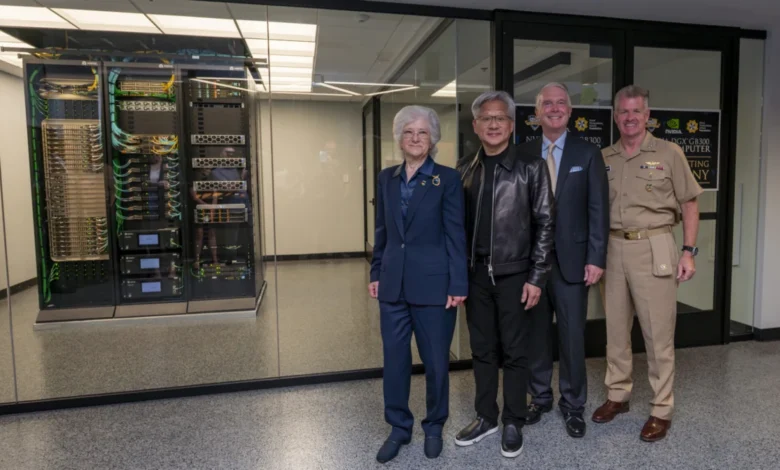
In a move that signals a significant shift in the integration of high-performance computing within the United States military, NVIDIA founder and CEO Jensen Huang visited the Naval Postgraduate School (NPS) in Monterey, California, to officially commission the NVIDIA DGX GB300 supercomputer. This deployment represents a major milestone for the institution, as it brings one of the world’s most advanced artificial intelligence (AI) platforms fully online for use by students, researchers, and faculty at the U.S. military’s flagship graduate university. The commissioning took place during the "Converge @ NPS" event, a three-day symposium designed to foster collaboration between the Department of Defense (DoD), academia, and the private sector.
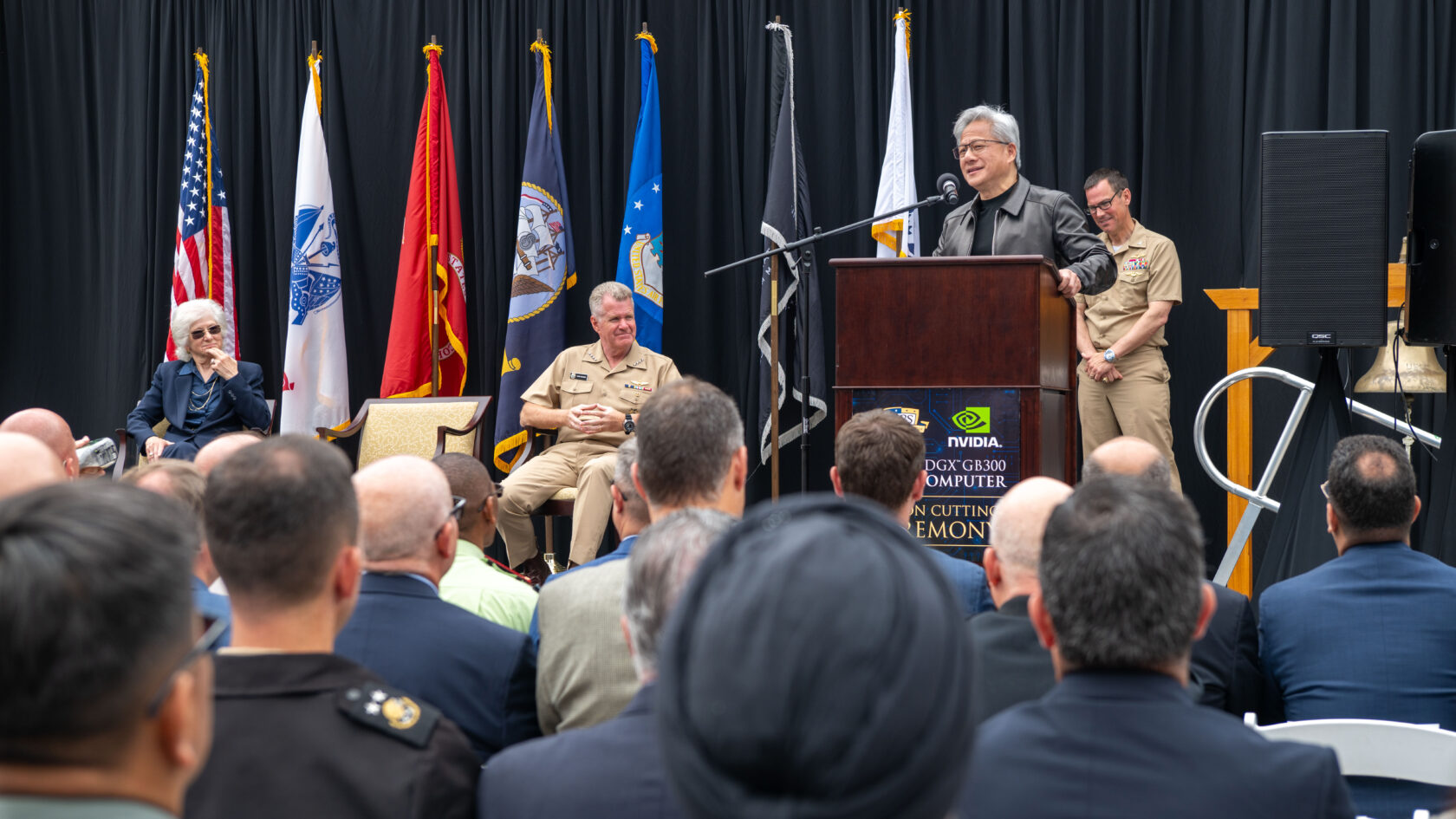
The introduction of the DGX GB300 system at NPS is not merely a hardware upgrade; it is a strategic enhancement of the military’s capacity to process information and generate insights at the speed of modern conflict. Addressing an audience of military leaders, mid-career officers, and international partners, Huang emphasized the critical nature of timely intelligence. "Our nation depends on our men and women who fight on the front lines," Huang stated during the ceremony. "Nothing is more valuable to you than information and insight, and information and insight in a timely way, and to understand its impact and consequence. I can’t imagine anything more important."
A New Era of On-Premises Computational Power
The NVIDIA DGX GB300, powered by the latest Blackwell architecture, represents the pinnacle of AI infrastructure. Unlike standard data center equipment, the DGX GB300 is designed to handle the most demanding generative AI workloads, large-scale model training, and complex simulations. At NPS, this system is paired with NVIDIA Mission Control software, a suite designed to optimize the management of large-scale AI clusters. This combination provides the school’s 1,500 in-resident students and 600 faculty members with unprecedented on-premises access to large-scale AI computing.
The decision to house such a powerful system on-premises is a critical component of the school’s research strategy. While cloud computing offers scalability, on-premises infrastructure allows for the processing of sensitive, classified, or proprietary data within a controlled environment—a necessity for military research. The DGX GB300 will support a wide range of applications, including advanced weather prediction, cybersecurity defense, and disaster resilience planning. These capabilities are essential for the Navy and the broader DoD as they navigate increasingly volatile global environments where traditional modeling often falls short of the precision required for tactical success.
Strategic Collaboration and the Converge @ NPS Event
The commissioning ceremony was a highlight of the three-day Converge @ NPS event, which serves as a nexus for innovation within the defense community. This event marks the latest chapter in a long-standing collaboration between NVIDIA and the Naval Postgraduate School. Central to this partnership is the NVIDIA AI Technology Center (NVAITC) located on the Monterey campus. This dedicated hub serves as a focal point for AI research and graduate instruction, and it is now anchored by the DGX GB300 supercomputer.
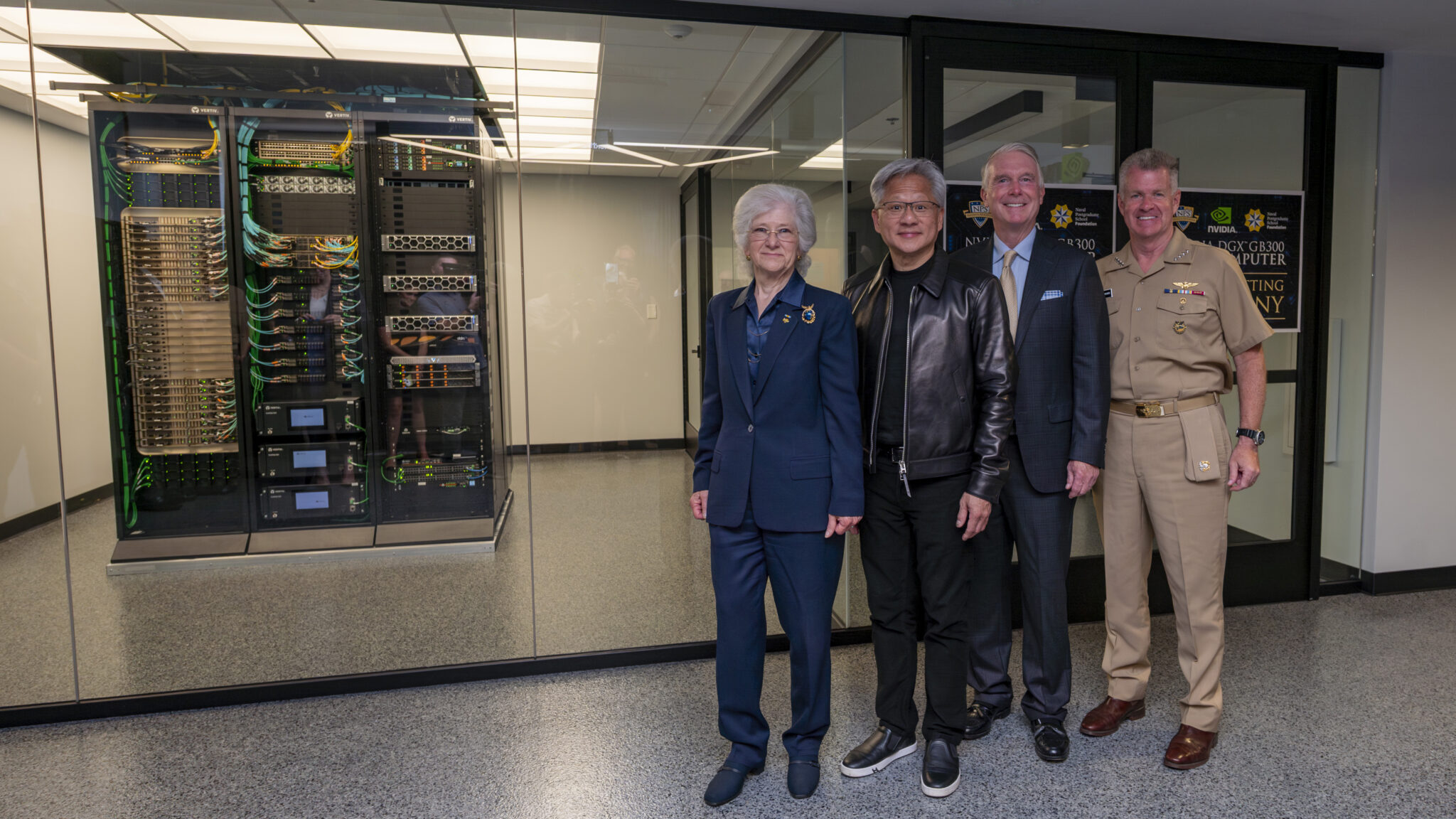
The integration of AI into military education was a central theme of the event. Admiral Samuel Paparo, Commander of the U.S. Indo-Pacific Command, joined Huang to discuss the implications of these technologies for the future of warfare. Admiral Paparo noted that technological modernization must be met with a corresponding evolution in leadership training. "As we modernize our technology, we must also modernize how we educate our leaders," Paparo said. "Access to advanced computing capability means NPS students and faculty understand the opportunities and responsibilities that come with these technologies."
Paparo’s presence at the event underscores the importance of AI in the Pacific theater, where the U.S. military faces sophisticated adversaries and complex geographical challenges. The ability to process vast amounts of sensor data and automate decision-making processes is increasingly viewed as a prerequisite for maintaining a competitive edge in the region.
Training the Next Generation of AI-Literate Leaders
The Naval Postgraduate School is unique in its mission to educate active-duty officers from all branches of the U.S. military, as well as international partners. Its programs span diverse disciplines, including space operations, ocean science, and electrical engineering. By embedding the DGX GB300 into the graduate curriculum, NPS ensures that its graduates are not just consumers of AI technology, but architects of its application in the field.
Jensen Huang addressed the perceived complexity of AI, encouraging students to engage with the technology regardless of their technical background. He noted that the primary goal of AI is to make technology more intuitive and accessible over time. "The most important advice that I would give to someone is to engage the technology," Huang remarked. "It’s not as hard as you think it is, and the reason for that is because, on first principles, technology is supposed to get smarter and smarter over time."
To support this educational mission, NVIDIA has expanded its involvement through the Deep Learning Institute (DLI). By providing instructor toolkits and specialized training to NPS faculty, NVIDIA is helping to weave AI concepts throughout the graduate curricula. This ensures that whether an officer is studying logistics or cyber warfare, they understand how to leverage AI to enhance mission outcomes. Admiral Paparo echoed this sentiment, warning that future commanders will operate in "AI-enabled environments" where information moves at lightning speeds. The goal of the NPS curriculum is to ensure that human leaders remain the ultimate decision-makers, exercising judgment and ethics that machines cannot replicate.
From Digital Twins to Oceanographic Modeling
The practical applications of the DGX GB300 at NPS are already taking shape. The school frequently hosts hackathons and research sprints that tackle real-world problems. With the new supercomputer, these efforts can scale from experimental prototypes to robust, deployable solutions. One of the most promising areas of research involves the creation of "digital twins"—virtual replicas of physical environments or systems.
Through a partnership with MITRE, a nonprofit organization that operates federally funded research and development centers, NPS has developed a framework built on NVIDIA Omniverse libraries. This framework allows researchers to create high-fidelity digital twins of maritime environments, enabling simulations of naval navigation and decision-making under uncertain conditions. These simulations can account for variables such as sea states, atmospheric changes, and adversarial interference, providing a safe and cost-effective way to test new tactics and technologies.
Furthermore, the DGX GB300 will power advanced oceanographic models. Understanding the complexities of the underwater environment is vital for submarine operations and anti-submarine warfare. AI-driven models can process historical and real-time sensor data to predict acoustic conditions and current patterns with a level of accuracy that was previously unattainable.
The Infrastructure Ecosystem: DDN, VAST, and Vertiv
The successful deployment of the DGX GB300 was made possible through a collaborative ecosystem of industry partners. Building a supercomputing cluster of this magnitude requires more than just GPUs; it necessitates a sophisticated architecture of storage, data management, and cooling systems.
DDN (DataDirect Networks) contributed high-performance data infrastructure, ensuring that the DGX GB300 can access and process massive datasets without being throttled by storage bottlenecks. This is particularly important for AI workloads that require high throughput and low latency.
VAST Data provided a unified data platform designed to bridge the gap between edge, core, and cloud environments. This platform ensures that data can be securely managed and moved across different stages of the research lifecycle, from initial collection in the field to intensive processing on the Monterey campus.
The physical infrastructure required to support the DGX GB300 was provided by Vertiv. Given the immense power consumption and heat output of modern AI hardware, Vertiv’s contribution of specialized racks, power distribution units, and liquid cooling systems was essential. Vertiv also provided the technical support for installation, testing, and fluid management, ensuring that the system operates at peak efficiency.

Broader Implications for National Security
The commissioning of the DGX GB300 at the Naval Postgraduate School is a microcosm of a larger trend within the U.S. Department of Defense. As the "Third Offset Strategy" emphasizes the role of AI and autonomous systems in maintaining military superiority, the need for high-performance computing at the tactical and educational levels has become paramount.
This deployment reflects a realization that AI is not a standalone weapon system but a foundational technology that will permeate every aspect of military operations. By placing this power in the hands of graduate students—who are often the same officers who will lead combat units in the coming years—the Navy is fostering a culture of innovation that is both technically grounded and operationally relevant.
The analysis of this event suggests that the partnership between NVIDIA and NPS will serve as a blueprint for other military and government institutions. As AI continues to evolve, the ability to rapidly iterate on models and simulations will become a key metric of national power. The DGX GB300 at NPS represents a significant investment in that future, ensuring that the leaders of the U.S. military are equipped with the tools and the knowledge to "see, understand, decide, and act faster" than any potential adversary.
Related posts: