The Weekly Challenge 391: Merging Arrays and Optimizing Box Stacking Algorithms


The Perl Weekly Challenge, a community-driven initiative that invites programmers to solve algorithmic problems using Perl and Raku, recently released its 391st edition. This installment focused on two distinct computational puzzles: the calculation of a median from two pre-sorted arrays and the determination of the maximum nesting depth for a collection of dimensional boxes. These challenges highlight common data structure manipulation problems, requiring developers to balance algorithmic efficiency with code readability and maintainability.
The Median Problem: Computational Complexity and Optimization
The first task presented to participants involved merging two already-sorted arrays and identifying the median value. In statistical computing, the median represents the middle value of a sorted data set. When two sorted arrays are provided, the most straightforward approach is to combine the datasets into a single array, re-sort the combined collection, and locate the midpoint. However, this brute-force method ignores the inherent order of the input, leading to unnecessary computational overhead.
From a performance perspective, simple concatenation followed by a full sort results in a time complexity of O(N log N). In contrast, developers can leverage the fact that the source arrays are already sorted to implement a "merge" step, similar to the logic used in merge sort algorithms. By utilizing two pointers or indices—one for each array—a single pass through the data can identify the median in O(N) time.
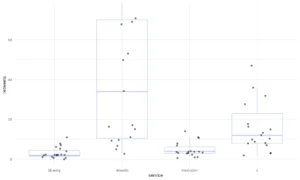
Benchmarking results within the community have demonstrated significant performance disparities between these approaches. While native Perl sorting is highly optimized, manual iteration through arrays can be significantly faster for large datasets. Comparative testing of various methods, including the use of statistical modules like Statistics::Basic::Median and PDL (Perl Data Language), indicates that specialized libraries offer convenience at the cost of slight performance overhead, whereas custom, low-level implementations provide the highest throughput.
The Box Stacking Challenge: Combinatorial Optimization
The second task of the week involved finding the maximum number of boxes that can be nested within one another. For a box to be considered "nested," it must possess both a smaller width and a smaller height than the outer container. This problem is a classic example of a "Longest Increasing Subsequence" variant, often solved through dynamic programming or depth-first search (DFS) algorithms.
The complexity of the box-stacking problem arises from the multi-dimensional nature of the constraints. Unlike a one-dimensional sequence, boxes present a two-variable constraint system. The task requires developers to create a robust model to evaluate potential stack configurations. Many participants opted to define a "Box" class, encapsulating width and height attributes to simplify the comparison logic. This object-oriented approach improves code clarity, allowing the logic to focus on the canHold method, which returns a boolean value based on the dimensions of two compared objects.
To solve the nesting puzzle, developers must navigate a search space of possible configurations. By employing a breadth-first search (BFS) or a depth-first search (DFS) with pruning—discarding paths that cannot mathematically exceed the current maximum stack found—the algorithm effectively traverses the solution space. The primary challenge remains the potential for an exponential increase in possibilities as the number of boxes grows, necessitating efficient pruning to ensure the script completes in a reasonable timeframe.
Chronology of Algorithmic Development
The evolution of these programming challenges reflects broader trends in software engineering, where the focus has shifted from mere functionality to algorithmic efficiency and resource management. Historically, early programming tasks prioritized simple solutions. Today, as the Weekly Challenge series approaches its 400th installment, participants are increasingly tasked with considering memory allocation, garbage collection, and the impact of object-oriented overhead on runtime performance.

The 391st edition followed a standard release cycle:
- Announcement: The problem set was released to the community, inviting submissions in various languages, though primarily focusing on Perl and Raku.
- Community Review: Participants submitted their solutions, providing a diverse look at how different developers approach the same logic.
- Benchmarking and Optimization: Peer review highlighted the importance of avoiding redundant sorting operations.
- Documentation: Final solutions were compiled and shared, serving as a repository for best practices in array merging and recursive search algorithms.
Data Analysis and Performance Implications
The importance of these exercises extends beyond the specific problems presented. Efficient array merging is a fundamental requirement in database management, where large, sorted indexes must be combined to return query results. Similarly, the box-stacking algorithm is a simplified model of logistics and packaging optimization, where reducing the volume of shipping containers is a critical business metric.
In the case of the median task, the data shows that "DIY" (do-it-yourself) sorting algorithms, when optimized for already-sorted inputs, outperform most off-the-shelf statistical libraries. The performance gap, sometimes reaching upwards of 200% in execution speed, underscores the reality that general-purpose libraries often contain overhead that is not required for specific, high-frequency operations.
In the box-stacking task, the use of a formal class structure—while slightly slower in terms of memory footprint compared to raw array indices—provides significant benefits in terms of debugging and future-proofing. In professional environments, code maintainability is often prioritized over micro-optimizations, provided the solution remains within acceptable latency limits.
Industry Impact and Broader Context
The Perl community, while smaller than it was in the early 2000s, remains a critical hub for high-performance text processing and system administration tooling. The Weekly Challenge serves as an educational bridge, training the next generation of developers to think about complexity classes and memory usage.
Experts in the field note that these types of challenges are highly indicative of technical interview assessments used by major tech firms. The ability to distinguish between an O(N log N) solution and an O(N) solution is a standard benchmark for assessing a candidate’s readiness for engineering roles. By engaging with these problems, developers hone the analytical skills required to identify bottlenecks in larger systems.
Furthermore, the integration of statistical packages like PDL in the solutions shows how modern Perl developers leverage high-performance C-bindings for numerical analysis. This hybrid approach—writing core logic in Perl while delegating heavy numerical lifting to optimized C libraries—is a cornerstone of high-performance computing in the language.
Conclusion
The Weekly Challenge 391 demonstrates that even simple tasks regarding sorting and object nesting offer deep insights into software architecture. Whether one is optimizing a median calculation by avoiding redundant re-sorts or efficiently navigating a search tree to maximize box stacking, the fundamental lessons remain consistent: understand the input data, recognize the constraints, and choose the abstraction level that best balances performance with readability. As the community moves toward its 400th edition, the focus on these core algorithmic principles continues to provide a vital service for developers seeking to master the craft of programming. The insights gained from such exercises serve not only as a solution to a specific prompt but as a roadmap for developing robust, scalable, and efficient software in professional environments.