Navigating the Post-Twitter Landscape: Martin Fowler Analyzes Social Media Engagement and Website Traffic Dynamics Across Platforms

The modern digital publishing landscape has undergone a profound structural transformation over the past two decades, shifting from centralized blogging networks and open web syndication to a fragmented ecosystem dominated by corporate social media silos. For prominent software engineer, author, and international speaker Martin Fowler, the challenge of distributing technical content has mirrored these broader macroeconomic and technological shifts. Since first adopting Twitter in 2008 as a primary broadcast channel for new articles published on martinfowler.com, Fowler has maintained a continuous social media presence to alert his readership to newly released software architecture and development insights. However, the systemic changes that followed major industry acquisitions—specifically the 2022 acquisition of Twitter by Elon Musk, commonly referred to in the tech community as the "muskover"—fundamentally fractured the microblogging space.
In response to this fragmentation, digital publishers have been forced to diversify their distribution strategies to reach audiences scattered across newly minted platforms. For Fowler, this operational necessity resulted in a quadrupling of his administrative overhead. Announcements that were once consolidated onto a single platform must now be manually cross-posted across four distinct networks: LinkedIn, X (formerly Twitter), the decentralized Fediverse via Mastodon, and Bluesky. While copy-pasting and slightly tweaking announcements across multiple interfaces is a relatively low-friction routine, it highlights a broader industry trend where independent creators must expend disproportionate labor to navigate a balkanized digital public square. Despite maintaining these active channels, Fowler continues to emphasize that traditional, open web syndication protocols such as RSS feeds remain the most efficient and reliable method for followers to consume his work without algorithmic interference.
Quantitative Analysis of Multi-Platform Engagement
To evaluate the return on investment for this multi-platform distribution strategy, publishers frequently audit analytics to determine where audience interaction is highest. Fowler recently conducted a comprehensive empirical review of his social media engagement metrics, analyzing a dataset spanning 19 individual posts published between June 16 and September 6, 2026. By examining three core engagement metrics—retweets (or platform equivalents), likes, and direct replies—the analysis sought to establish a definitive hierarchy of platform effectiveness.
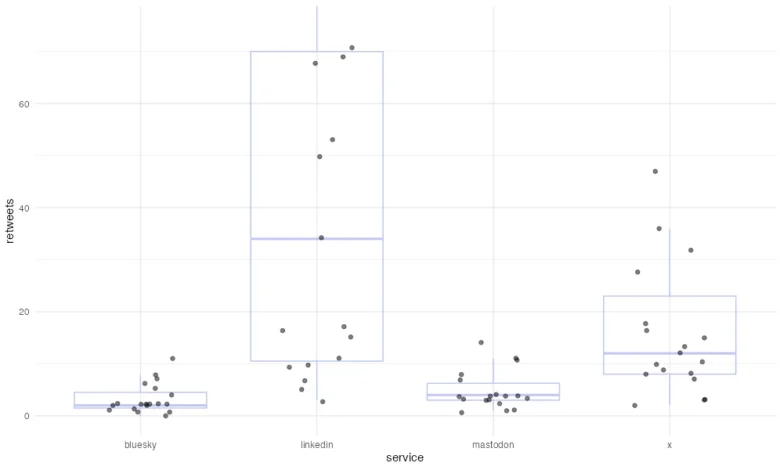
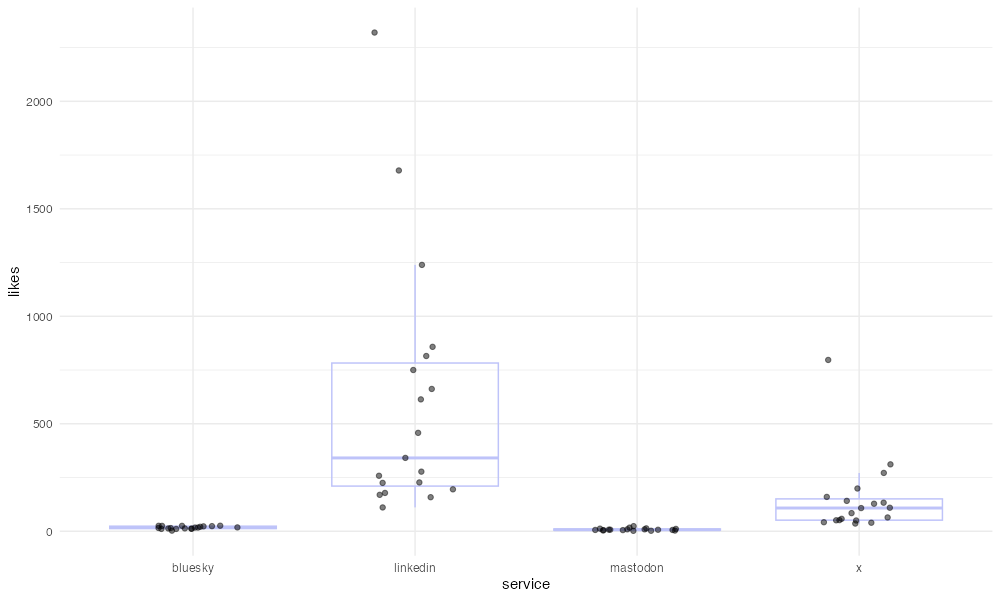
Rather than relying on simple arithmetic averages, which statistical experts frequently criticize for masking underlying data distributions and creating misleading summaries, Fowler utilized a combined visualization technique. Integrating strip charts—which display individual data points with horizontal jitter to prevent overlapping—alongside traditional box plots illustrating medians and interquartile ranges, the study mapped the complete distribution of user interactions. This methodological rigor ensures that extreme outliers do not skew the interpretation of typical platform performance.
The resulting data reveals a stark hierarchy of user engagement across the four networks. LinkedIn emerged as the definitive leader, commanding the highest volume of interactions across all measured categories. To assess the quality of engagement rather than passive endorsement, Fowler isolated retweet metrics—a metric heavily weighted toward content recommendation—while trimming upper statistical outliers to focus on core behaviors. The resulting granular data demonstrated that LinkedIn holds a commanding lead, with X securing a distant second place. Notably, the upper quartile of engagement on X fell below the median engagement observed on LinkedIn. Meanwhile, decentralized alternatives Bluesky and Mastodon recorded remarkably low interaction volumes, with their upper quartiles sitting comfortably below the lower quartile of X, though Mastodon maintained a slight, visible edge over Bluesky.
Strategic Dilemmas: Open Standards Versus Proprietary Reach
The stark disparity in engagement raises fundamental strategic questions for independent publishers and technical thought leaders. A purely utilitarian approach focused strictly on audience reach and interaction metrics would suggest an immediate cessation of publishing efforts on low-yield platforms like Bluesky and Mastodon. Expending operational energy on networks that generate negligible user response appears, on paper, to be an inefficient allocation of resources.
However, content distribution strategies are frequently driven by philosophical commitments as much as quantitative metrics. Fowler confirmed his intention to continue broadcasting across Bluesky and Mastodon despite their low yields, citing a fundamental preference for open, decentralized platforms over the proprietary, algorithmic walled gardens represented by LinkedIn and X. This decision underscores a broader ideological friction within the modern technology sector. While corporate platforms offer immediate network effects, massive user bases, and high commercial engagement, they expose creators to the unilateral whims of algorithmic changes, corporate policy shifts, and monetization pressures. Conversely, open protocols and decentralized networks align more closely with the foundational ethos of the early web, even if they currently lack the critical mass required for mainstream audience engagement.
Website Traffic Correlation and Search Engine Dominance
While social media engagement provides immediate feedback on content resonance, the ultimate objective of publishing promotional posts is to drive qualified referral traffic back to the primary domain. An examination of website analytics covering a 90-day period leading up to September 7, 2026, provides critical context regarding how social media platforms actually contribute to the top of the content funnel.
Traffic source analytics closely mirror the social engagement hierarchy observed in platform-specific metrics. LinkedIn leads the social referral category, outperforming X by a measurable margin, which in turn dwarfs the traffic contribution originating from Bluesky. Due to technical limitations within the analytics tracking parameters, Mastodon traffic remained statistically negligible, aligning with its low engagement profile.
Yet, when contextualized against the broader web ecosystem, social media referral traffic emerges as a surprisingly minor contributor to overall site readership. Even top-performing platforms like LinkedIn pale in comparison to traditional organic search engines. Google alone accounted for approximately 300,000 visits during the evaluated 90-day window. Furthermore, search engine traffic itself represents only a fraction of martinfowler.com’s total operational scale, which recorded an impressive 1.7 million aggregate visits over the same three-month period. Direct navigation, bookmarking, and RSS feed syndication continue to drive the vast majority of enterprise and professional readership, proving that direct audience retention often bypasses social media intermediaries entirely.
Longitudinal Shifts: A Year-Over-Year Comparative Analysis
A longitudinal evaluation of these publishing patterns reveals shifting user behaviors and platform trajectories across the broader digital landscape. By comparing the 2026 engagement distributions with historical baseline data collected in early 2025, analysts can map the shifting fortunes of competing social networks.
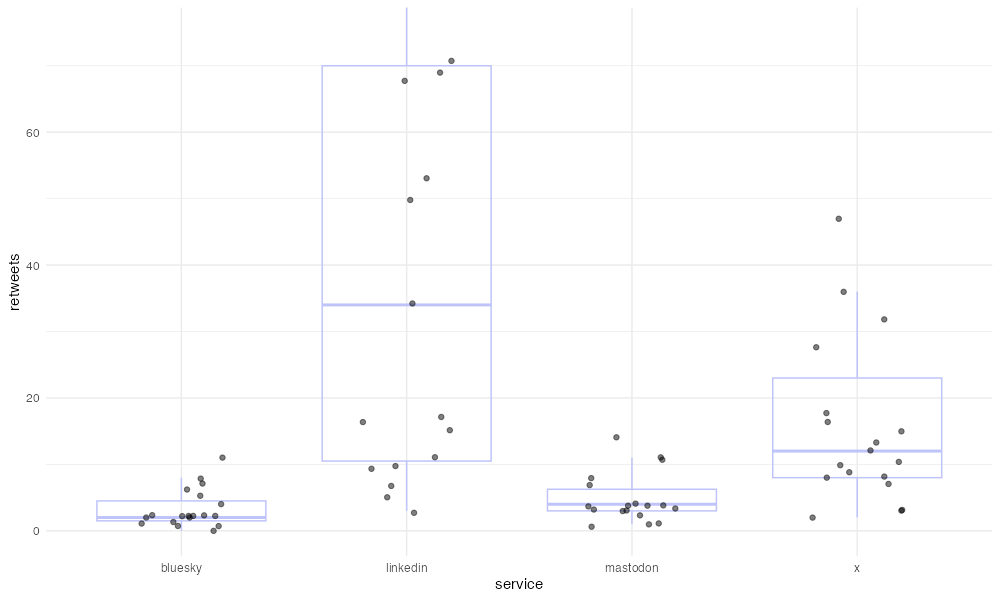
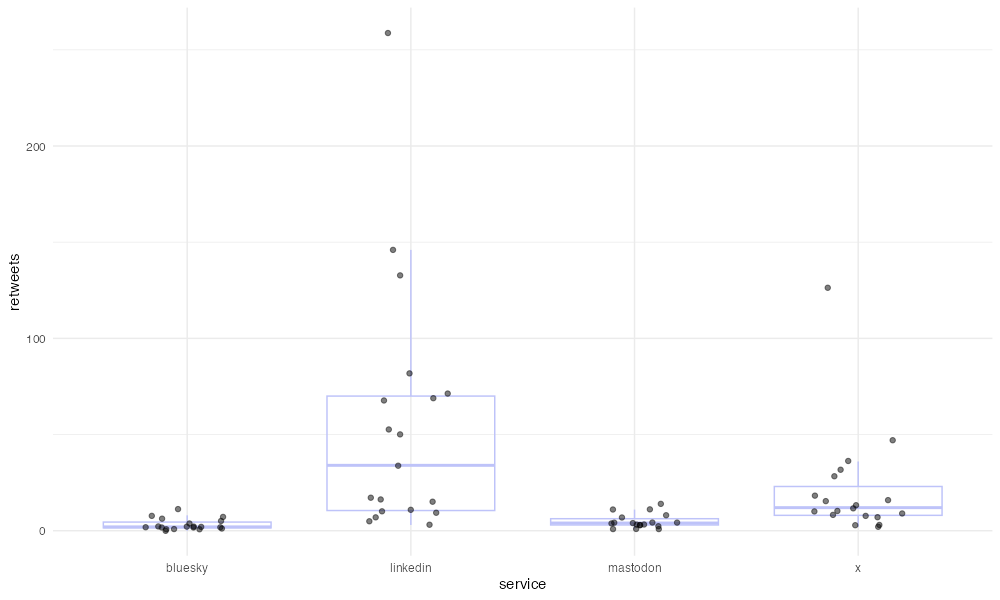
The comparative box plot analysis of retweets between mid-2026 and early 2025 highlights three distinct trends:
- LinkedIn has demonstrated modest, steady growth, cementing its status as the premier professional networking and content distribution channel.
- X has experienced a notable, measurable decline in user engagement for technical content compared to previous baseline periods.
- Bluesky has suffered a dramatic drop in interaction volume, contrasting sharply with the initial enthusiasm and migration spikes that followed its post-launch growth phase.
These shifts illustrate the volatile nature of the modern social media ecosystem. As platforms rise and fall in public favor, independent creators are forced into a state of perpetual adaptation. For software engineering professionals and digital publishers alike, the data serves as a sobering reminder: while social media platforms serve as necessary megaphones in a fragmented digital age, their long-term reliability fluctuates wildly, reinforcing the enduring value of foundational, open-web publishing mechanisms like RSS feeds and direct domain ownership.