The Evolution of Information Retrieval
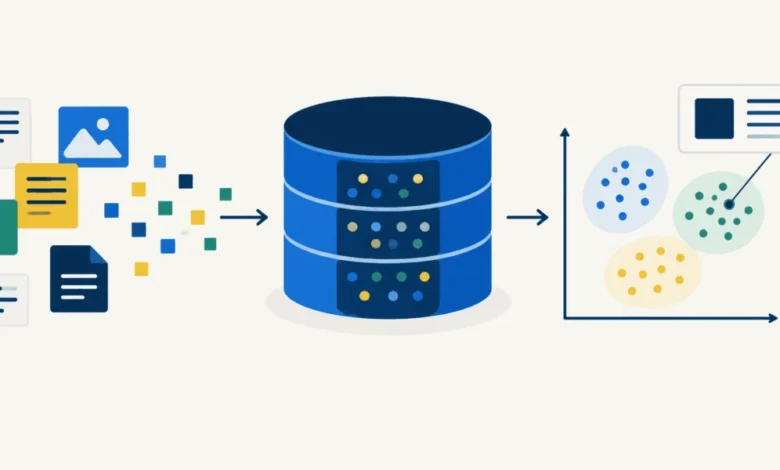
Traditional databases, which rely heavily on keyword-based indexing (SQL and NoSQL systems), operate on exact string matching or boolean logic. If a user searches for "energy supply in biological systems," a standard database might fail to retrieve relevant documents if the specific phrase "mitochondria" is not present in the user’s query or the document index. Vector databases address this by representing text as dense vectors—arrays of numbers that capture the semantic meaning of the content.
The shift toward vector-based search has been propelled by the rise of Large Language Models (LLMs) and transformer architectures. By converting text into embedding space, these databases allow for "fuzzy" or semantic searching, where the distance between a query vector and a document vector in multi-dimensional space determines the relevance of the results. This transformation of natural language into mathematical coordinates has revolutionized recommendation engines, retrieval-augmented generation (RAG) pipelines, and intelligent search systems.
Step-by-Step Implementation Framework
The process of building a vector database from scratch involves a ten-step lifecycle that balances data ingestion, indexing, and retrieval efficiency.
- Environmental Setup and Dependencies: To begin, developers require a workspace equipped with NumPy for numerical operations and the Sentence-Transformers library for generating embeddings. The initial setup involves defining utility functions to handle data visualization—specifically, a
show()function to display search results with scores and anheader()function to organize the output. - Indexing the Corpus: The second step focuses on transforming raw text into an indexed format. By passing a corpus of documents through an embedding model, the system converts every document into a fixed-length vector (e.g., 384 dimensions). A crucial aspect of this stage is that the resulting index size is independent of document length; whether a document is a short sentence or a long essay, it occupies the same fixed space, ensuring predictable memory usage.
- Executing Initial Queries: Once the index is populated, searching becomes a matter of calculating the vector distance between the query and the stored documents. In this implementation, top results are returned based on their similarity score.
- Semantic Capability Verification: The true power of the vector approach is highlighted when queries return results that share zero common words with the input. By matching based on underlying concepts, the system can resolve queries like "why does my loaf taste sour" by surfacing results related to fermentation and lactic acid, even if those specific keywords were absent from the query.
- Score Interpretation: In a production environment, similarity scores must be calibrated. A vector database will always return results if requested, but developers must implement a score threshold to filter out irrelevant matches that happen to be the "least bad" options in a sparse index.
- Metadata Filtering: Advanced retrieval requires narrowing results using categorical data. By passing a
whereclause during the search, the system ignores irrelevant document clusters before the ranking phase, significantly increasing precision. - Refining Search Constraints: When a filter is more restrictive than the number of requested results (k), the system must gracefully handle the discrepancy without returning false positives, ensuring that metadata integrity is maintained throughout the search cycle.
- Implementation of Guard Rails: Error handling is essential for production-grade systems. Developers must ensure that inputs (texts and metadata) are perfectly synchronized. Mismatched lengths or data types can lead to "silent corruption," where the index becomes misaligned with its source data.
- Persistence Strategies: Saving the index is managed by decoupling the vector data (stored in compact
.npyfiles for efficient loading) from the text/metadata (stored in human-readable.jsonfiles). This approach ensures that the index can be reloaded and queried instantly without the need to re-encode the entire corpus. - Scalability and Performance Analysis: The final step involves measuring latency. As the dataset grows from 25 to 100,000 documents, the computational cost of scanning the index remains relatively low. For instance, scanning 100,000 vectors takes only a few milliseconds, demonstrating why this architecture is highly efficient for enterprise-level applications.
Technical Implications and Industry Impact
The underlying mathematics of this system—specifically the use of normalized vectors to turn dot products into cosine similarity—highlights the elegance of vector databases. By scaling vectors to a length of 1, the system simplifies the ranking process into a single matrix multiplication. This is a significant optimization that allows for rapid retrieval even as the document count scales into the millions.
The primary implication for the industry is that the core logic of a vector database is relatively lightweight. While commercial vendors offer valuable services such as distributed hosting, real-time index updates, and advanced filtering, the underlying "brain" of the operation is essentially a high-performance linear algebra engine.
Future Perspectives
As organizations continue to integrate RAG into their workflows, the demand for custom-built or specialized vector solutions is expected to rise. The ability to control the index structure, the embedding model, and the filtering logic provides developers with a competitive advantage, particularly in industries requiring strict data privacy or domain-specific semantic understanding.
This tutorial series serves as a reminder that understanding the "how" behind machine learning infrastructure is vital. While high-level APIs provide convenience, the ability to build and debug a vector database from scratch offers deep insights into the trade-offs between accuracy, speed, and storage that define modern artificial intelligence. For those seeking to further their expertise, exploring the integration of approximate nearest neighbor (ANN) algorithms—such as HNSW or IVF—will be the logical next step after mastering the fundamental exhaustive search implemented here.