AWS Emulator and Cloud Infrastructure Updates Signal a Shift Toward Localized Development and Granular Security

The recent introduction of the AWS Emulator marks a significant pivot in how developers interact with cloud services, shifting the paradigm from cloud-dependent testing to a localized, iterative workflow. By allowing developers to simulate AWS API interactions directly on local machines or within CI/CD environments, Amazon is addressing long-standing friction points related to cloud provisioning costs and development latency. This launch, coupled with a series of updates across the AWS ecosystem—including hardware-level sandboxing, enhanced token exchange protocols, and disaster recovery automation—underscores a broader industry trend toward increasing developer autonomy and infrastructure security.
The Emergence of Localized Cloud Simulation
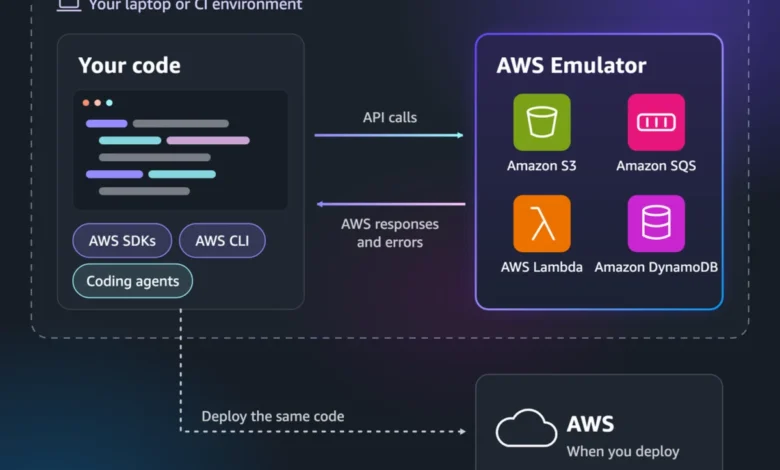
For years, the "happy-path" demo—a perfectly orchestrated sequence of events—has masked the complexities of building robust cloud applications. Developers have historically relied on provisioning live AWS resources for even the most trivial testing scenarios, resulting in unnecessary costs and extended feedback loops. The AWS Emulator fundamentally changes this by providing a local HTTPS endpoint that accepts standard AWS SDK and CLI calls.
The technical architecture of the emulator is designed for high compatibility, allowing developers to point their existing infrastructure-as-code tools at a local socket rather than a remote cloud endpoint. This environment supports common operations such as Amazon DynamoDB table creation, item manipulation, and data retrieval. By decoupling the development phase from the cloud environment, teams can now perform rapid testing without incurring service fees or navigating the latency inherent in remote API calls.
However, it is critical for engineering teams to recognize the limitations of this tool. Because the emulator does not currently replicate IAM (Identity and Access Management) policies, resource-level security enforcement, or cross-region behaviors, it is intended as a high-fidelity development companion rather than a replacement for final production-stage testing. Developers must continue to validate security configurations and cross-account permissions within the actual AWS environment before deployment.
Hardware Isolation and the Rise of Nitro Sandboxes
Parallel to the push for localized development, AWS has introduced Nitro Sandboxes, which provide a hardware-level isolation layer for Amazon EKS pods and Amazon ECS tasks. This update addresses the growing demand for multi-tenant isolation, particularly in environments where agents are tasked with executing generated code or managing sensitive workloads.
By leveraging the underlying Nitro system, these sandboxes offer two distinct operational modes: isolated and confidential. Isolated mode enforces a boundary between workloads sharing the same EC2 instance, while confidential mode introduces cryptographic attestation, ensuring that even node operators cannot access the data being processed. This innovation is particularly relevant for organizations operating under strict compliance frameworks where the logical separation of processes is insufficient to meet regulatory standards. The integration into EKS and ECS is seamless, requiring no additional costs beyond standard instance pricing, thereby lowering the barrier for enterprises to adopt high-assurance security architectures.
Enhancing Agent-Based Workflows and Delegation
As the adoption of AI coding agents accelerates, the mechanisms for secure delegation and feedback have become critical. Amazon’s recent support for OAuth 2.0 token exchange within Amazon Cognito is a direct response to this need. Developers can now exchange a primary user token for a downstream-scoped token that carries narrower permissions and specific audience constraints.
This feature introduces the "act" claim, which formally identifies the intermediary agent when calling backend services on a user’s behalf. This explicit delegation model mitigates security risks associated with over-privileged tokens and simplifies the audit trail for complex, multi-step agentic workflows. By integrating these delegation capabilities into the Cognito identity lifecycle, AWS is enabling more sophisticated, agent-driven architectures that maintain strict security postures without sacrificing usability.
Data Management and Disaster Recovery Advancements
Operational resilience remains a cornerstone of the AWS product roadmap. Recent updates to Amazon OpenSearch Service and Amazon ElastiCache reflect a maturation of managed services designed to simplify complex operational tasks.
The introduction of managed cross-region disaster recovery for OpenSearch Service (version 3.7 and later) provides a structured path for maintaining business continuity. With AWS committing to a recovery point objective (RPO) of under one minute and a recovery time objective (RTO) of under 20 minutes, organizations can now execute planned switchovers with minimal data loss. While these features are automated, they place a residual responsibility on the infrastructure team to ensure that domain configurations remain synchronized across regions, necessitating a shift in how disaster recovery planning is documented and tested.
Simultaneously, the update to Amazon ElastiCache Serverless—enabling the integration of vector, full-text, and hybrid search with server-side aggregations—positions the service as a robust solution for real-time, agent-memory retrieval. By performing aggregations on the server side using Valkey 9, developers can reduce the computational burden on application logic, which is essential for low-latency recommendation engines and product discovery features.

Organizational Efficiency and Cost Optimization
The evolution of Amazon Bedrock and Amazon CloudWatch also highlights an organizational focus on efficiency. The new default AgentCore runtime for Bedrock agents offers a significant leap in performance, with start-up times reduced to under two seconds and improved memory scaling. By transitioning to a more efficient microVM architecture, these agents can now scale to zero during idle periods, significantly reducing operational overhead for infrequent or bursty workloads.
Complementing these infrastructure efficiencies, Amazon has introduced account-level retention policies for CloudWatch Logs. This allows platform teams to enforce global governance standards for log data, ensuring that security-critical logs are preserved across all log groups without the need for manual, per-group configuration. This reduction in administrative toil is a minor but impactful change for enterprises managing thousands of microservices, where maintaining consistent logging standards has historically been a source of drift and non-compliance.
Broader Implications for the Development Lifecycle
The cumulative effect of these updates is a more cohesive, high-velocity development ecosystem. The industry is clearly moving toward a model where "cloud-native" no longer implies a total dependence on cloud connectivity during the coding phase. Instead, developers are being equipped with local mirrors of cloud behavior, hardware-grade security boundaries, and more granular control over identity and delegation.
For architects and engineering leads, the challenge remains the integration of these disparate tools into a unified pipeline. The focus must remain on measuring the return on investment for these implementations. As noted in recent guidance on Amazon Bedrock, organizations should focus on the cost-per-task, comparing agent performance against established, human-driven baselines.
As the AWS ecosystem continues to evolve, the distinction between development and production environments will become increasingly transparent. Tools like the AWS Emulator and Nitro Sandboxes are not merely convenience features; they represent a fundamental change in how software is engineered, tested, and secured at scale. By reducing the reliance on constant remote connectivity and providing more granular control over the execution environment, AWS is positioning itself to support the next generation of AI-augmented development and high-performance computing.
Looking forward, the upcoming re:Invent conference in Las Vegas is expected to provide further clarity on how these tools will integrate into the broader AI-driven development roadmap. As developers digest these recent changes, the emphasis will undoubtedly shift toward standardizing these new patterns—idempotent modules, configuration-driven workflows, and automated disaster recovery—across the entire enterprise architecture.