Optimizing Latency and Accuracy for Clinical AI Chatbots in Enterprise Environments

The pursuit of low-latency artificial intelligence in sensitive fields like healthtech presents a complex engineering paradox: how to deliver instantaneous, human-like interaction without compromising the rigorous clinical accuracy required for patient-facing applications. In modern software architecture, the "Time to First Token" (TTFT)—the interval between a user’s query and the moment the AI begins rendering its response—has become the primary metric for perceived speed. However, for engineers developing chatbots that interface with private, high-stakes medical knowledge bases, prioritizing speed at the expense of retrieval discipline or logical grounding can lead to critical failure.
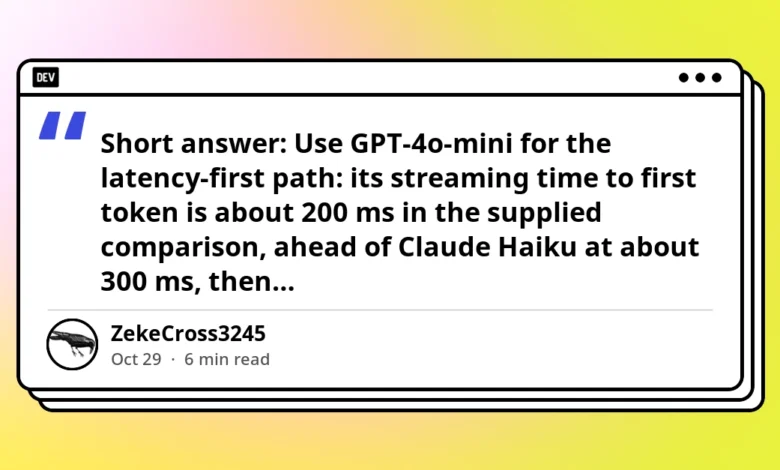
Current industry standards indicate that for a responsive user interface, the initial token must arrive within 200 to 300 milliseconds. If the delay exceeds this window, the user experience deteriorates, often leading to interface abandonment. Data from recent performance benchmarks place GPT-4o-mini at the forefront of this latency race, with a recorded TTFT of approximately 200 milliseconds. Claude Haiku follows at roughly 300 milliseconds, while Google’s Gemini Flash remains a competitive contender currently undergoing widespread empirical evaluation. Despite these metrics, the consensus among systems architects is that speed is only one variable in a broader equation that must include retrieval accuracy, authorization compliance, and prompt-length management.
The Anatomy of a Latency-Sensitive Workflow
The technical challenge lies in the fact that TTFT is not an isolated event; it is the culmination of a multi-stage pipeline. When a user inputs a query, the system must perform a series of back-end tasks: it must authorize the user, retrieve relevant documents from a private knowledge base, construct a context-aware prompt, manage model queueing, and finally, generate the response.
In a healthcare setting, the risk is not merely technological but clinical. If a model generates a rapid, low-latency greeting but fails to ground its subsequent advice in the specific, authorized medical policy documents, the speed of the interface becomes irrelevant. The primary risk is the "fast hallucination," where a model provides an immediate but incorrect or unverified clinical interpretation. To mitigate this, engineers are increasingly adopting "disciplined retrieval" strategies. This involves strictly bounding the retrieved context—ensuring the model only sees authorized information—and implementing token-counting protocols before the request is dispatched to the model.
By counting tokens before the request reaches the LLM, developers can create a visible trade-off between prompt size and latency. If a prompt is excessively large, it risks pushing the response time beyond the acceptable threshold. Consequently, treating prompt length as a structural constraint rather than an afterthought allows for more predictable performance in production.
Comparative Analysis: Choosing the Right Model
Selecting an LLM is no longer a matter of choosing the most powerful or "smartest" model, but rather identifying the most appropriate tool for a specific operational context. The current hierarchy of models for chat-based, latency-sensitive applications is defined by a balance between the speed of the first token and the quality of the ensuing reasoning.
The following table summarizes the strategic positioning of the current leading models in production environments:
| Model Option | Performance Characteristic | Strategic Application | Operational Boundary |
|---|---|---|---|
| GPT-4o-mini | ~200ms TTFT (Fastest) | Default for standard latency-sensitive chat | Requires validation of clinical answer quality |
| Claude Haiku | ~300ms TTFT (Balanced) | Ideal for complex queries requiring higher reasoning | Used when quality outweighs minor latency gains |
| Gemini Flash | Variable/Unverified | Future candidate for benchmarking | Pending standardized latency benchmarks |
While GPT-4o-mini offers a clear advantage in raw speed, developers must not treat this as a license to disregard clinical safety. The 100-millisecond difference between GPT-4o-mini and Claude Haiku may be critical for a fluid UI, but if the faster model requires a second, follow-up clarification turn from the user due to a lack of precision, the net user-experience benefit is lost.
Operational Infrastructure and the Role of APIs
The infrastructure layer—specifically how applications connect to AI providers—is increasingly shifting toward abstracted, unified interfaces. Utilizing a REST API or a consolidated service layer, such as Infrai, allows development teams to manage multiple AI capabilities through a single credential and billing framework.
For many healthtech firms, the administrative overhead of managing disparate provider accounts, SDK versions, and compliance audits for each model is a significant burden. By consolidating these routes, a team can shift its workflow between models—for instance, switching from GPT-4o-mini to Claude Haiku for more sensitive diagnostic queries—without rewriting the entire application integration.
However, this abstraction is not without its pitfalls. Configuration errors, such as the duplication of version prefixes in URL paths or mismanaged environment variables, often result in "latency incidents" that appear to be model-level issues but are, in fact, simple infrastructure errors. Furthermore, for organizations with strict compliance requirements, the use of an intermediary platform may complicate security audits. In such cases, direct vendor integration remains the industry standard, despite the added complexity of managing multiple client libraries.
Implementing a Production Rollout Strategy
To successfully integrate these models, a systematic, two-week rollout strategy is recommended. During this window, developers should subject the system to a series of de-identified, representative queries. The evaluation criteria must include:
- TTFT and Full-Answer Latency: Measuring the total time for the response to be completed.
- Retrieval Hit Quality: Assessing whether the model correctly identified and utilized the provided private knowledge-base snippets.
- Reviewer Judgments: Using clinical staff to score the faithfulness of citations, the appropriateness of refusal behavior, and the model’s ability to handle scenarios where the context is missing.
The objective is to establish a "quality floor." If a specific class of medical inquiry cannot be answered with sufficient accuracy by the fastest model, the system must be architected to dynamically route that query to a more capable, albeit slower, model. This "conditional routing" is the hallmark of a mature, production-grade AI system.
The Limits of Current AI Readiness
It is imperative to distinguish between the maturity of text-based chat and other AI functionalities. While streaming chat is highly optimized, other capabilities—such as audio transcription, real-time voice interaction, and automated content moderation—are still in early stages of deployment within these architectures.
For instance, relying on a chat model to perform moderation via a JSON-schema fallback is a stopgap measure, not a replacement for dedicated moderation infrastructure. Combining these disparate services under a single, high-speed umbrella can lead to a false sense of security. As of the current development cycle, text-based knowledge retrieval is the only area where latency and accuracy have reached a sufficient level of synergy for widespread clinical implementation.
Conclusion: The Future of Latency-Optimized AI
The push for "fast" AI in healthcare is not a pursuit of speed for speed’s sake. It is a fundamental requirement for the adoption of AI in the clinical workflow. If a clinician or patient is forced to wait for an interface to "think," the cognitive flow is broken, and the utility of the tool diminishes.
However, as the industry matures, the focus must shift from the "leaderboard" mentality—which often fixates on raw, uncontextualized metrics—to a more nuanced, system-based approach. The future of the field lies in the ability to deliver high-quality, verified, and authorized information within the narrow window of human attention. By rigorously defining the relationship between prompt complexity, model selection, and user-interface constraints, developers can build systems that are not only fast but fundamentally reliable.
In the final analysis, latency is a product feature, but correctness and clinical scope are system properties. The most successful implementations will be those that accept that "fast" is always conditional, and that the ultimate success of an AI deployment is measured by the quality of the outcome, not just the speed of the first token. Through careful benchmarking, disciplined prompt engineering, and a focus on modular, secure architecture, the promise of the responsive, intelligent clinical assistant is well within reach. The challenge moving forward remains the integration of these models into more complex, multi-modal workflows while maintaining the strict safety standards that the healthcare industry demands.