A Breakthrough in Non-Destructive Quantum Measurement: Researchers Reveal Self-Signaling Qubits That Could Simplify Quantum Computing

In the race to build scalable, fault-tolerant quantum computers, scientists have continually confronted a foundational paradox: to harness the immense computational power of qubits, one must eventually read the data they hold. Yet, the very act of measurement frequently collapses the delicate quantum states required for computation, erasing the information in the process. Traditional methods to bypass this dilemma involve complex architectures using auxiliary components, adding layers of hardware and vulnerability to error.
Now, a collaborative international team of physicists has proposed a radically streamlined approach. By utilizing a specialized class of components known as Andreev qubits, researchers have shown that a quantum bit can generate its own internal electrical signature—an oscillating supercurrent—allowing scientists to read its state without direct, destructive interference. Published in Physical Review B Letters, the study marks a significant theoretical step forward in minimizing hardware complexity while preserving quantum data integrity.
The Measurement Dilemma and the Limits of Ancilla Qubits
To understand the magnitude of this breakthrough, one must examine the baseline mechanics of quantum versus classical computing. Ordinary computers rely on bits that process data strictly as either a 0 or a 1. These classical bits can be measured repeatedly without altering their values. Quantum computers, conversely, exploit superposition, permitting qubits to exist simultaneously in combinations of 0 and 1. This multi-state capability endows quantum systems with exponential processing potential, but it introduces extreme fragility.
When a standard projective measurement is applied to a qubit in superposition, the wave function collapses. The system abruptly assumes a single definite state, permanently erasing the complex probabilities that made the calculation valuable.
To mitigate this, physicists developed quantum nondemolition (QND) measurements. The most common QND protocols rely on "ancilla" qubits—auxiliary quantum systems acting as intermediaries. Instead of probing the primary qubit directly, researchers transfer its data to the ancilla and measure that secondary component. While effective, this process introduces heavy logistical burdens. As quantum processors scale from dozens of qubits to thousands, managing networks of ancilla bits, executing precise data-transfer sequences, and performing constant resets demands sophisticated error-correction overhead and physical space.
Recognizing these scaling bottlenecks, a research team led by José Carlos Egues, a full professor at the São Carlos Institute of Physics at the University of São Paulo (IFSC-USP) in Brazil, and Yugui Yao of the School of Physics at the Beijing Institute of Technology in China, sought an entirely different pathway. Rather than relying on external intermediaries to ferry data out of the system, they investigated whether a qubit could actively broadcast its own state.
The Physics of Andreev Qubits and Zero-Voltage Supercurrents
The team’s solution hinges on the unique properties of Andreev qubits, named in honor of Soviet physicist Alexander Andreev, who in 1964 discovered the distinct quantum mechanical processes that occur at the boundary where normal conductors meet superconductors.
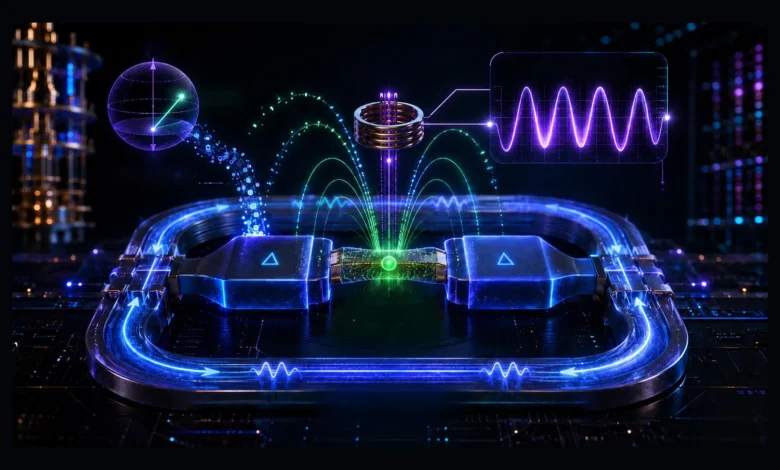
Superconductors allow electricity to flow completely free of resistance. At junctions involving these materials, confined quantum states—known as Andreev states—frequently emerge. In the theoretical framework analyzed by Egues, Yao, and their colleagues, these states are restricted to a nanoscale quantum dot engineered within an indium arsenide (InAs) nanowire, flanked on both sides by superconducting terminals. These localized Andreev states effectively serve as the foundational 0 and 1 values, as well as their superpositions.
Crucially, when an Andreev qubit is placed into a superposition, the supercurrent traversing the system develops an active, time-varying component. This oscillation is not generated by an external voltage—a phenomenon known in classical superconductivity as the AC Josephson effect. Instead, it arises autonomously from the internal, coherent quantum evolution of the qubit itself.
The researchers discovered that the geometry of this oscillation directly mirrors the qubit’s internal parameters. The constant component of the supercurrent and the amplitude of its fluctuation disclose the relative probability weights of the 0 and 1 states. Meanwhile, the precise temporal phase—the exact moment the oscillation begins—encodes the relative phase relationship between those quantum components. In essence, the electrical current functions as an intrinsic data cable, translating microscopic quantum mechanics into a macroscopically observable electrical signature.
Detecting Quantum States via Sensitive Superconducting Circuits
To transform this theoretical signal into actionable data, the research team designed a hypothetical read-out architecture. They propose enclosing the Andreev qubit within a closed superconducting circuit, allowing the self-generated supercurrent to circulate continuously.
Positioned in close proximity to this circuit would be a SQUID (Superconducting Quantum Interference Device), an ultra-sensitive magnetometer capable of detecting infinitesimal fluctuations in magnetic fields. Because any flowing electric current generates a corresponding magnetic field, the oscillating supercurrent produces a predictable, time-varying magnetic signature. The SQUID senses these minute magnetic variations, enabling researchers to reconstruct the qubit’s initial state without injecting invasive measuring energy directly into the quantum dot.
Egues likens the setup to a pair of magnetically coupled compasses. The circulating supercurrent acts as one magnetic source, while the SQUID acts as the detector. Because the electromagnetic coupling between the two is exceptionally weak, the feedback disturbance inflicted on the qubit is kept minimal, closely approaching the theoretical ideal of a non-destructive readout.
Simulation Results and Error-Correction Thresholds
Before introducing a physical prototype, the research team tested the viability of their model through rigorous computer simulations. These models were explicitly designed to account for real-world degradations, including environmental measurement noise and the minute feedback currents introduced by the SQUID sensor itself.
Despite these simulated imperfections, the results exceeded initial expectations. Depending on the measurement parameters and duration, the model achieved quantum state reconstruction accuracies of 99.52%, 99.81%, and 99.85%.
These high-fidelity figures carry significant implications for quantum error correction (QEC). Modern fault-tolerant quantum computing architectures require gate and measurement fidelities that consistently clear strict operational thresholds to prevent errors from compounding throughout a calculation. The fact that the Andreev qubit simulation cleared these thresholds without the aid of auxiliary ancilla infrastructure suggests that the protocol could be integrated into future error-corrected systems without increasing hardware density.
Broader Implications and Path to Experimental Validation
While the study represents a major theoretical advancement, the research team is transparent regarding the next steps. The findings are currently derived from mathematical models and computational simulations; an operational physical device embodying this specific geometrical setup has yet to be constructed and tested in a cryogenic laboratory.
Nevertheless, the scientists emphasize that the proposal does not rely on speculative physics or undiscovered materials. The parameters used in their calculations are drawn directly from existing, laboratory-tested semiconductor-superconductor heterostructures, and SQUID sensors are already staple diagnostic instruments in low-temperature physics laboratories. The primary challenge lies in precision nano-fabrication—specifically, assembling the InAs nanowire quantum dots and superconducting circuits into the precise configuration required to observe the voltage-free AC supercurrent.
If subsequent experimental research validates these theoretical predictions, the impact on quantum hardware design could be profound. By removing the necessity for ancilla qubits, complex reset cycles, and bulky auxiliary control lines, self-signaling Andreev qubits could substantially lower the engineering hurdles associated with scaling quantum processors.
Ultimately, the research opens a promising conceptual window for the broader quantum physics community: rather than viewing measurement exclusively as an external force that destroys fragile quantum states, future architectures may rely on the internal voice of the qubits themselves, listening to the subtle rhythms of a self-generated current to read the future of computing.