UCLA Researchers Develop Breakthrough Optical-Neural Processor to Defeat Advanced Deepfake Videos at Scale


The rapid proliferation of synthetic media has triggered an escalating technological arms race, forcing cybersecurity experts and artificial intelligence researchers to constantly rethink how to verify digital authenticity. In response to this pressing global challenge, a team of researchers at the University of California, Los Angeles (UCLA) has engineered a revolutionary hybrid optical-neural processor that harnesses the physical properties of light to identify deepfake videos with unprecedented speed, exceptional accuracy, and remarkable energy efficiency. Detailed in a study titled "Scalable, Energy-Efficient Optical-Neural Architecture for Multiplexed Deepfake Video Detection" and published in the journal eLight, the innovation offers a transformative approach to large-scale content screening. Unlike traditional digital architectures that evaluate video streams sequentially and consume astronomical amounts of computational power, the UCLA system leverages the physical propagation of light to analyze 15 or more video streams simultaneously in a single optical pass, marking a significant milestone in the defense against synthetic media manipulation.
The escalating urgency of this development cannot be overstated. As generative artificial intelligence models mature at an exponential rate, the digital landscape has been flooded with hyper-realistic synthetic videos capable of mimicking real human likenesses with terrifying precision. These deepfakes are increasingly deployed in sophisticated social engineering campaigns, corporate espionage, electoral interference, and targeted harassment. Traditional digital detectors, while often precise, labor under severe constraints. They typically rely on resource-heavy digital computing infrastructure, requiring hundreds of billions of floating-point operations (FLOPs) to analyze even a single clip. Because these conventional systems must process videos one after another, both processing times and electricity demands scale linearly with the volume of content, creating severe bottlenecks for platforms tasked with moderating millions of uploads daily. Furthermore, malicious actors have developed adversarial evasion techniques—subtly altering pixel patterns or introducing imperceptible artifacts designed to trick digital neural networks into misclassifying manipulated footage as genuine.
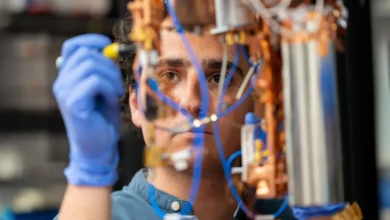
To overcome these twin hurdles of throughput and vulnerability, Professor Aydogan Ozcan and his research team—including co-lead authors Parnian Ghapandar Kashani and Dr. Shiqi Chen from the UCLA Electrical and Computer Engineering Department, the Bioengineering Department, and the California NanoSystems Institute—envisioned a fundamentally different processing paradigm. Rather than forcing digital processors to shoulder the entire computational burden, the UCLA team created a hybrid digital-optical pipeline. The workflow begins when a lightweight digital encoder captures vital spatial, spectral, and temporal features from each incoming video stream. This condensed information is then converted into a phase pattern and projected onto a programmable spatial light modulator. From this point, the digital data is translated into an optical wavefront that travels freely through a passive, free-space optical decoder. At the terminal end of this optical journey, paired optical detectors instantly measure the wavefront to produce a definitive authenticity score for every individual video stream processed during that single flash of light.
During rigorous laboratory testing utilizing visible light, the optical-neural processor demonstrated staggering performance metrics. The system successfully examined 15 Celeb-DF benchmark videos simultaneously during a single optical pass, achieving an impressive overall average detection accuracy of 97.79%. More crucially for high-stakes screening applications where missing a manipulated video carries severe consequences, the system yielded a sensitivity rating of 99.86% alongside a specificity of 95.72%. Sensitivity measures the processor’s capability to correctly flag manipulated media, and this near-perfect score translated to an exceptionally low false-negative rate of approximately 0.14%, ensuring that virtually zero deepfakes slipped past the initial screening layer unnoticed. When the research team pushed the hardware boundaries by expanding the capacity to process 18 video streams simultaneously in a single optical pass, the system maintained robust functionality, recording an average detection accuracy of 96.13%.
Beyond raw parallelism, the UCLA research team discovered that the processor’s analytical depth could be dynamically enhanced without triggering proportional surges in power consumption or latency. By integrating two optimized, passive diffractive layers into the architecture to handle increasingly complex deepfake manipulations, the team boosted overall detection accuracy by roughly 6.8%. These phase-only diffractive layers are manufactured as static physical surfaces that perform calculations entirely through the natural diffraction of light waves. Because they operate without consuming electrical power during the inference phase, they bypass the severe energy penalties typically associated with scaling up conventional digital neural networks. This passive computational capability represents a profound leap forward in sustainable artificial intelligence engineering, proving that physical optics can augment neural network depth with zero electrical overhead.
In an effort to prove the versatility and future-proofing of their optical architecture, the researchers subjected the processor to an even more formidable testbed: synthetic videos generated by Google’s advanced VEO-3 model. Modern generative video frameworks are specifically engineered to eliminate the crude visual artifacts, unnatural blinking patterns, and boundary blending anomalies that characterized older deepfakes, rendering them notoriously difficult for legacy detectors to identify. However, after applying only minimal fine-tuning to the system, the UCLA optical processor achieved a remarkable 94.80% accuracy rate and a 97.61% sensitivity rate when evaluating previously unseen VEO-3 footage. These findings indicate that the optical-neural framework possesses the intrinsic adaptability required to keep pace with the rapidly evolving capabilities of generative AI developers.
Security and resilience against adversarial tampering formed another core pillar of the UCLA study. Digital neural networks are notoriously susceptible to black-box and white-box adversarial attacks, where malicious actors probe a system’s algorithmic pathways to craft targeted illusions that bypass security protocols. The UCLA optical processor introduces an innate layer of hardware-level security. Because a substantial portion of the inference calculation occurs physically via the diffraction of light through complex spatial parameters, the core operational weights of the model are fundamentally embedded within physical space. This physical entanglement makes the system exceptionally difficult for bad actors to reverse-engineer, measure, or mathematically model. Consequently, designing precise adversarial inputs to fool the optical detector becomes a formidable engineering barrier. Furthermore, the processor demonstrated remarkable resilience when subjected to real-world data degradation, maintaining stable performance despite the introduction of image noise, severe blur, standard JPEG compression artifacts, and experimental optical misalignments.
Industry analysts and academic peers tracking the development of deepfake mitigation technologies have noted that the UCLA processor is not intended to operate as a standalone replacement for deep-learning digital forensics, but rather as an ultra-fast, highly resilient first line of defense. In a practical deployment scenario, massive digital platforms could route incoming video streams through the parallel optical processor to perform rapid, energy-efficient triage. Content flagged as suspicious by the optical layer could then be automatically routed to heavier, computationally intensive digital neural networks for granular forensic authentication. This hybrid methodology effectively merges the best attributes of both technological realms: the blistering speed, high sensitivity, energy efficiency, and adversarial resistance of optical computing, paired with the deep contextual reasoning of advanced digital algorithms.
The implications of this breakthrough extend far beyond social media content moderation. As synthetic media threatens to undermine public trust in journalism, legal evidence, corporate communications, and democratic institutions, the demand for scalable authentication infrastructure has never been more urgent. Security-critical applications, ranging from live enterprise surveillance and broadcast verification to legal document authentication, stand to benefit immensely from hardware capable of screening vast quantities of visual data instantaneously. By bridging the gap between photonics and artificial intelligence, Professor Ozcan and his team at UCLA have laid the foundational groundwork for a new generation of secure, sustainable, and impenetrable digital defense systems, proving that light itself may ultimately become our most powerful weapon in the war against synthetic deception.