I watched a humanoid robot clean my apartment it felt like a taste of the future

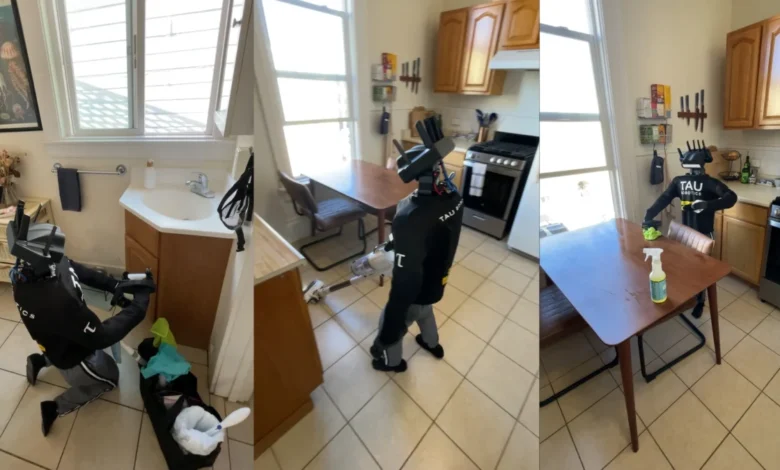
The domestic landscape is undergoing a subtle, high-tech transformation in San Francisco, where the startup Tau Robotics has begun deploying humanoid robots into private residences to perform household chores. While the concept of automated domestic labor has long been a staple of science fiction—most notably in the mid-century optimism of The Jetsons—the reality currently unfolding in Northern California is a complex hybrid of advanced robotics, teleoperation, and machine learning. These machines, while physically capable of traversing living spaces and manipulating cleaning tools, remain tethered to human pilots who guide their every movement, turning the act of cleaning into a collaborative, data-gathering exercise.
The Mechanism of Modern Housekeeping
Tau Robotics has adopted a pragmatic approach to the challenges of unstructured domestic environments. The robots, standing approximately four-and-a-half feet tall, are designed with a focus on functional utility rather than anthropomorphic perfection. They feature 3D-printed heads equipped with high-fidelity cameras and antennae for connectivity, paired with claw-like end effectors. According to the company, these grippers are prioritized over human-like dexterity for their durability and efficacy in gripping common household items like sponges, vacuum hoses, and mop handles.
The robots utilize a process known as kinematic guidance. In this setup, a remote human operator performs a specific task—such as folding a T-shirt or scrubbing a countertop—while wearing specialized hardware. The robot’s sensors mirror these movements in real-time, executing the task within the client’s home. This is not merely a service; it is a data-collection pipeline. Every successful interaction between the robot’s claw and a piece of laundry provides the necessary telemetry for Tau’s AI models to eventually transition from remote-controlled operation to full autonomy.
A Chronology of Deployment and Beta Testing
The deployment of these robots is currently in a formative beta phase. In late 2024 and throughout 2025, Tau Robotics began soliciting residential clients in San Francisco to participate in these pilot programs. The company’s growth strategy is tied to the volume of data it can harvest from varied environments.
The user experience, however, remains erratic. In early test runs, the robots faced significant physical limitations. During a documented service call, the robot struggled to navigate an eight-stair entryway, moving with a gait that lacked stability. Technical hurdles, such as network latency between the robot and the remote pilot, often resulted in "drunken" movements or momentary stalls. Furthermore, external factors such as local weather conditions have occasionally hindered operations; in one instance, extreme heat impacted the connectivity of the remote pilot’s equipment, forcing the robot to cease operations prematurely.
Despite these setbacks, the company has shown a high degree of responsiveness. Following service interruptions, Tau has demonstrated a commitment to customer retention by providing complimentary follow-up visits, ensuring that the iterative learning process continues uninterrupted.
Economic and Operational Realities
Tau Robotics’ current pricing model reflects its status as an early-stage startup seeking to optimize data acquisition rather than maximize short-term profit. While the cost of a one-time cleaning visit is set at $100, the company incentivizes recurring usage with a $60-per-weekly-cleaning rate for two robots.
Economically, these figures place the service in a unique position. The robots are currently slower than human professionals. For a consumer, the utility of the service is not currently found in time efficiency, but in the novelty and the long-term potential of the technology. The robots are, however, capable of performing specific, high-intensity tasks—such as deep-cleaning a toilet or vacuuming hard-to-reach areas—with a surprising degree of precision. The ability of the machine to reattach a fallen cleaning wand component during a task indicates that the current software stack is already capable of handling basic, corrective physical feedback.
Expert Perspectives and Strategic Vision
Cornelia Weinzierl, co-founder of Tau Robotics, frames the initiative not as a replacement for human labor, but as a solution to a labor shortage. In professional cleaning, high turnover rates and the inherent risk of physical injury to human workers are persistent challenges. By automating these tasks, the company aims to address a market that is often underserviced.
Looking forward, the company’s roadmap extends beyond residential housekeeping. The fundamental AI models being trained in San Francisco living rooms are intended for broader, more high-stakes applications. Future iterations could theoretically be deployed for hazardous tasks, including mold remediation, sanitation in bio-hazardous environments, or physical assistance in home health care. This shift could redefine the role of robotics in the service sector, moving away from simple vacuuming and toward complex, multi-step physical labor.
The Broader Implications of AI-Driven Labor
The rapid development of humanoid robots carries significant socio-economic implications. If, as Tau Robotics anticipates, these machines achieve true autonomy, the domestic labor market will face a paradigm shift. Unlike industrial robotics, which have operated in controlled factory settings for decades, these robots are entering the "unstructured" world of human habitation.
The ethical concerns regarding this shift are multifaceted. As AI continues to replace manual tasks, the necessity for robust policy frameworks becomes more urgent. In the United States, the infrastructure for supporting workers displaced by AI-driven automation remains underdeveloped. Furthermore, the privacy implications of inviting a networked, camera-equipped robot into one’s home cannot be overstated. Clients are essentially trading their domestic data—video footage of their personal belongings, habits, and living conditions—for the convenience of a robotic cleaning service. While the company maintains that this data is essential for training the AI models, the long-term storage and use of such personal imagery remain topics of intense scrutiny for data privacy advocates.
The Path Toward Autonomy
The technological leap from a teleoperated "radio-controlled car" model to an autonomous humanoid is immense. Experts note that the amount of data required to navigate the infinite variations of home layouts—varying carpet textures, furniture placements, and clutter—is exponentially larger than the data required for autonomous driving.
However, the progress observed in the last year has been tangible. The transition from requiring a handler to be present for every move to allowing for remote, autonomous vacuuming and mopping cycles marks a significant milestone. As these robots become more common in the urban landscape of San Francisco, they are becoming part of the city’s broader tech-centric identity. Much like the adoption of autonomous taxis (Waymos) in the city, the presence of humanoid robots in homes is shifting from a spectacle to a potential normalcy.
Conclusion: A Future in Beta
Tau Robotics is currently in the "toddler stage" of its development. The robots are occasionally clumsy, prone to overheating, and require significant human intervention to overcome simple physical obstacles. Yet, the fact that a machine can currently enter a home, maneuver through a kitchen, and successfully sanitize a bathroom is a testament to the rapid acceleration of robotic engineering.
The Jetsons’ vision of a robotic assistant once felt like a distant, perhaps unreachable, fantasy. With companies like Tau Robotics, that vision is no longer relegated to the realm of fiction; it is being tested, one room at a time. The ultimate success of these robots will not be determined by their ability to mimic humans, but by their ability to reliably, safely, and efficiently handle the mundane burdens of human life. As the training data accumulates, the "drunken" stagger of the prototype will likely give way to the fluid, precise movements of a mature, autonomous machine. For now, the residents of San Francisco are participating in a grand, experimental trial that will undoubtedly influence the future of labor and domestic life in the decades to come.