Mastering Financial Reporting: Essential Skills and Training Programs for Modern Accounting Professionals

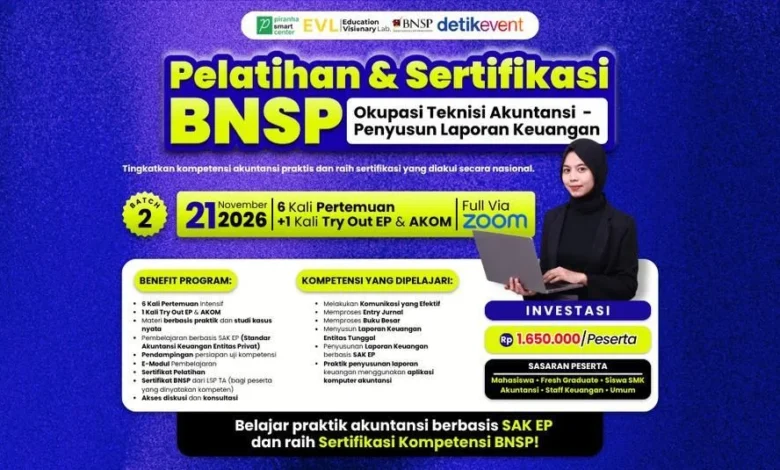
The landscape of modern business management has evolved significantly, making the ability to manage financial reports far more complex than simply recording daily income and expenses. Today, financial accountability requires a comprehensive understanding of multi-tiered accounting stages—ranging from the meticulous classification of financial transactions and the preparation of journals to systematic ledger postings and the final generation of compliant financial statements. These core competencies are no longer reserved exclusively for corporate accountants; they are fundamental skills required for entrepreneurs, business managers, and anyone seeking a resilient career in corporate finance. To bridge the gap between theoretical knowledge and practical industry demands, educational platforms and professional training initiatives have increasingly focused on structured programs designed to elevate the workforce. A prime example of this educational push is the upcoming Okupasi Teknisi Akuntansi Penyusun Laporan Keuangan Batch 2, a specialized training program meticulously structured to transform novices and intermediate practitioners into competent financial accounting technicians through a balanced curriculum of rigorous theory, hands-on software practice, and formal competency assessments.
Understanding the Comprehensive Financial Reporting Workflow
In the professional realm of corporate accounting, precision, analytical rigor, and an unwavering adherence to established financial frameworks are paramount. The journey of compiling an accurate financial statement begins with capturing raw financial data and translating it into standardized accounting language. Participants in professional development programs are typically taken through an immersive curriculum that unpacks the entire accounting cycle. This includes navigating complex financial standards, such as the implementation of the Financial Accounting Standards for Entities Without Public Accountability, commonly known as SAK EP, alongside comparative analyses with its predecessor framework, SAK ETAP.
Understanding these nuances is crucial for businesses operating within dynamic regulatory environments. Modern financial technicians must understand how these standards dictate the recognition of revenue, the valuation of assets, and the disclosure of liabilities. Furthermore, contemporary accounting cannot be effectively performed using manual ledgers alone. The integration of cloud-based accounting software, particularly platforms like Accurate Online, has become an industry standard. Training regimens now incorporate extensive modules on digital financial management tools, allowing participants to simulate real-world ledger management, automated inventory valuation, tax calculations, and comprehensive financial reporting. By bridging traditional accounting principles with modern enterprise software, programs ensure that participants acquire tangible skills that directly align with the immediate hiring requirements of modern corporations and small-to-medium enterprises (SMEs).
The Imperative of Professional Certification and Competency Assessments
As the job market becomes increasingly competitive, possessing a university degree or a basic certificate in accounting is often insufficient to guarantee employment or career progression. Employers across Southeast Asia, and particularly within Indonesia’s expanding economic sectors, are placing a premium on validated, standardized competencies. This has elevated the importance of official certification bodies, such as the National Professional Certification Board, widely recognized as BNSP.
Training programs tailored for financial accounting technicians typically extend beyond standard classroom lectures by integrating robust preparatory frameworks. These often include comprehensive practice worksheets, simulated examinations or try-outs, dedicated expert consultations, and personalized mentoring sessions. These supplementary tools are engineered to bridge knowledge gaps and alleviate the anxiety associated with high-stakes testing. Participants who successfully navigate the curriculum must undergo a rigorous evaluation process administered by certified assessors. Those who demonstrate proficiency and are declared competent earn an official BNSP competency certificate. In the professional arena, this credential serves as a nationally recognized stamp of approval, validating the bearer’s technical capacity to compile, analyze, and verify corporate financial reports in accordance with national and regional benchmarks.
Contextualizing the Demand for Skilled Accounting Technicians
The launch of advanced training cohorts like the Okupasi Teknisi Akuntansi Penyusun Laporan Keuangan Batch 2 occurs against a backdrop of sweeping economic transformation across the region. In recent years, the rapid digitization of commerce, coupled with stricter governmental regulations regarding corporate transparency and tax compliance, has amplified the demand for qualified financial personnel. According to labor market analysts, small and medium-sized enterprises—which form the backbone of the national economy—frequently struggle with financial mismanagement, largely due to a shortage of trained internal staff capable of producing standardized financial reports.
Historically, many growing businesses relied on informal bookkeeping methods, which often resulted in discrepancies during tax audits and hindered their ability to secure commercial bank loans. Financial institutions require audited or reliably compiled financial statements to evaluate creditworthiness before extending capital. Consequently, the presence of skilled accounting technicians who can seamlessly transition legacy systems into modern, software-driven accounting frameworks is critical for business longevity and expansion. Educational initiatives that democratize access to professional-grade accounting training play a vital role in addressing this structural deficiency in the labor pool.
Chronology and Program Implementation Structure
The rollout of professional certification programs follows a structured timeline designed to maximize learning retention and practical application. Typically, the lifecycle of such professional training initiatives is divided into distinct phases: preparation, instruction, practical simulation, and final evaluation.
In the initial preparation phase, organizers open registration periods, allowing candidates from diverse educational and professional backgrounds to enroll. Once the cohort is finalized—such as the upcoming Batch 2 initiative—participants enter the intensive instruction phase. This period spans several weeks, during which foundational accounting theories, regulatory standards like SAK EP, and comparative frameworks are introduced through blended learning modules.
Following the theoretical groundwork, the program transitions into the practical application phase. During this crucial window, participants engage directly with digital platforms such as Accurate Online, executing simulated business transactions, generating ledger entries, and compiling balance sheets and income statements under the guidance of experienced instructors. Concurrently, participants utilize practice worksheets and diagnostic try-outs to gauge their understanding of the material.
The final phase of the chronology involves the formal assessment process. Mentors provide targeted counseling to address lingering doubts before candidates sit for the official competency examination. Upon successful completion of this rigorous testing phase, successful candidates are awarded their certifications, officially marking their transition into recognized financial technicians ready for deployment in the corporate world. Interested candidates seeking to participate in these structured pathways can access comprehensive scheduling details and registration protocols through specialized educational portals, notably via platforms like detikevent.com.
Economic Implications and Broader Industry Impact
The systematic upskilling of the workforce through targeted accounting programs carries profound implications for the broader macroeconomic landscape. On an individual level, acquiring a recognized certification significantly enhances an employee’s marketability, often translating to better job placement rates, higher earning potential, and accelerated career mobility. Professionals equipped with both theoretical acumen and software proficiency are well-positioned to step into roles as financial analysts, corporate bookkeepers, or independent accounting consultants.
From an organizational perspective, the infusion of certified accounting technicians into the corporate ecosystem elevates the overall standard of financial governance. Companies benefit from reduced error rates in financial reporting, streamlined tax compliance, and enhanced internal controls that deter financial mismanagement. Furthermore, reliable financial documentation empowers business owners to make data-driven strategic decisions regarding investments, cost-cutting measures, and expansion opportunities. As markets continue to digitalize and regulatory bodies enforce stricter compliance standards, the ongoing development of professional accounting competencies will remain a cornerstone of economic stability and corporate growth.