Sandboxing AI Agent Code Execution in Python: Containers, MicroVMs and Beyond

The rapid integration of Large Language Models (LLMs) into autonomous agent frameworks has introduced a critical security paradigm shift: the necessity of executing untrusted, model-generated code in isolated environments. As AI agents gain the ability to write and execute Python scripts to solve complex data analysis, web scraping, and automation tasks, the security boundary surrounding these execution environments has become the primary defense against malicious code injection, resource exhaustion, and unauthorized data exfiltration. Effectively isolating this code requires a multi-layered approach, ranging from simple resource-limited subprocesses to high-fidelity, hardware-virtualized microVMs.
The Evolution of Sandboxing in the AI Era
Historically, software sandboxing was a concern reserved for web browsers and plugin architectures. However, the rise of agentic workflows—where an LLM acts as an autonomous developer—has necessitated the adoption of rigorous containment strategies. When an agent is granted an "execution tool," it essentially becomes a programmable threat vector. If the agent is prompted to process malicious input or is manipulated via prompt injection, it could potentially execute arbitrary code on the host infrastructure.
The evolution of these security boundaries has followed a clear trajectory over the last decade. Early implementations relied heavily on standard OS-level permissions. As containerization became the industry standard, tools like Docker provided a way to encapsulate environments. Yet, recent vulnerabilities, such as the November 2025 runc exploits that enabled container escapes, demonstrated that shared-kernel architectures are inherently limited in their ability to provide total isolation. This realization has pushed the industry toward microVM architectures, which leverage hypervisors to provide a unique kernel for every execution session, effectively closing the gaps that shared-kernel environments leave exposed.
Tiered Isolation: Subprocesses, Containers, and MicroVMs
The choice of a sandboxing tier represents a trade-off between performance (latency) and security posture.
1. The Limited Subprocess
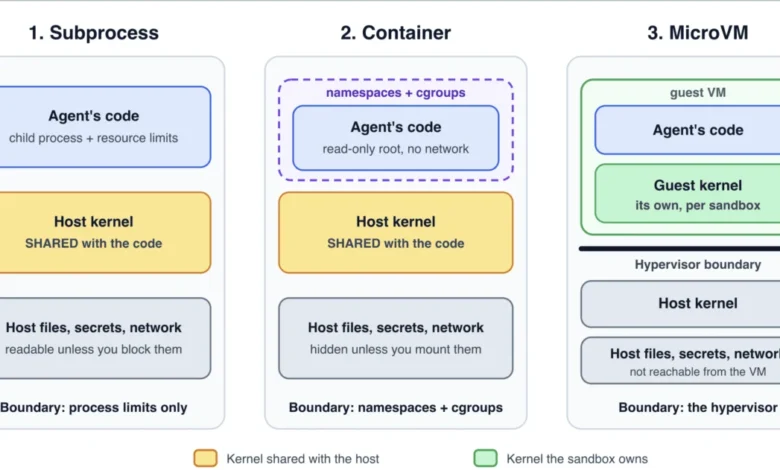
At the most lightweight end of the spectrum is the limited subprocess. By using Linux-native features like resource limits and the unshare system call, developers can restrict a child process’s access to CPU time, memory, and filesystem visibility. While this approach offers near-zero latency, it remains the weakest form of protection. Because the subprocess shares the host kernel, a sophisticated escape exploit can potentially lead to a full system compromise. This tier is appropriate only for local development or environments where the code being executed is entirely trusted and vetted.
2. Hardened Docker Containers
Containers provide a mid-tier solution by utilizing namespaces and cgroups to isolate processes. However, as noted by security researchers and Docker’s own technical documentation, containers are not inherently secure; they are merely a tool for organization. To transform a container into a sandbox, it must be "hardened." This involves running the container with a read-only filesystem, dropping all Linux capabilities, disabling new privilege escalation, and explicitly setting memory and CPU caps. While significantly more secure than a raw subprocess, the shared-kernel vulnerability remains a constant risk factor for high-stakes enterprise applications.
3. Firecracker MicroVMs
MicroVMs represent the current state-of-the-art in secure execution. By running a tiny, purpose-built kernel (such as Firecracker, developed by AWS) within a hardware-virtualized environment, the sandbox gains a distinct security boundary that is physically separated from the host kernel. Organizations like AWS (for Lambda) and E2B have pioneered this technology to ensure that even if an execution environment is compromised, the attacker is trapped within a virtualized guest, unable to touch the underlying host or other parallel execution sessions.
Comparative Analysis of Safety and Performance
The trade-off between these tiers is best illustrated by testing them against hostile payloads. A standard test suite typically includes six core attack vectors:
- CPU Exhaustion: An infinite loop to test process termination latency.
- Memory Bloat: A 512 MB allocation test to check memory ceiling enforcement.
- Fork Flooding: Attempting to spawn hundreds of child processes to exhaust the host process table.
- Disk Filling: Writing large files to consume storage capacity.
- Unauthorized Access: Attempting to read host-level credentials or environment variables.
- Network Probing: Attempting to reach internal services or external APIs.
In empirical testing, the subprocess tier fails to block fork floods and host-level filesystem access, as it lacks the namespace isolation required to hide host resources. Conversely, a properly configured container blocks the majority of these attacks by restricting network and filesystem access. However, the microVM tier consistently outperforms both in security efficacy, as it lacks the host kernel surface area entirely.
Regarding latency, the performance impact is measurable. A simple "Hello World" execution in a subprocess typically completes in single-digit milliseconds. A Docker container incurs a slight overhead due to runtime initialization, usually measured in tens of milliseconds. MicroVMs, while the most secure, face the "cold start" penalty. While modern microVM implementations like E2B have optimized startup times to approximately 150 milliseconds, this is still slower than the overhead of starting a native process.
Industry Trends and Future Outlook
The industry is moving toward a standard where security is handled by infrastructure providers rather than individual developers. In April 2026, Docker officially integrated sandboxing into its core platform via microVMs, and AWS Lambda’s evolution into a microVM-based model confirms that this is the preferred architectural pattern for ephemeral code execution.
For developers building AI agents, the implications are profound:
- Infrastructure as Code: Security policies—such as network restrictions and filesystem read-only modes—must be defined at the infrastructure level, not within the agent’s logic.
- Assume Compromise: Developers should build agentic systems under the assumption that the code-writing model will eventually be coerced into running malicious instructions.
- Tiered Deployment: Organizations should employ a hybrid approach. Use subprocesses for low-risk, internal data exploration; use containers for standard web-based agent tasks; and utilize microVMs for any agent that processes sensitive data, interacts with external APIs, or runs in a multi-tenant environment.
Conclusion
The challenge of securing AI agent code execution is essentially an exercise in balancing isolation against velocity. As LLMs become more capable, the complexity of the code they write will increase, and with it, the potential attack surface. By moving away from shared-kernel architectures and embracing microVM-based sandboxing, developers can provide a robust, scalable, and secure foundation for the next generation of autonomous agents. The era of "trusting" model-generated code is over; the future belongs to those who treat every execution as a potential security breach, ensuring that the boundary remains, even if the code itself is untrusted.