University of Oxford Researchers Recreate Ghostly Quantum Phenomenon Using Hybrid Quantum Hardware

In the shadowy, counterintuitive realm of quantum mechanics, physical contact and direct proximity are not always prerequisites for influence. For decades, one of the most intellectually baffling tenets of theoretical physics has been the notion that a charged particle can be decisively altered by a magnetic field it never actually touches. Recently, a team of pioneering researchers at the University of Oxford has successfully brought this ghostly theoretical abstraction into a tangible laboratory setting, utilizing a hybrid quantum computer to demonstrate how an invisible magnetic influence can bring a simulated particle’s movement to a grinding, absolute halt.
The breakthrough experiment, spearheaded by a team of physicists at Oxford and detailed in their published findings in the journal Nature Physics, effectively recreated the legendary Aharonov-Bohm effect. In this classic quantum phenomenon, a charged particle traveling around a region containing magnetic flux experiences a measurable, undeniable change in its quantum state, despite its physical trajectory never intersecting with the magnetic field itself. By merging the distinct capabilities of qubits and quantum oscillators within a hybrid architecture, the Oxford scientists have opened a compelling new frontier for investigating fundamental interactions between matter and energy fields—complex systems that routinely push classical supercomputers to their absolute computational limits.
The Historical Genesis of a Quantum Paradox
To understand the magnitude of the Oxford achievement, one must retrace the historical trajectory of modern physics back to the mid-20th century. In classical mechanics—the physics of everyday life first codified by Sir Isaac Newton—objects respond exclusively to the forces and fields they directly encounter. If a particle is not touched by a magnetic field, it remains oblivious to its presence.
However, as quantum mechanics matured in the decades following World War II, physicists began to realize that the subatomic universe operates according to profoundly different rules. In 1959, theoretical physicists Yakir Aharonov and David Bohm published a groundbreaking paper that challenged classical intuitions. They predicted mathematically that a charged particle could be profoundly affected by magnetic flux even if it traveled entirely outside the localized spatial region containing the magnetic field.
Rather than experiencing a conventional, direct magnetic Lorentz force along its flight path, the particle would undergo a subtle yet profound shift in its quantum phase. In the lexicon of quantum mechanics, phase describes an intrinsic aspect of a particle’s wave-like behavior that dictates how different possible trajectories interfere with one another. While an isolated quantum phase cannot be measured directly in a vacuum, differences in phase between competing pathways can produce massive, highly quantifiable interference effects.
When first proposed, the Aharonov-Bohm effect was met with widespread skepticism, as it suggested that electromagnetic potentials were far more physically fundamental than the electric and magnetic fields derived from them. Yet, as experimental techniques improved over subsequent decades, subsequent generations of physicists verified the phenomenon using real electrons passing around microscopic solenoids. The effect cemented its status as one of the most crystalline proofs that the quantum domain defies classical logic.
The Computational Bottleneck of Lattice Gauge Theories
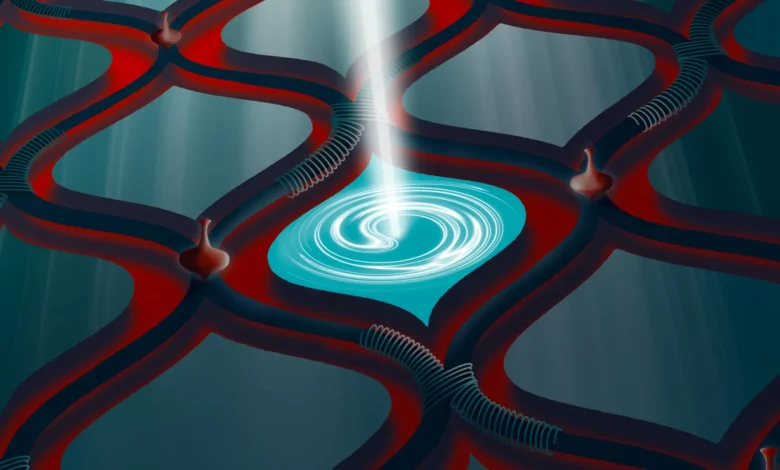
In contemporary theoretical physics, researchers are intensely eager to observe how the Aharonov-Bohm effect and similar phenomena behave within vastly more complex frameworks known as lattice gauge theories. These advanced mathematical structures describe how matter interacts with the fundamental force fields of the universe. To make these systems calculable, theorists conceptualize space not as a smooth continuum, but as a rigid grid or lattice, where matter resides at discrete nodal points and the force fields are associated with the connecting edges between them.
Lattice gauge theories are indispensable tools in high-energy and particle physics, providing the foundational mathematics researchers use to study quarks, gluons, and the fundamental architecture of matter. However, they carry a catastrophic computational drawback: as the simulated systems grow in size and complexity, the underlying mathematics expands exponentially.
Even the world’s most powerful conventional supercomputers struggle intensely to calculate the exact evolutionary trajectories of these multidimensional, interacting components. Classical algorithms bog down when attempting to track the sprawling webs of entanglement and superposition that characterize multi-particle quantum systems.
Enter quantum simulation—a paradigm-shifting alternative. Instead of forcing a classical computer to mathematically brute-force every minute detail of a quantum system through standard numerical analysis, scientists can construct a dedicated, highly controllable quantum system that obeys the exact same foundational mathematical rules. By engineering this surrogate system and observing its real-time behavior, researchers can bypass the computational roadblocks of classical architecture entirely.
Building the Hybrid Quantum Simulator: A Chronology
The recent Oxford breakthrough has its roots in an initiative launched in 2022. Dr. Sebastian Saner, Dr. Oana Bazavan, and their colleagues at the University of Oxford set out to design a robust experimental framework capable of simulating complex lattice gauge theories. Recognizing the limitations of relying on a single type of quantum hardware, the team established a critical collaboration with Dr. Alejandro Bermudez of the Instituto de Física Teórica in Madrid.
The resulting experimental architecture was a hybrid system that cleverly combined two distinct physical manifestations of quantum information:
- Trapped Ion Qubits: The researchers utilized the internal electronic states of electrically charged atoms (ions) held rigidly in physical space by precision electromagnetic fields. These qubits served double duty, representing the dynamic gauge fields within the theoretical lattice model.
- Quantum Oscillators: The collective, quantized vibrational motion of those exact same trapped ions acted as the second component, effectively simulating the behavior of matter.
By fusing these two disparate systems into a cohesive apparatus, the Oxford team constructed a micro-scale loop—a fundamental building block of a larger lattice gauge theory. In this minimalist setup, two quantum oscillators represented matter localized at two distinct spatial positions, while two qubits represented the dynamic fields bridging those locations. Despite its modest scale, the apparatus possessed all the necessary ingredients to model sophisticated matter-field interactions.
From Technical Workaround to Scientific Breakthrough
Originally, the research team had envisioned incorporating the simulated magnetic flux as a static, unchanging background condition applied to the loop from the outside. However, the physical constraints of their current quantum hardware made engineering this specific external interaction exceedingly difficult.
Faced with this technical hurdle, the researchers pivoted to an alternative strategy: they encoded the magnetic flux directly into the quantum states of the qubits themselves. While initially viewed as a pragmatic workaround to bypass hardware limitations, this design choice unlocked a vastly more profound scientific capability.
By embedding the flux directly into the qubits, the magnetic influence ceased to be a passive, static backdrop. Instead, it became an active, dynamic participant in the unfolding quantum evolution of the entire system.
"For us, the exciting step was to encode the magnetic flux in a gauge field that was itself dynamical," noted lead author Dr. Sebastian Saner, reflecting on the pivot. "Rather than having matter evolve in a fixed background, the matter and gauge field become part of the same quantum dynamics."
This integration allowed the team to explore a richer, more realistic version of the Aharonov-Bohm phenomenon—one where the field and the matter constantly influence and react to one another in real time.
Quantum Entanglement and the Freezing of Particle Motion
With their dynamic loop successfully initialized, the Oxford researchers turned their attention to a fundamental quantum process known as tunneling. Quantum tunneling allows subatomic particles to permeate barriers and migrate between different states in ways that would be strictly forbidden under the deterministic laws of classical mechanics.
When the team ran their simulation in the complete absence of any simulated magnetic flux, the matter particle exhibited normal behavior, tunneling freely and rhythmically around the loop between the two oscillator states.
However, the introduction of the simulated magnetic flux—operationalized through the entangled states of the qubits—transformed the system entirely. Entanglement, a quintessential quantum phenomenon where multiple particles become deeply correlated in ways inexplicable by classical physics, was used to establish the exact conditions of the flux.
Because the simulated particle possessed two distinct potential pathways to traverse around the loop, the presence of the embedded magnetic flux altered the relative quantum phases of those paths. As the particle’s wave functions propagated along the competing routes, they encountered destructive interference. The wave crests of one path aligned perfectly with the wave troughs of the other, causing their quantum contributions to completely cancel each other out.
The macroscopic consequence of this microscopic interference was absolute: the quantum tunneling was completely suppressed. The simulated particle, previously moving fluidly around the circuit, was frozen dead in its tracks, locked firmly into its original spatial state.
This dramatic arrest of movement confirmed that the Aharonov-Bohm effect had been successfully reproduced within a fully dynamical lattice gauge theory. The experiment decisively proved that the phenomenon is not merely an artifact of static, external magnetic fields acting on passive particles, but can naturally emerge from deeply integrated, mutually interacting quantum components.
Parallel Discoveries and Broad Implications for Physics
The milestone achieved at Oxford did not occur in a vacuum. Coinciding with the publication of the Oxford findings in Nature Physics, a separate research team at the University of Maryland, led by Professor Norbert Linke, released a complementary study exploring adjacent territory.
While the Oxford group focused on dynamics and lattice gauge theories, the Maryland team utilized their own hybrid quantum system to simulate the Yukawa potential—a crucial mathematical framework describing nuclear forces and interactions between subatomic particles. Although both groups pursued their investigations independently, they coordinated the concurrent submission of their papers to Nature Physics, underscoring a broader, synchronized shift within the global physics community toward hybrid quantum simulation.
Experts in the field suggest that the convergence of these studies highlights the growing viability of hybrid quantum architecture as a transitional technology. By cleverly mating trapped-ion qubits with vibrational oscillators, experimentalists can bypass the daunting error-correction hurdles currently plaguing monolithic, large-scale gate-based quantum computers. These hybrid simulators provide tailored, highly stable sandboxes where specific classes of complex physical interactions can be modeled with unprecedented fidelity.
The implications of this research extend far beyond the academic recreation of historical physics paradoxes. As physicists grapple with phenomena at the extremes of energy and scale—ranging from the behavior of quark-gluon plasmas inside particle accelerators to the exotic phases of matter predicted in high-temperature superconductors—conventional computational power will continue to fall short.
By demonstrating that complex quantum field interactions can be accurately modeled, manipulated, and observed using dynamic hybrid simulators, the University of Oxford team has delivered a powerful new instrument to the scientific community. More than six decades after Aharonov and Bohm first committed their abstract mathematics to paper, their ghostly quantum effect has found a modern home in the heart of a quantum computer, pointing the way toward a deeper, more intuitive understanding of the fundamental forces that govern the universe.