How SmileID Scaled to 160 Million Identity Verifications by Re-Engineering Its Android SDK with CameraX

The landscape of digital banking, mobile financial services, and remote onboarding relies heavily on the integrity of identity verification systems. For platforms operating across emerging markets, particularly in Africa where mobile-first banking is expanding exponentially, verifying a user’s identity securely and efficiently presents a unique set of engineering hurdles. Capturing clear, high-resolution facial data capable of defeating modern deepfakes and spoofing attempts without triggering out-of-memory crashes on low-end hardware has historically been an uphill battle for Android developers. Recently, SmileID, a leading digital identity verification software development kit (SDK) provider, addressed these systemic camera challenges by migrating its core architecture to Android’s CameraX library. The transition not only resolved persistent hardware fragmentation issues but also fundamentally accelerated the company’s business growth, scaling its verification volume past the 160 million mark.
The Engineering Hurdles of Fragmented Hardware Environments
Before adopting CameraX, SmileID operated within the constraints of legacy Camera1 and low-level Camera2 API implementations. These older frameworks exposed developers to a labyrinth of device-specific eccentricities. For an ecosystem where Android devices constitute roughly 85 percent of the target market share—encompassing everything from high-end flagships to entry-level smartphones with heavily restricted processing capabilities, obscure regional variants, and custom-built Point of Sale (POS) terminals—maintaining camera stability was exceptionally difficult.
Engineers tasked with building facial recognition and liveness detection pipelines frequently encountered distorted preview feeds, unpredictable sensor orientation rotations, sudden out-of-memory (OOM) crashes, and undocumented original equipment manufacturer (OEM) bugs. These technical roadblocks created severe operational friction. Year-over-year SDK adoption growth was largely stagnant, hovering between two and three times expansion. Furthermore, because real-time on-device liveness checks frequently failed on fragmented hardware, many verification procedures were forced to default to fallback methods. This involved uploading static, high-resolution photographs over high-latency REST APIs, introducing significant delays for end-users and increasing operational server overhead for client financial institutions.

A Strategic Migration to CameraX Pipelines
To break through these technical bottlenecks, SmileID re-engineered its entire mobile SDK architecture around CameraX, a Jetpack support library built specifically to abstract away the disparate complexities of the underlying Android hardware ecosystem. CameraX provides a consistent, natively lifecycle-aware developer interface that simplifies the integration of complex camera use cases.
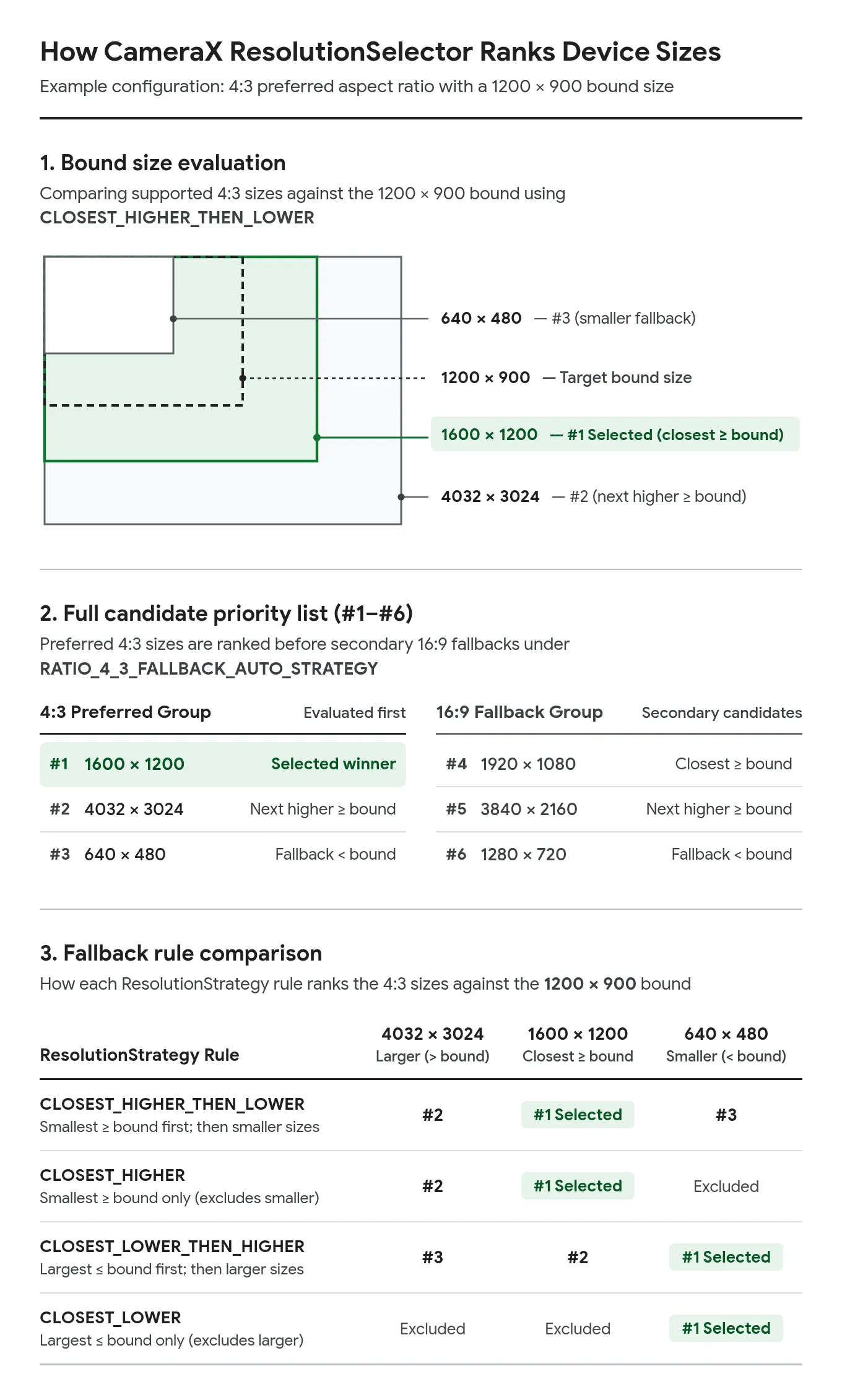
Utilizing CameraX’s core modules—specifically Preview and ImageAnalysis—SmileID constructed a robust, dual-purpose camera pipeline designed to handle live rendering and background machine learning inference concurrently. A critical component of this redesign was the implementation of the ResolutionSelector API within the ImageAnalysis configuration. This modern API empowers developers to request specific target resolutions while establishing precise fallback rules for devices that lack native support for those exact pixel dimensions.
By strategically configuring fallback behaviors, such as prioritizing the closest higher resolution followed by lower options, or vice-versa to cap memory usage, the development team successfully captured ultra-sharp facial details required for advanced deepfake detection. Crucially, SmileID optimized this data pipeline by compressing the cropped facial regions directly on the client device. This local processing ensured that network upload sizes remained identical to previous iterations, securing higher-fidelity input data for machine learning models without increasing cellular data consumption or financial costs for end-users on limited data plans.
Comprehensive Compatibility Management and Testing

Solving the hardware fragmentation dilemma required more than just a modern API; it demanded systematic validation across thousands of physical device configurations. SmileID benefited significantly from Google’s extensive infrastructure investments in device compatibility testing.
At Google’s dedicated Camera and Media Test Lab, an automated testing framework executes daily across a rotating inventory of more than 190 physical Android device models, capturing diverse chipsets, operating system versions, and camera sensor specifications. This rigorous, continuous integration testing catches regressions before they infiltrate production environments.
Complementing this lab testing is CameraX’s internal architecture for managing device-specific quirks. Android hardware often exhibits undocumented quirks—such as failing to respect custom exposure parameters or returning inverted frame data under specific aspect ratios. Rather than forcing developers to write convoluted conditional code blocks filled with checks for specific device manufacturers and models, CameraX maintains internal quirk repositories, including DeviceQuirks and CameraQuirks. When the library encounters a recognized device anomaly at runtime, it automatically injects the appropriate workaround. For SmileID, this meant their SDK could natively support over 18,000 distinct Android device types without requiring continuous, manual patching by their internal engineering team.
Measurable Business Impact and Scale
The decision to migrate to CameraX yielded immediate, quantifiable improvements across every core performance metric for SmileID and its enterprise clients. Most notably, verification pass rates for applications utilizing SmileID’s SDKs increased by 20 percent. In the context of digital banking and mobile money services across Africa, a 20 percent boost in successful onboarding translates directly to hundreds of thousands of legitimate users completing account creation instead of abandoning the process out of frustration.
Additionally, the capture resolution for selfies and liveness checks increased fourfold, providing machine learning algorithms with the high-density pixel data necessary to reliably identify sophisticated presentation attacks and synthetic media. Developers responded enthusiastically to the enhanced stability and simplified integration process. SmileID experienced a 15-fold surge in SDK adoption during the first year following the migration, scaling to a 20-fold increase by the second year. To date, the platform has successfully processed more than 160 million identity verifications globally.
Implications for the Broader Mobile Development Ecosystem
The successful transformation of SmileID’s infrastructure highlights a broader evolution in how enterprise-grade mobile applications manage hardware-dependent features. As mobile commerce, digital KYC (Know Your Customer) regulations, and biometric security requirements tighten globally, developers can no longer afford to spend valuable engineering hours writing bespoke compatibility layers for fragmented hardware markets.
Standardized, reactive frameworks like CameraX demonstrate that platform-level abstractions can successfully shoulder the burden of hardware diversity. By delegating low-level camera management, lifecycle binding, and quirk mitigation to well-maintained jetpack libraries, organizations can redirect their engineering resources toward core product innovation and machine learning accuracy. Furthermore, the introduction of AI-assisted development tools—such as the recently released CameraX Skill for coding agents like Gemini—signals a future where migrating legacy camera implementations and establishing complex multi-camera pipelines will become increasingly streamlined, lowering the barrier to entry for robust mobile security applications worldwide.