The evolution of Large Language Models (LLMs) has transitioned from simple chat interfaces to sophisticated "agentic" workflows, where AI systems can reason, use tools, and maintain complex states over time. While single-turn interactions—where a user asks a question and a model provides a direct response—have become a commodity, the development of reliable, multi-step agents remains a significant engineering hurdle. LangGraph, a library built on top of the LangChain ecosystem, has emerged as a critical solution for developers seeking to move beyond linear chains and into the realm of cyclic, stateful graphs. This article explores the architecture, implementation, and broader implications of building agentic workflows using LangGraph in Python.
The Shift from Chains to Graphs in AI Orchestration
In the early stages of LLM application development, the "Chain" was the dominant paradigm. A developer would sequence a series of prompts where the output of one became the input of the next. However, real-world problem-solving is rarely linear. Agents often need to loop back to a previous step, retry a tool call with different parameters, or maintain a persistent memory across multiple days of interaction.
LangGraph addresses these requirements by representing an agent as a directed graph. In this framework, nodes represent units of computation, and edges define the flow of control. Unlike traditional Directed Acyclic Graphs (DAGs), LangGraph allows for cycles, which are essential for the "Reason-Act" (ReAct) pattern that defines modern AI agents. By formalizing the agent’s logic into a graph structure, developers gain granular control over the execution flow, making the system more predictable, debuggable, and scalable.
The Core Primitives: State, Nodes, and Edges
To understand LangGraph, one must first master its three foundational components: State, Nodes, and Edges. These primitives work in concert to manage the lifecycle of an agentic interaction.
State Management and Reducers
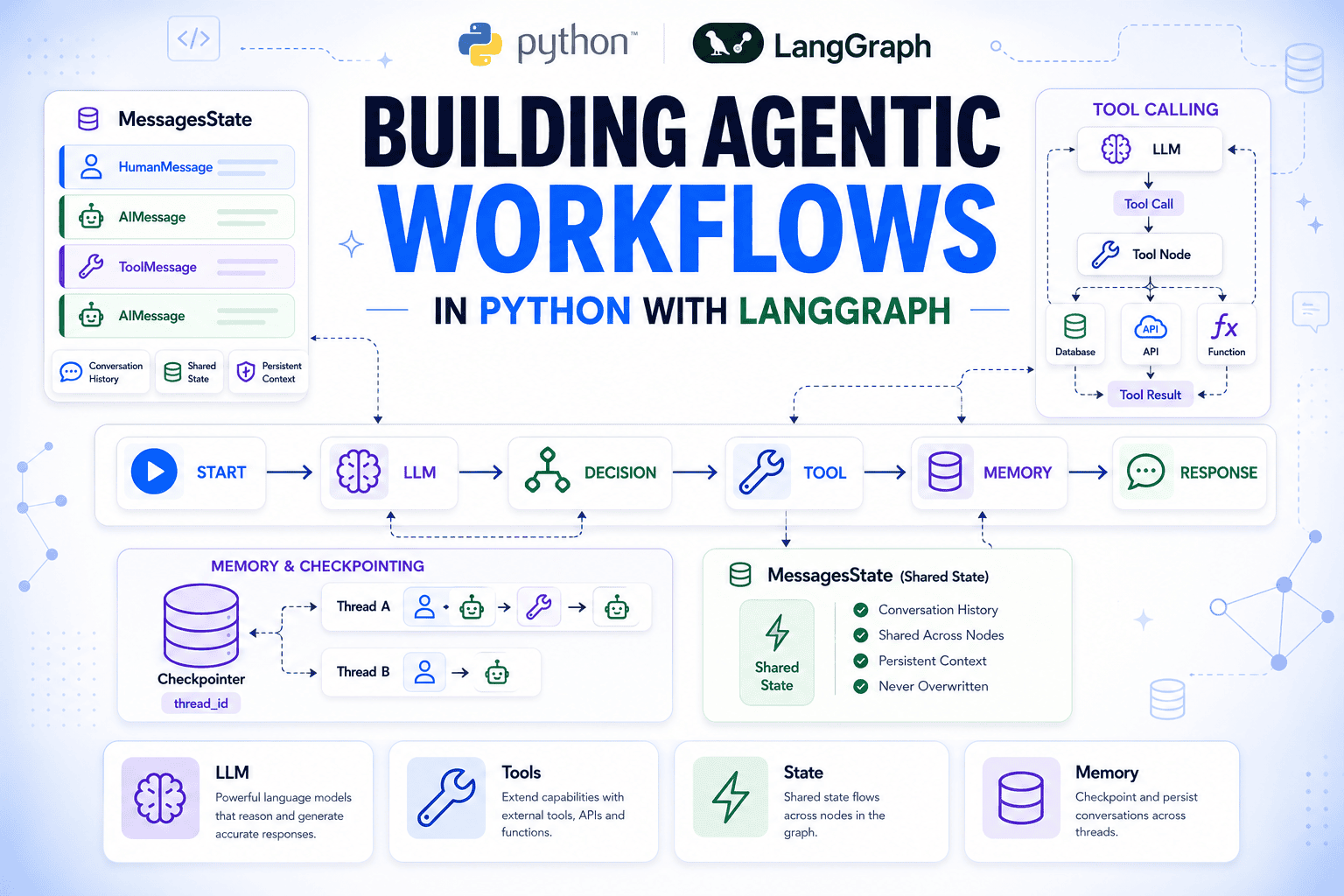
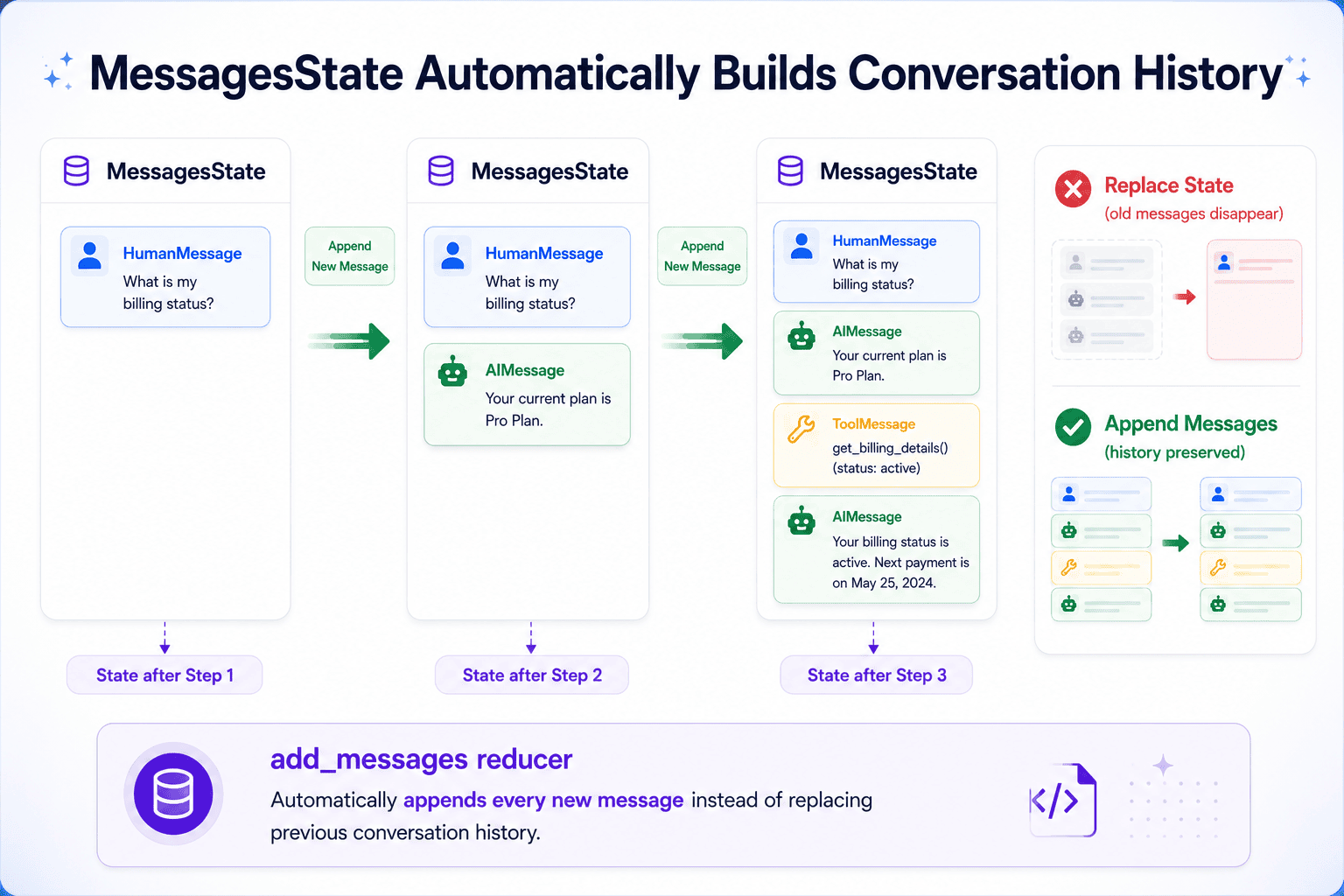
The "State" is the shared memory of the graph. It is typically defined as a TypedDict in Python, acting as a central repository for all data generated during the agent’s execution. A critical innovation in LangGraph is the use of "reducers." By default, when a node returns a value for a state field, it overwrites the existing value. However, for fields like message history or logs, developers can annotate the field with a reducer function, such as operator.add. This ensures that new data is appended to the history rather than replacing it, allowing the agent to maintain a continuous context of the conversation.
Functional Nodes
Nodes are essentially Python functions that perform a specific task. A node might call an LLM, query a database, or process a user’s input. What distinguishes a LangGraph node is its interface: it receives the current state as an argument and returns a dictionary containing only the fields it wishes to update. This functional approach ensures that nodes are decoupled from the overall graph logic, promoting code reusability and easier testing.
Execution Edges and Conditional Logic
Edges dictate the sequence of operations. A standard edge simply connects node A to node B. However, the true power of agentic workflows lies in "conditional edges." These edges use a routing function to decide the next node based on the current state. For example, if an LLM’s response contains a request to use a tool, a conditional edge can route the execution to a tool-handling node; otherwise, it can route the execution to the end of the process.
Implementing a Stateful Support Agent
The practical application of these concepts is best demonstrated through the construction of an automated support agent for a Software-as-a-Service (SaaS) product. Such an agent must be able to recognize user intent, access account data via tools, and remember the user’s details across multiple turns.
Environment Setup
Development begins with the installation of the langgraph and langchain-openai packages. Modern agent development relies heavily on environment variables to manage API keys and configuration settings, often handled via a .env file. This separation of configuration from code is a standard best practice in professional software engineering.
The Role of MessagesState
LangGraph provides a specialized state type called MessagesState. This built-in structure is pre-configured to handle the complexities of chat history. It includes a messages field equipped with an add_messages reducer, which automatically manages message deduplication and chronological ordering. For developers, this eliminates the need to manually concatenate lists of "HumanMessage," "AIMessage," and "ToolMessage" objects, which can become error-prone as conversation depth increases.
Tool Integration and the ReAct Pattern
An agent’s utility is often defined by its ability to interact with external systems. Using the @tool decorator, developers can transform standard Python functions into tools that an LLM can invoke. These tools include detailed docstrings that serve as instructions for the model, explaining when and how to use the function.
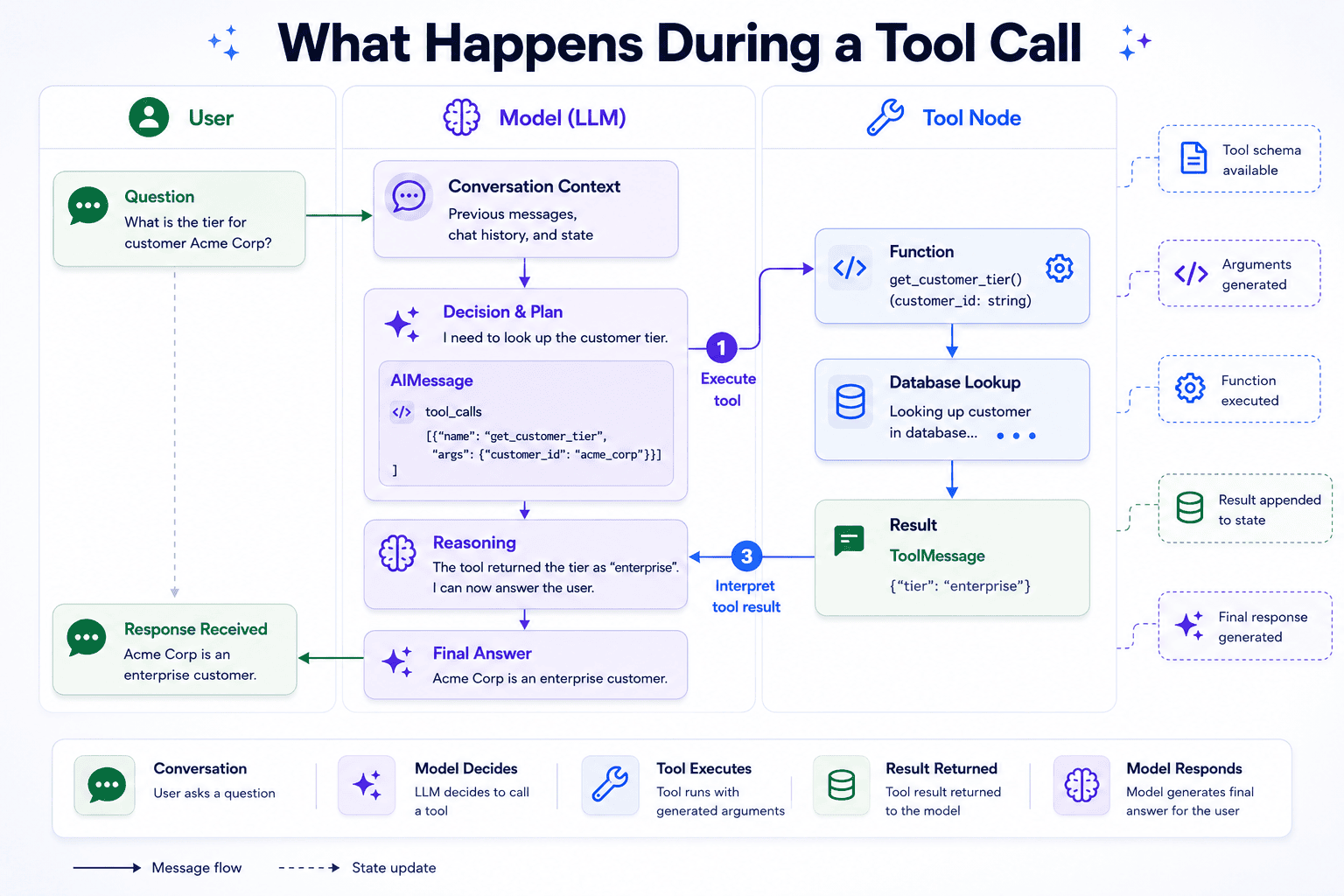
The integration process involves "binding" these tools to the LLM. When a model is "tool-aware," it does not just return text; it can return a "tool call" object. This triggers a specific sequence:
- Model Call: The LLM analyzes the user input and decides to use a tool.
- Tool Execution: A dedicated
ToolNodeexecutes the function and returns the result. - Re-invocation: The agent loops back to the LLM, providing it with the tool’s output so the model can generate a final, informed response.
This loop is the hallmark of the ReAct pattern, allowing the agent to "think" (reason) and then "act" (execute a tool) iteratively until the task is complete.
Chronology of an Agentic Interaction
To visualize the impact of this architecture, consider the timeline of a single request where a user asks, "What is the status of my enterprise subscription?"
- T+0ms: The graph is invoked with a
HumanMessage. The state is initialized. - T+500ms: The
run_modelnode executes. The LLM identifies the need for theget_customer_tiertool. It returns anAIMessagecontaining a tool call ID and arguments. - T+510ms: The
tools_conditionedge detects the tool call and routes the flow to theToolNode. - T+800ms: The
ToolNodecompletes the database lookup and appends aToolMessageto the state. - T+810ms: The graph loops back to the
run_modelnode. - T+1300ms: The LLM, now seeing the "enterprise" status in the
ToolMessage, generates a final response: "Your account is currently on the Enterprise plan." - T+1310ms: The
tools_conditionedge sees no further tool calls and routes toEND.
Data Persistence and Conversation Memory
A significant challenge in AI deployment is "statelessness." By default, each call to an API is independent. LangGraph solves this through "Checkpointers." A checkpointer is a persistence layer that saves the state of a graph at every step.
By associating a conversation with a thread_id, developers can ensure that the agent remembers previous interactions. For instance, if a user provides their customer ID in one message and asks about their plan in the next, the checkpointer restores the state from the previous turn, allowing the agent to maintain continuity.
While InMemorySaver is suitable for development, production environments typically utilize persistent databases like PostgreSQL or Redis to store these checkpoints. This ensures that even if the application server restarts, the agent’s "memory" remains intact.
Technical Analysis: The Impact of Agentic Workflows
The transition to graph-based agents represents a move toward more "durable execution." In traditional software, a failure mid-process often results in lost data. In a stateful graph, every transition is a checkpoint. If a tool call fails or a network timeout occurs, the system can resume from the last successful state.
Furthermore, the visibility afforded by LangGraph is a major step forward for AI safety and observability. Because every reasoning step is captured as a node transition in the state, developers can trace exactly why an agent made a specific decision. This "traceability" is essential for debugging hallucination issues or malformed tool calls.
Broader Implications for the Industry
The adoption of agentic frameworks like LangGraph is expected to significantly impact several sectors:
- Customer Support: Beyond simple chatbots, agents can now perform end-to-end tasks like processing refunds, updating subscription tiers, and troubleshooting technical issues by interacting with internal APIs.
- Data Analysis: Agents can iteratively query databases, write code to visualize results, and refine their analysis based on the output of previous steps.
- Software Development: Multi-agent systems—where one agent writes code and another tests it—are becoming a reality, enabled by the cyclic nature of graph architectures.
Industry analysts suggest that the "Agentic Era" will shift the focus from the size of the model to the sophistication of the workflow. A smaller, faster model (like GPT-4o-mini) orchestrated by a well-designed graph can often outperform a larger model running in a single-turn configuration.
Conclusion
LangGraph provides the necessary scaffolding for developers to build AI systems that are not just reactive, but proactive and persistent. By leveraging the power of stateful graphs, nodes, and conditional edges, developers can create agents that handle the complexities of real-world interactions with precision. As the AI landscape continues to evolve, the ability to orchestrate these complex workflows will become a foundational skill for software engineers and data scientists alike, paving the way for more autonomous and capable intelligent systems.
Related posts: